AI Services Market › スキルファクトリー › ドキュメント › Composition Study Generator
$4.99 · サインイン不要v1.0.0– 回表示
Composition Study Generator
なぜその絵が機能するのかを教えてくれる1枚のシートです。
作品や写真をサムネイル、明暗マップ、注釈付き図解に分解する構造化された構図学習シートを生成し、意図的な練習を支援します。
こんな方におすすめ
美術学生、教師、独学の画家の方
所要時間
初稿まで約20分
レベル
初心者向け
3ステップでインストール
登録不要。CLIツールも不要です。お使いのAIを選んで、1行コピーして貼るだけです。
ご自分で入れたい場合は、スキルを購入($4.99)し、購入完了画面からZIPをダウンロードして、上のディレクトリに展開し、AIのセッションを再起動してください。結果は同じです。すでに購入済みの場合は、AIアシスタントにダウンロードしてもらうこともできます。
パックの内容
SKILL.md(手順書)1点とスターターテンプレート1点が入っています。プレビューはこちらです:
Composition Study Generator
When to use
- You're learning to paint or draw and want to study master works or photos systematically, not just copy them
- You teach art and need a ready-to-print study sheet for a class exercise
- You keep making the same composition mistakes (dead-centre subjects, tangent edges, flat values) and want targeted drills
- You're preparing a portfolio and want to show you can analyse composition, not just render detail
- You found a photo or painting with a composition you admire and want to understand why it works
- You want a repeatable practice routine — one sheet, one study, 30–45 minutes
Workflow
- Choose the reference (input: candidate images → output: one selected reference)
Pick one image with a clear compositional idea: a strong focal point, an interesting value structure, or a deliberate arrangement of shapes. Avoid images that are all detail and no structure (a busy crowd scene with no hierarchy) and images you chose for subject matter alone ("I like cats"). The best study references are ones where you can describe the composition in one sentence before you start — "a dark diagonal divides the frame, the light figure sits at the crossing point." - Make the thumbnail set (input: selected reference → output: 4–6 thumbnails)
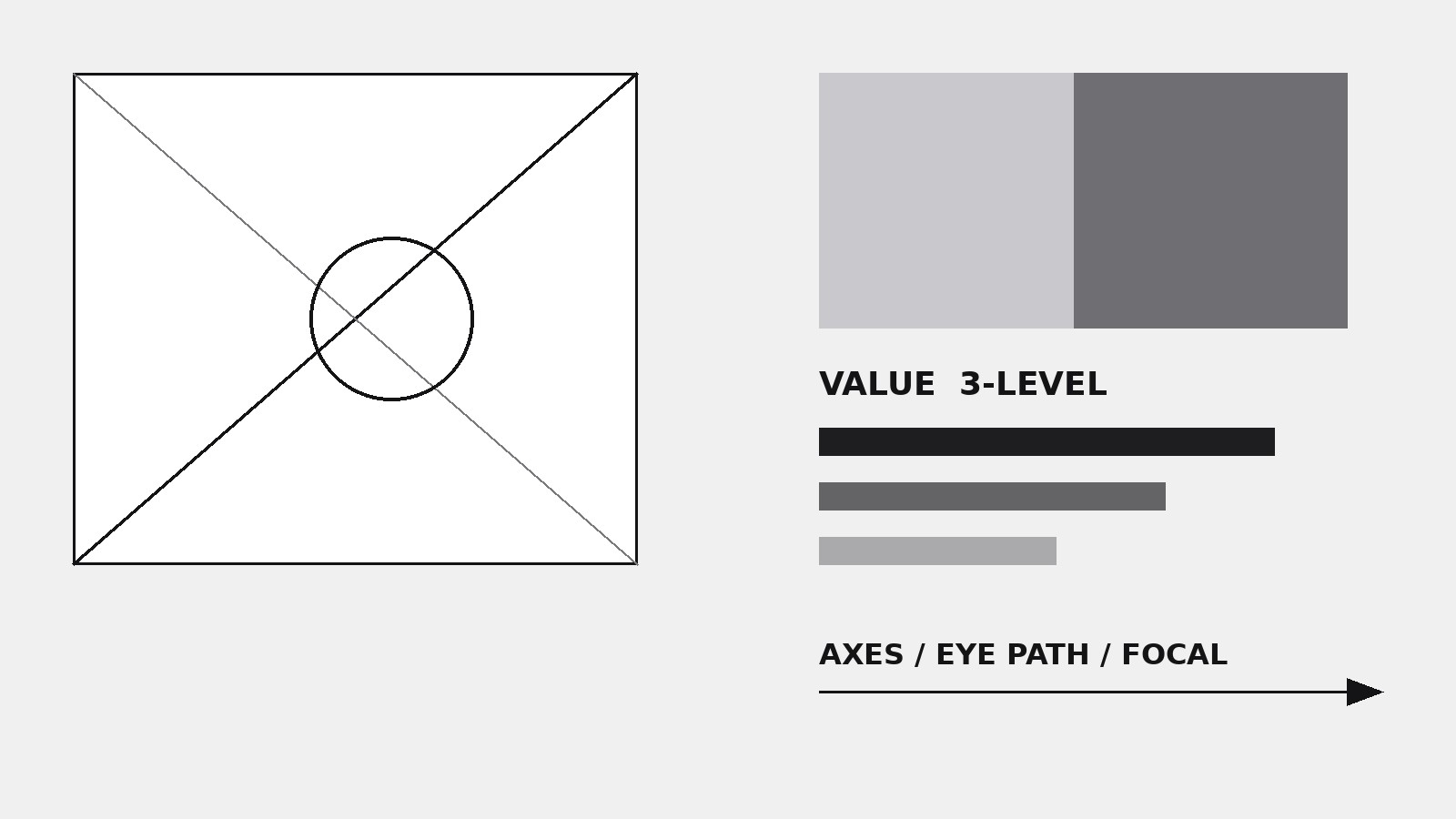
Draw or generate 4–6 small thumbnails (roughly 2:3 or 3:2, no bigger than a playing card) from the reference: one faithful small copy, one with the subject removed (shapes only), one with values pushed to 3 levels (dark / mid / light), and one rotated or cropped differently to test what breaks. Thumbnails force you to see structure before detail — if you can't reduce the image to five shapes, you don't yet understand it. - Map the values (input: reference → output: value map)
Reduce the image to 3–5 value masses: squint, and block in the big dark shapes, the big light shapes, and the mid-tones. Label the darkest dark and the lightest light, and mark where they touch — high-contrast adjacencies are where the eye goes. Note the overall value key (mostly dark? mostly light? balanced?) in one line. Most failed compositions fail here: the values are evenly spread and nothing leads the eye. - Diagram the structure (input: reference + value map → output: annotated diagram)
Overlay the structural skeleton on a clean copy of the thumbnail: the main axes and diagonals, the focal point and the path the eye takes to reach it, any framing devices (arches, shadows, foreground shapes), and any tangents or edge problems (objects just touching the frame edge, subjects half-cut). Use arrows for eye movement and circles for focal areas. One diagram, clearly labelled — this is the sheet's analytical core. - Write the takeaways (input: diagrams → output: 3–5 written lessons)
State what the composition does, in plain language: "The diagonal road carries the eye from bottom-left to the figure, then the dark tree stops it from leaving the frame." Each takeaway must name a device and its effect — not "nice balance" but "the large dark mass on the left balances the small bright figure on the right." End with one rule to try in your own work ("in my next piece, put the focal point where two diagonals cross, not at the centre"). - Set the practice task (input: takeaways → output: timed exercise)
Convert the study into a 30–45 minute exercise: make one original composition (from a different subject) using the same structural device, at thumbnail scale, in 3 variations. The point is transfer — copying the reference proves you can copy; applying its device to a new subject proves you learned it. Put the time limit on the sheet: timed practice beats open-ended noodling.
テンプレートのプレビュー
Composition Study Generator — Study Sheet Template
One sheet per reference. Keep it to one page where possible.
Reference
- Image: {reference_image}
- Artist / photographer: {creator}, {year_if_known}
- Source: {source}
- Composition in one sentence: {one_sentence_description}
Thumbnail set (4–6 small thumbnails, playing-card size)
- Faithful small copy: {notes_or_file}
- Shapes only (subject removed): {notes_or_file}
- 3-value version (dark / mid / light): {notes_or_file}
- Cropped or rotated variation: {what_you_changed_and_what_broke_or_survived}
- (Optional) Second variation: {notes}
- (Optional) Third variation: {notes}
Value map
スキルパック本体(SKILL.md とテンプレート)は英語で書かれています。