AI Services Market › スキルファクトリー › 画像 › Annotated Wash Diagram
$4.99 · サインイン不要v1.0.0– 回表示
Annotated Wash Diagram
全工程を順番通りに。推測の余地を残しません
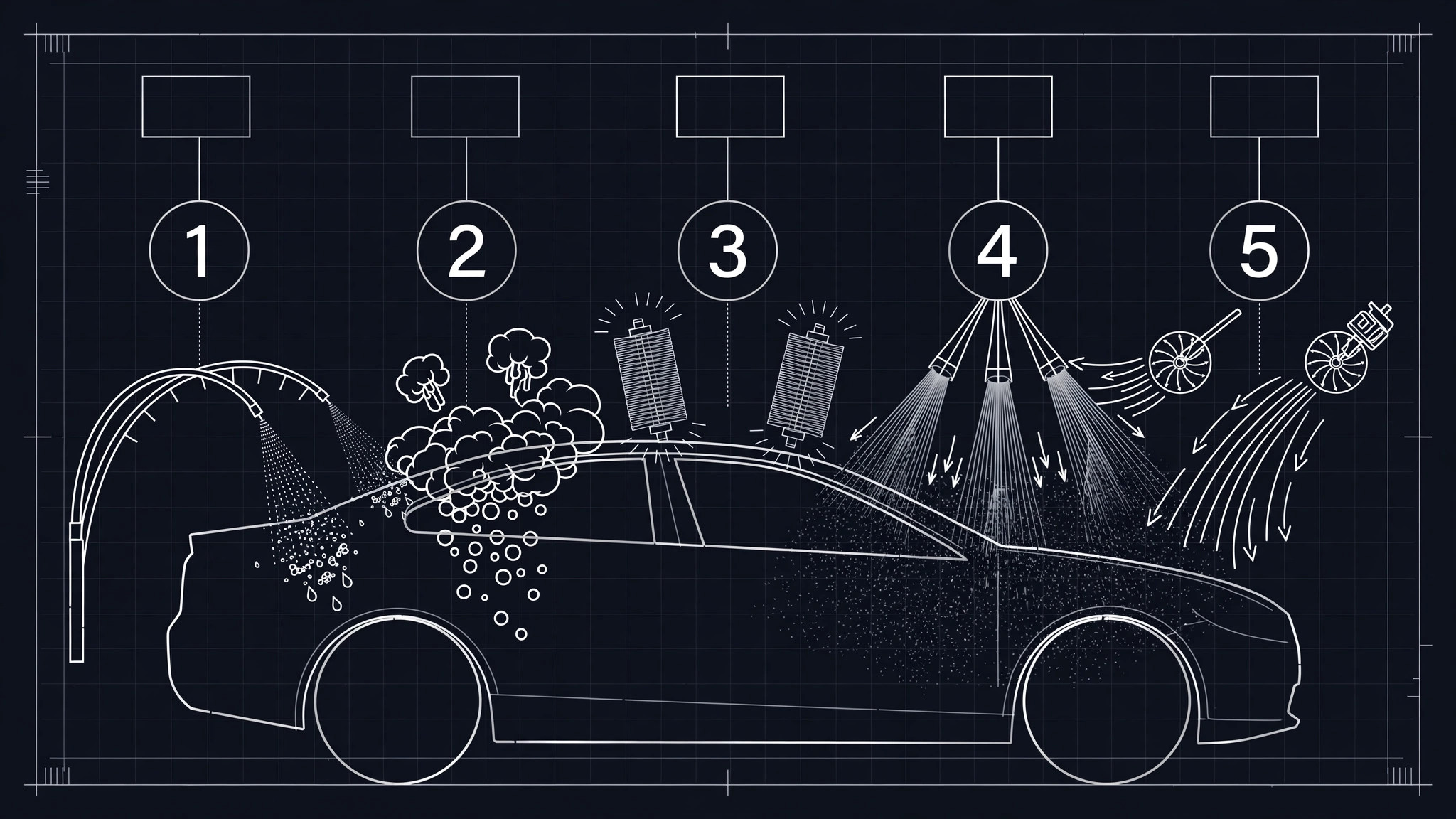
洗車工程のような洗浄プロセスを説明するダイアグラムを構築します。番号付きコールアウト、リーダーライン、ミスが起きる場所に配置した警告を備えた、1本の順序立てた背骨として構成します。
こんな方におすすめ
推測なしに他人が従える工程図が必要な洗車事業者、トレーナー、マニュアルライター
所要時間
初稿まで約25分
レベル
初心者向け
3ステップでインストール
登録不要。CLIツールも不要です。お使いのAIを選んで、1行コピーして貼るだけです。
ご自分で入れたい場合は、スキルを購入($4.99)し、購入完了画面からZIPをダウンロードして、上のディレクトリに展開し、AIのセッションを再起動してください。結果は同じです。すでに購入済みの場合は、AIアシスタントにダウンロードしてもらうこともできます。
パックの内容
SKILL.md(手順書)1点とスターターテンプレート1点が入っています。プレビューはこちらです:
Annotated Wash Diagram
When to use
- You need to explain a multi-stage wash process — a car wash, a parts wash, a laundry line, a cleaning protocol — and a paragraph of text leaves readers unsure of the order
- Customers keep asking "what actually happens to my car in there?" and your answer is currently a list of chemical names
- You are writing an operations manual, training doc, or customer-facing explainer where each stage's purpose, inputs, and result must be unambiguous
- You need a diagram that works in print, on a web page, and on a wall poster without being redrawn three times
- Your existing diagram has arrows pointing everywhere, labels overlapping the drawing, and no clear place to start
Workflow
- List the stages (input: the real process → output: ordered stage list)
Walk the actual process in order and write each stage as a verb phrase: pre-rinse, foam, contact wash, rinse, dry. Confirm the order with someone who runs the process — diagrams drawn from memory routinely swap two stages or invent one. For each stage, note three things: what goes in, what happens, what comes out. If a stage has a branch (a deluxe option, a decision point), mark it as a branch now rather than forcing it into the main line. - Draw the spine (input: stage list → output: process flow)
Lay the stages out as one clear spine — left to right for a horizontal diagram, top to bottom for a vertical one — with one arrow of flow between consecutive stages. The spine is the diagram's promise: a reader can follow it from stage one to the end without lifting their eyes. Keep the spine straight and uncluttered; anything that is not a stage (chemicals, equipment, warnings) hangs off the spine as annotation, never sits on it. - Number and annotate (input: process flow → output: callout system)
Number every stage in order, large and unmissable. Each number gets a callout with the same three-part structure: what happens (one line), why it matters (one line), and the key detail (water temperature, contact time, product used — whatever the stage turns on). Keep callouts outside the drawing with leader lines to their stages, and keep leader lines short, straight, and non-crossing. One number, one callout, one leader line — if two leader lines cross, the layout needs reworking, not the reader's patience. - Add the safety and decision layer (input: annotated flow → output: complete diagram)
Add what the process depends on: decision points (if heavily soiled, repeat the pre-rinse), warnings (keep the chemical off unpainted trim), and end states (what "done" looks like). Put warnings where they apply — next to the stage they govern, not in a footnote block at the bottom that nobody reads. Keep the language imperative and specific: "rinse within 60 seconds" beats "rinse promptly." - Test with a stranger (input: complete diagram → output: verified diagram)
Show the diagram to someone who does not run the process and ask them to narrate it back: what happens first, what happens next, when do you repeat a stage, what must you not do. Where they hesitate, the diagram is unclear — fix the layout or the wording, not the reader. Then check production: text legible at the smallest size it will be used (wall poster across the room, phone screen, printed page), numbers high-contrast, and leader lines still traceable after printing in greyscale.
テンプレートのプレビュー
Annotated Wash Diagram — Diagram Template
One diagram, one process. Confirm the stage list with someone who runs the process before drawing.
Process: {e.g. standard car wash} | Orientation: {horizontal L→R / vertical top→bottom}
Verified with: {name of person who runs the process} — Date: {date}
Stage list (in real order — never rearranged for visual balance)
Branches: {deluxe option / decision point — describe, or "none"}
Callouts (one per stage — what happens / why it matters / key detail)
1 — {stage}: {what happens — one line} Why: {one line} Key detail: {…}
2 — {stage}: {…} Why: {…} Key detail: {…}
3 — {stage}: {…} Why: {…} Key detail: {…}
スキルパック本体(SKILL.md とテンプレート)は英語で書かれています。