Paper-Texture Resume Site
Un sito curriculum che sembra un foglio stampato con cura.
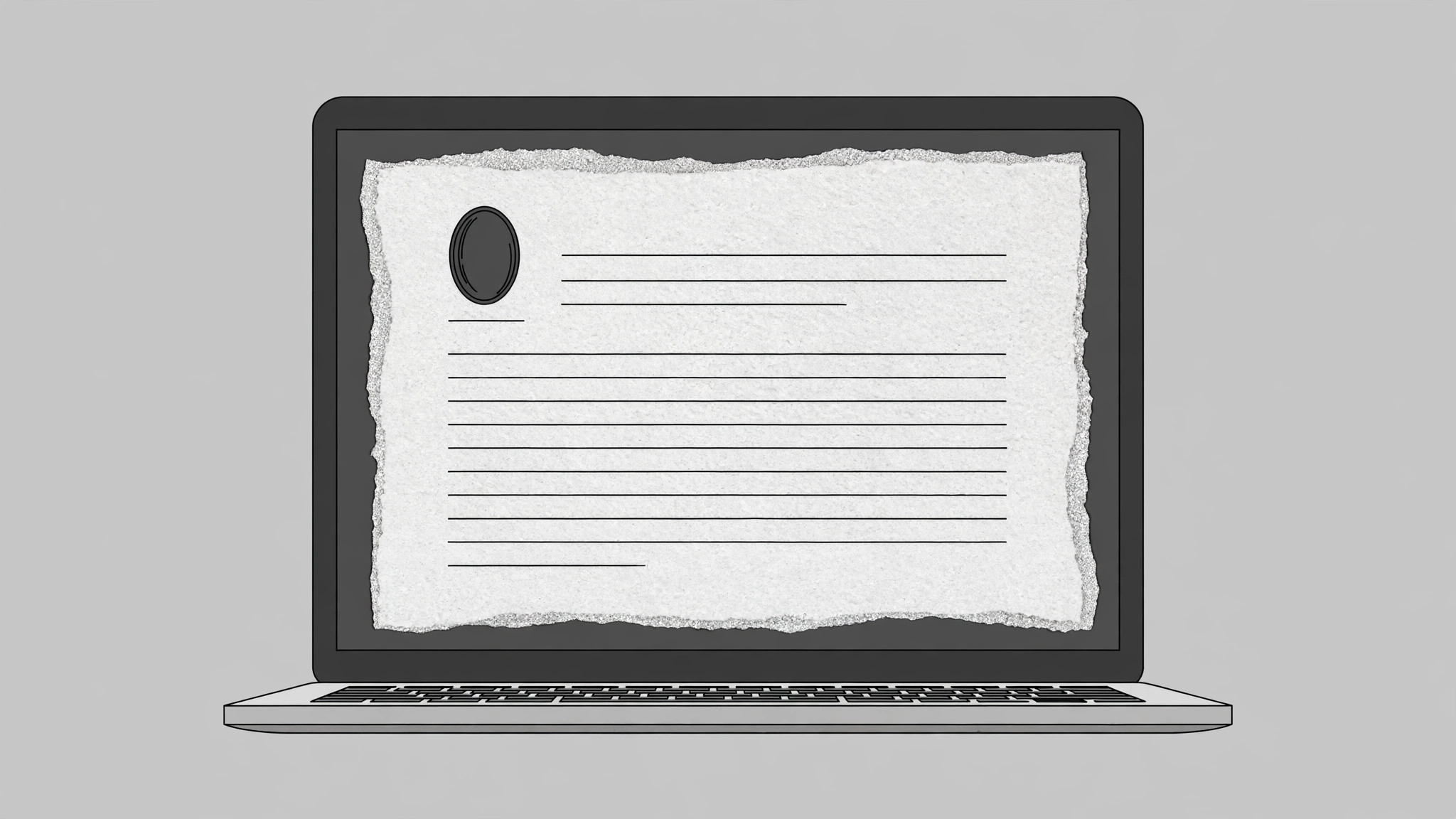
Trasforma la tua IA in un web designer che crea un sito curriculum personale con una texture di carta tattile — layout ispirato alla stampa, grana calda e dettagli con bordi strappati — che si comporta comunque come un sito veloce, accessibile e ottimizzato per mobile.
Installala in 3 passaggi
Nessuna registrazione. Nessuno strumento da riga di comando. Scegli la tua AI, copia una riga e incollala.
Preferisci fare da te? Acquista la skill ($4.99), scarica lo ZIP dalla conferma d'acquisto, decomprimilo nella cartella mostrata sopra e riavvia la sessione della tua AI — stesso risultato. L'hai già acquistata? Il tuo assistente AI può scaricarla per te.
Cosa contiene
Un file SKILL.md (la guida operativa) + un modello di partenza. Un'anteprima:
Paper-Texture Resume Site
When to use
- A designer, writer, illustrator, or craftsperson wants a resume site that feels handmade rather than templated
- You need a one-page personal site: name, what you do, selected work, experience, contact
- A job seeker wants a link to send instead of a PDF, with the same care a printed resume gets
- A portfolio that should print beautifully — the site doubles as the printable resume
- You want a personal site with a strong tactile identity but no heavy images, frameworks, or build step
Workflow
- Write the resume first (input: career facts → output: plain-text resume)
Write the content as plain text before any design: name, one-line positioning ("Product designer who ships boring tools people love"), 3–5 selected projects with one-line outcomes, work history (role, org, dates, one line each), skills, education, contact. Cut ruthlessly — a resume site is not a CV dump; anything that would not survive on one printed page does not survive here. Every project line states an outcome, not a duty: "Redesigned onboarding; trial-to-paid rose from 12% to 19%" beats "Responsible for onboarding." This text is the whole site; the design only dresses it. - Set the paper system (input: plain-text resume → output: design tokens)
Define a small token set: two paper tones (a warm off-white base and a slightly darker deckle edge), one ink color (near-black, never pure black), one accent (a muted stamp red or pencil blue), and two typefaces (a serif for headings, a clean sans for body). Texture comes from a lightweight repeating grain — a tiny tiled image or a CSS noise pattern — applied at low opacity over the background, never from a huge photographic scan. Torn and deckle edges are drawn with small SVG masks or border-radius tricks, not heavy images. Every token gets a name and a hex value so the site stays consistent across sections. - Lay out the page like a printed sheet (input: tokens + resume text → output: page structure)
Structure the page as a single sheet of paper: a header block (name, positioning line, contact), then sections in print order — Selected work, Experience, Skills, Education, Contact. Use generous margins, a single column with a maximum width around 720px, and rules (thin horizontal lines) between sections like a letterpress resume. Work samples sit as small captioned figures with paper-frame borders, not a masonry gallery — this is a resume that shows work, not a gallery that happens to have a resume. Keep the total page weight light: text first, a handful of small images, no carousels. - Make it behave like a website (input: page structure → output: working site)
Build it as a single static HTML file with inline or one linked stylesheet — no framework, no build step, no JavaScript required for the core page. Make it responsive: the sheet narrows to the phone screen, type scales down one step, and the deckle edges simplify rather than breaking. Add the web behaviors a PDF cannot offer: a workingmailto:contact link, anchor navigation to sections, and semantic HTML (header,main,section,h1/h2) so screen readers and search engines read it as a resume. Add a print stylesheet so printing the page yields a clean one-or-two-page resume with the texture toned down and backgrounds removed. - Proof, test, and ship (input: working site → output: live resume site)
Proofread every word — a resume site with a typo is worse than no site — and check every date, link, and email address by clicking it. Test on a phone, a desktop, and in print preview; test with images off to confirm the text alone still reads as a complete resume. Check contrast: ink on paper tones must pass a basic contrast check, and the grain must never sit behind body text at an opacity that hurts reading. Ship as a single page on any static host, then send the link to one honest friend and fix whatever confuses them before sending it to anyone who hires.
Anteprima del modello
Paper-Texture Resume Site — Template
Fill in the resume text first, then the tokens, then build the single page.
Resume text (write this before any design)
Name: {full name} Positioning line (one line): {e.g. Product designer who ships boring tools people love} Contact: {email} | {city} | {portfolio/social link}
Selected work (3–5 projects, outcome per line)
- {Project name} — {one-line outcome, e.g. "Redesigned onboarding; trial-to-paid 12% → 19%"} — {link or image}
- {Project name} — {one-line outcome} — {link or image}
- {Project name} — {one-line outcome} — {link or image}
Experience
Skills
Il pacchetto della skill (SKILL.md + modello) è scritto in inglese.


