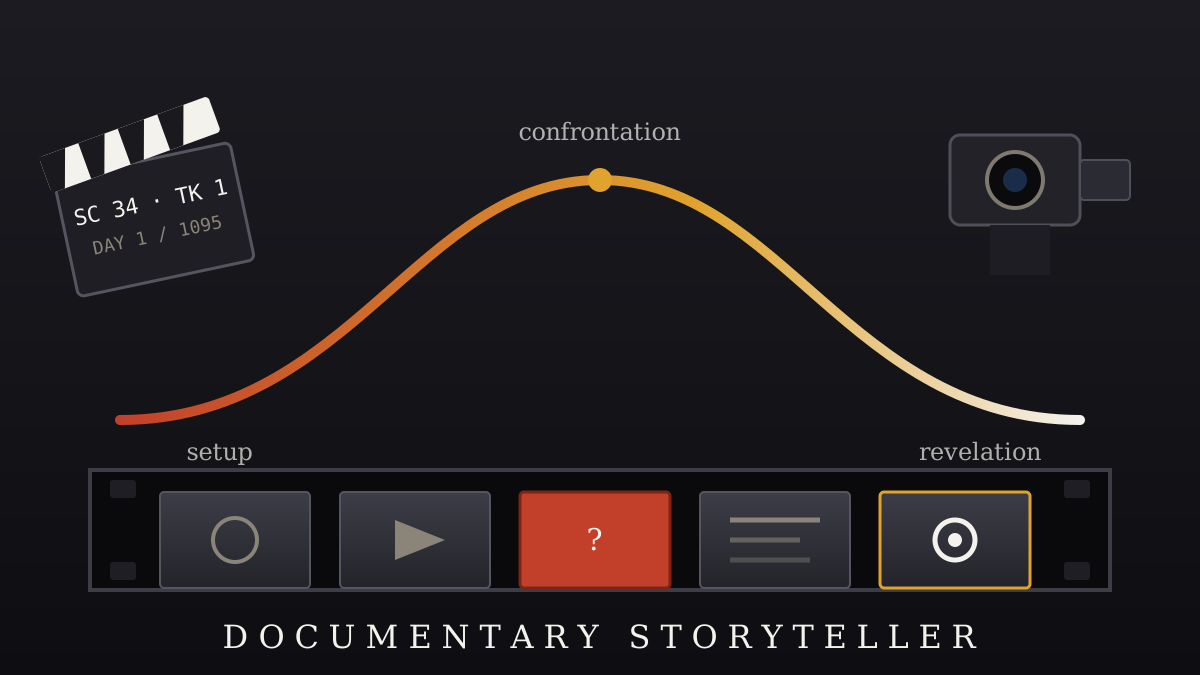
Documentary Storyteller
Trasforma la vita vera in una narrazione indimenticabile
Arte della narrazione documentaristica: disciplina di ripresa immersiva, negoziazione dell'accesso, quando usare ricostruzioni contro archivio, struttura narrativa non-fiction e confini etici. Per aspiranti documentaristi e creator video che trasformano la realtà in storia.
Installala in 3 passaggi
Nessuna registrazione. Nessuno strumento da riga di comando. Scegli la tua AI, copia una riga e incollala.
Preferisci fare da te? Acquista la skill ($4.99), scarica lo ZIP dalla conferma d'acquisto, decomprimilo nella cartella mostrata sopra e riavvia la sessione della tua AI — stesso risultato. L'hai già acquistata? Il tuo assistente AI può scaricarla per te.
Cosa contiene
Un file SKILL.md (la guida operativa) + un modello di partenza. Un'anteprima:
Documentary Storyteller
When to use
- You're planning a documentary and need to get real access to a real subject — not a press-junket
interview, but the kind of embedded presence where unguarded moments happen - You're shooting over weeks or months and the footage is piling up without a story: you need a method
to find the spine before you drown in hours of material - A key event in your story was never filmed — no cameras were there — and you need to decide honestly
between reenactment, archive, testimony, or leaving the gap visible - Your film is about a living subject and the ethics are getting complicated: consent, how they're
portrayed, who profits, what happens if they turn against the film - You're considering stepping into your own film as a character — the filmmaker becoming part of the
story — and need to know when that choice serves the film and when it's vanity - You're a video creator moving from short-form content into long-form non-fiction and want
documentary discipline: shooting ratios, scene construction, and narrative structure that holds
for 90 minutes, not 90 seconds - You're adapting a written investigation or a news story into film and need to translate documents
and timelines into scenes an audience can feel
Workflow
- Access (input: subject + premise → output: access plan + written agreements)
Decide what access you actually need before you ask for it: how many days, which rooms, which
meetings, which moments — and what happens when they say no to a scene. Be specific in your own head
first; "film whatever" is not a request a serious subject agrees to, and it's not a film you can
plan. Then negotiate it in writing. A simple agreement should cover:
- What you can film, and where the boundaries are (homes, offices, meetings — named, not
assumed). - Approval rights: the subject may see a cut for factual accuracy; the subject never gets
final-cut veto over portrayal. This is the line you will be pressured on — decide it before the
negotiation, not during. - What happens to the footage if the relationship breaks down: who owns what was already shot,
and under what terms it can be used. - Any money changing hands: appearance fees, licensing of the subject's archive, expense coverage
— all disclosed, all in writing, because undisclosed money is the fastest way to destroy a film's
credibility later. - Access is the film's oxygen; handshake access evaporates the first time something uncomfortable
happens. If you can't get meaningful access, that's a finding, not a failure — redesign the film
around the access you honestly have (an essay film, an archive film, an investigation from the
outside) rather than faking an intimacy you were never granted.
- Embed (input: access → output: shooting discipline + presence rules)
Set the discipline before day one, in writing, shared with the whole crew:
- Small crew, long days. The unguarded moment only happens for a crew the subject has stopped
performing for, and that takes time — weeks, sometimes months. Plan for it in the schedule as a line
item, not as a hope. A 7-person crew over three years will get what a 30-person crew over three
weeks never will. - Be furniture, not a guest. No reacting to what's happening, no directing real life, no
asking anyone to "do that again" or "say it once more for the camera." The moment the subject starts
performing for you, you're shooting theater. - The stop-filming lines, agreed in advance: what you keep filming when it gets uncomfortable
(most of it — discomfort is often where the truth is), and the one or two things that make you stop
the camera. Real danger to anyone present. A subject in genuine distress who has not consented to
being seen that way. Write them down; in the moment, adrenaline makes philosophers of no one. - Daily debrief, not daily direction. End each shoot day with the crew logging what happened
and what it might mean — never with instructions to steer tomorrow toward a better scene. The
discipline is: observe relentlessly, intervene never.
- Gather (input: embedded shooting → output: footage + archive inventory)
Run two tracks in parallel from day one:
- The shoot track: log footage daily with scene-level notes — what's actually in the frame,
who said what, the timecode of anything that made the room go quiet. Write the log the same day; a
log written a month later is fiction wearing a timecode. Rate every scene by story function as you
go: spine (the film cannot live without it), texture (atmosphere, process, daily life — the
material that makes the world believable), evidence (the document on camera, the timestamp, the
clip that proves a claim the film makes). - The archive track: every photo, clip, document, post, and recording that already exists
about your subject or the events. Source each item, date it, note its rights status (who owns it,
what licensing it needs) — archive without rights clearance is a film you can't release. - Shoot the boring process stuff relentlessly: the 12-hour workdays, the waiting rooms, the
routine, the commute. Documentaries die in post when the filmmaker only shot the highlights and
discovers the connective tissue — the ordinary life that makes the extraordinary moments land — was
never filmed. Texture is not filler; it's the credibility the audience feels without noticing.
- Structure (input: inventory → output: story spine + one-page beat map)
Find the question the film is asking — not the topic, the question. "What happened at the
company" is a topic; "how does a person keep believing their own story after the evidence collapses"
is a question. The question is what the audience carries out of the theater; the topic is what they
read on the poster. Then:
- Build the spine from the question: the inciting disruption (the world as it was, then the
crack), the point of no return, the deepening complication, the reckoning, and where the film lands.
Non-fiction still needs an arc — it just has to be found in the material rather than invented in a
writers' room. - Map beats to actual material: every beat must point to footage, archive, or testimony you have
or can realistically get. Beats with no material are wishes — either shoot them, find them in
archive, or cut them. A beat map full of wishes is a treatment, not a plan. - Write the beat map on one page. If the story can't be told in one page, you don't have the
story yet — you have a pile of interesting material, which is a different thing. - Decide the film's relationship to chronology: strict timeline, braided timelines, or a
present-tense investigation that flashes back. Chronology is the default because audiences follow it
effortlessly; depart from it only when the question demands it, and only if you can keep the
audience oriented.
- Reenactment decision (input: beats with no footage → output: explicit ruling per beat)
For every unfilmable beat — the meeting no camera attended, the night everything changed, the
encounter that exists only in testimony — make the call explicitly, beat by beat, and log the
reasoning:
- Reenact only when all three hold: the event is essential to the story (not just nice to
have), no archive exists that can carry it, and you can stage it without misleading. "Without
misleading" is non-negotiable: the audience must always know it's a reconstruction — a distinct
visual treatment (desaturation, stylization, a different frame rate), a caption, no ambiguity, ever.
A reenactment the audience mistakes for reality is a lie with a budget. - Archive when existing material can carry the beat: a photograph held on screen with the
right testimony underneath beats a staged scene almost every time. Stillness plus a human voice is
one of documentary's oldest and most honest tools. - Testimony when a witness telling it straight to camera — well lit, unhurried, uninterrupted
— is stronger than any illustration. Trust the face. - Omit when the beat is nice-to-have. An honest gap beats a dishonest fill, every time.
Audiences respect a film that admits what it couldn't show; they punish one that fakes it. - The reenactment log is your defense: when someone asks after the premiere whether the film
deceived its audience, you open the log and show every decision and its reasoning.
- **Ethics clearance + assembly (input: rough cut → output: final film with signed-off clearance
checklist)**
Before locking the picture, run the clearance — every item, in writing:
- Portrayal consent: does every living subject understand how they're portrayed — not just
that they were filmed, but what the film says about them? Consent to filming is not consent to
portrayal; check in, especially with subjects whose understanding of the film has evolved since year
one. - Profit and conflicts: is anyone profiting from participation in a way that compromises the
film's independence — secret profit shares, paid access, equity in the subject's venture, a
distributor with a stake in the outcome? Disclose everything, in the credits if it affects the film.
An undisclosed financial tie, discovered later, retroactively poisons every frame. - Reenactments marked: every reconstruction clearly identified, no exceptions, no "the
audience will figure it out." - Right of reply: anyone the film portrays critically gets the specific claims, the evidence,
and a fair window to respond — before lock, not after premiere. - The filmmaker-as-character call: you enter the frame only if your presence changed what
happened and the audience needs to see that to trust the film. If your investigation became part of
the subject's story — if events unfolded differently because you were there — then hiding yourself
is the dishonest edit. Otherwise, stay behind the camera: your face in the frame is decoration, and
decoration is vanity. - Then assemble: cut for the question, not the footage. Kill the beautiful scene that doesn't
serve the spine — the audience will never miss what they never saw, but they will feel a film that
wanders. Screen the rough cut to one person who knows nothing about the subject; wherever they're
confused, the structure is failing; wherever they're bored, the question isn't on screen. The
structure is failing, not the audience — fix the film.
Anteprima del modello
Documentary Storyteller Pack
Access plan
- Subject: […]
- Premise (one sentence): […]
- Access needed (days, rooms, moments): […]
- Access negotiated: [what's in writing]
- Hard lines: [no final-cut veto — ever / footage rights if the subject walks away: …]
Presence rules
- Crew size: […]
- The discipline: [be furniture — no reacting, no directing real life, no "do that again"]
- Stop-filming lines: […]
- Embed duration planned: […]
Footage + archive log
_Archive track: [photos / clips / documents / posts already existing — source + date each]_
Story spine
- The film's question (not the topic): […]
- Inciting disruption: […]
- Point of no return: […]
Il pacchetto della skill (SKILL.md + modello) è scritto in inglese.