Crypto Harbor Landing
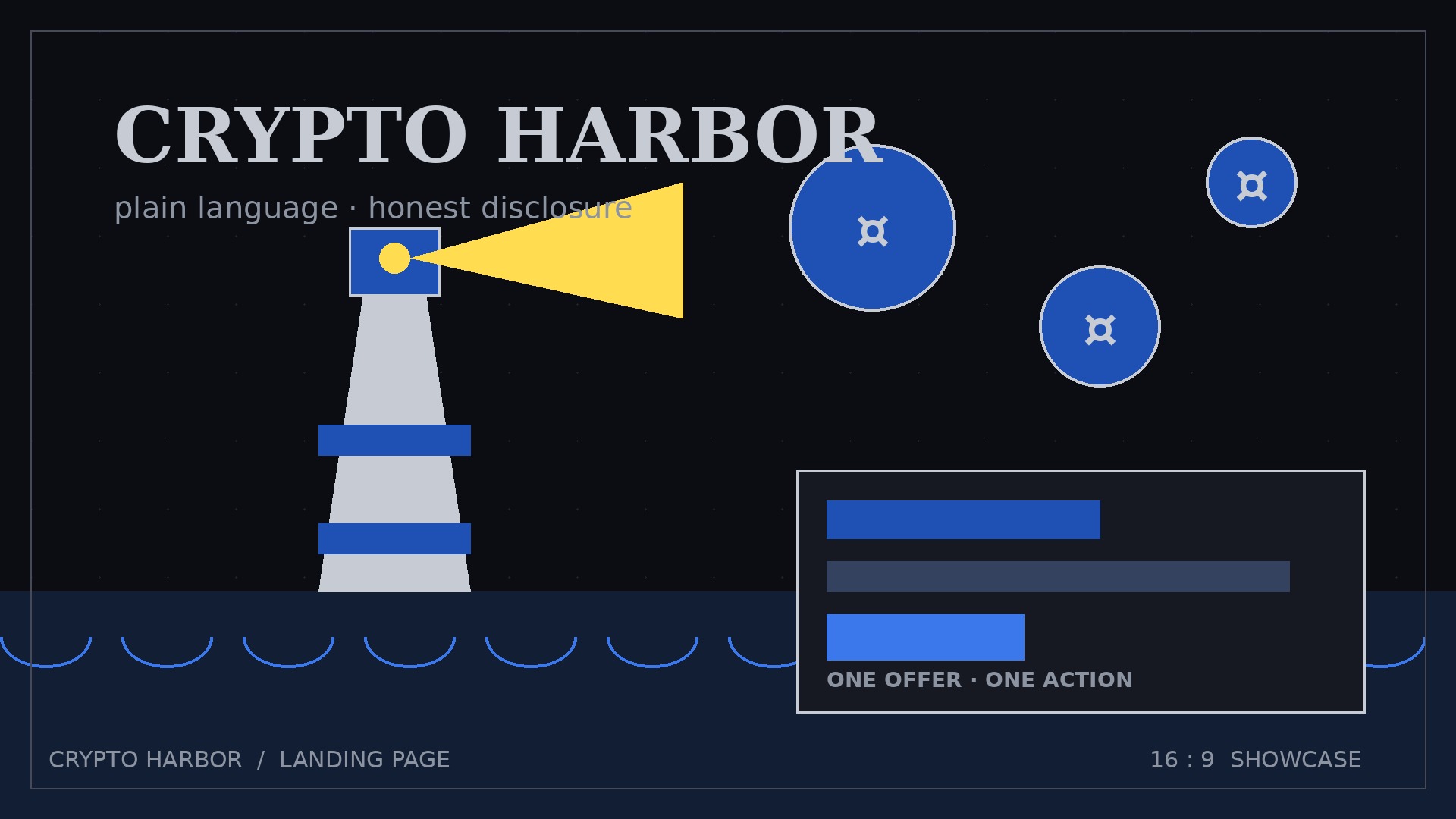
Una landing page crypto in linguaggio semplice: un'offerta, un'azione e un'informativa sui rischi onesta.
Scrive la landing page completa di un prodotto crypto — wallet, funzione di exchange, prodotto formativo o pagina di lista d'attesa: hero, problema, come funziona, funzionalità, sicurezza, FAQ e call to action. Linguaggio semplice dall'inizio alla fine, termini crypto spiegati al primo uso e un'informativa sui rischi leggibile, senza promesse di rendimento.
Installala in 3 passaggi
Nessuna registrazione. Nessuno strumento da riga di comando. Scegli la tua AI, copia una riga e incollala.
Preferisci fare da te? Acquista la skill ($4.99), scarica lo ZIP dalla conferma d'acquisto, decomprimilo nella cartella mostrata sopra e riavvia la sessione della tua AI — stesso risultato. L'hai già acquistata? Il tuo assistente AI può scaricarla per te.
Cosa contiene
Un file SKILL.md (la guida operativa) + un modello di partenza. Un'anteprima:
Crypto Harbor Landing
When to use
- You're launching a crypto product — wallet, exchange feature, portfolio tool, learning course — and need a landing page that explains it without hype
- You need a waitlist page to gauge interest before building the full product
- You're announcing a new feature to existing users and need a page that shows what it does and how to try it
- Your current page is jargon soup ("decentralized synergy") and visitors bounce without understanding the offer
- You're running ads or content to a page and need one clear action per visitor, not five competing buttons
Workflow
- Define the offer and the audience (input: product, who it's for → output: one offer + one action)
One page, one offer, one action: "Try the wallet" or "Join the waitlist". Name the audience precisely — "people who hold crypto on an exchange and want self-custody" — and the single action they take. If the page needs two CTAs, it needs two pages. Write the offer in one sentence a non-crypto friend would understand; if they can't, the page isn't ready. - Structure the page (input: offer → output: section outline — hero, problem, how it works, features, safety, FAQ, CTA)
Fixed spine: Hero (outcome + CTA) → Problem (the pain, in the visitor's words) → How it works (3 steps, no jargon) → Features (what it does, each tied to a benefit) → Safety (how keys, funds, and data are handled, honestly) → FAQ (the real objections) → Final CTA. Every section earns its place by moving the visitor one step toward the action — decoration gets cut. - Write the copy (input: outline → output: full page copy — headlines, body, FAQ, disclosure)
Headlines state outcomes, not features: "Your keys stay on your device" beats "Non-custodial architecture". Body copy stays plain: explain each crypto term on first use. The FAQ answers the objections visitors actually raise — fees, supported chains, what happens if I lose my key — not softball questions. End with a risk disclosure block: crypto is volatile, never invest more than you can afford to lose, this page is not financial advice. - Design and build (input: copy → output: built page — layout, mobile, speed, form)
Layout rules: hero with headline + one CTA above the fold, one action repeated down the page (same action every time), mobile-first, fast load, form with the fewest fields that work. The CTA button says what happens next — "Join the waitlist" or "Download the app" — never a bare "Submit". Test the form end-to-end yourself before launch: a landing page with a broken form is a leak, not a page. - Launch checks (input: built page → output: launched page with disclosure, legal review, analytics, QA passed)
Run the launch checklist: risk disclosure present and readable, legal/compliance review done where required, analytics on the CTA (not just pageviews), every link works, page renders on phone and desktop, load time acceptable. After launch, watch the CTA conversion and the FAQ: the questions visitors actually ask tell you what the page still fails to explain.
Anteprima del modello
Crypto Harbor Landing — Template
One page, one offer, one action. Write the offer in a sentence a non-crypto friend would understand.
Offer + audience
Product: { } Audience (precisely): { } One offer: { } One action: {try / join waitlist / download / other: } CTA button text: {says what happens next — never bare "Submit"}
Page copy
Hero (above the fold)
Headline (outcome, not feature): { } Subhead (one sentence, plain words): { } CTA: {button text} → {where it goes}
Problem
{the pain, in the visitor's words — 2–3 sentences}
How it works (3 steps, no jargon)
- {step — plain words}
- {step}
- {step}
Features (each tied to a benefit)
Il pacchetto della skill (SKILL.md + modello) è scritto in inglese.