Wording Choice
Deux formulations s’affrontent — la plus faible est rayée, la plus forte s’impose.
Met en scène les choix de formulation comme des duels côte à côte : les deux options partent à égalité, la perdante est rayée, la gagnante s’impose, et la raison en une ligne nomme le mécanisme. Couvre la sélection des paires, le minutage du verdict, les lignes de justification et l’enchaînement des paires en une leçon.
Installez-la en 3 étapes
Sans inscription. Sans outils en ligne de commande. Choisissez votre IA, copiez une ligne, collez-la.
Vous préférez le faire vous-même ? Achetez la compétence ($4.99), téléchargez le ZIP depuis votre confirmation d'achat, décompressez-le dans le répertoire indiqué ci-dessus, redémarrez votre session IA — même résultat. Vous l'avez déjà achetée ? Votre assistant IA peut la télécharger pour vous.
Contenu du pack
Un fichier SKILL.md (le guide pratique) + un modèle de départ. Aperçu :
Wording Choice
When to use
- Your video teaches writing, naming, messaging, or communication, and the lesson lives in the difference between two phrasings
- You are deciding a headline, a button label, a title, or a slogan on camera and want the audience to see the reasoning, not just the verdict
- A script review, a copy teardown, or a brand-naming session needs a visual language for "this one, not that one"
- The difference between two options is subtle — one word, one verb, one framing — and spoken explanation alone would blur it
- You want a repeatable comparison beat: the same side-by-side duel can run through a whole video, one pair at a time
Workflow
- Find the real pairs (input: draft copy / script → output: 3–7 wording pairs)
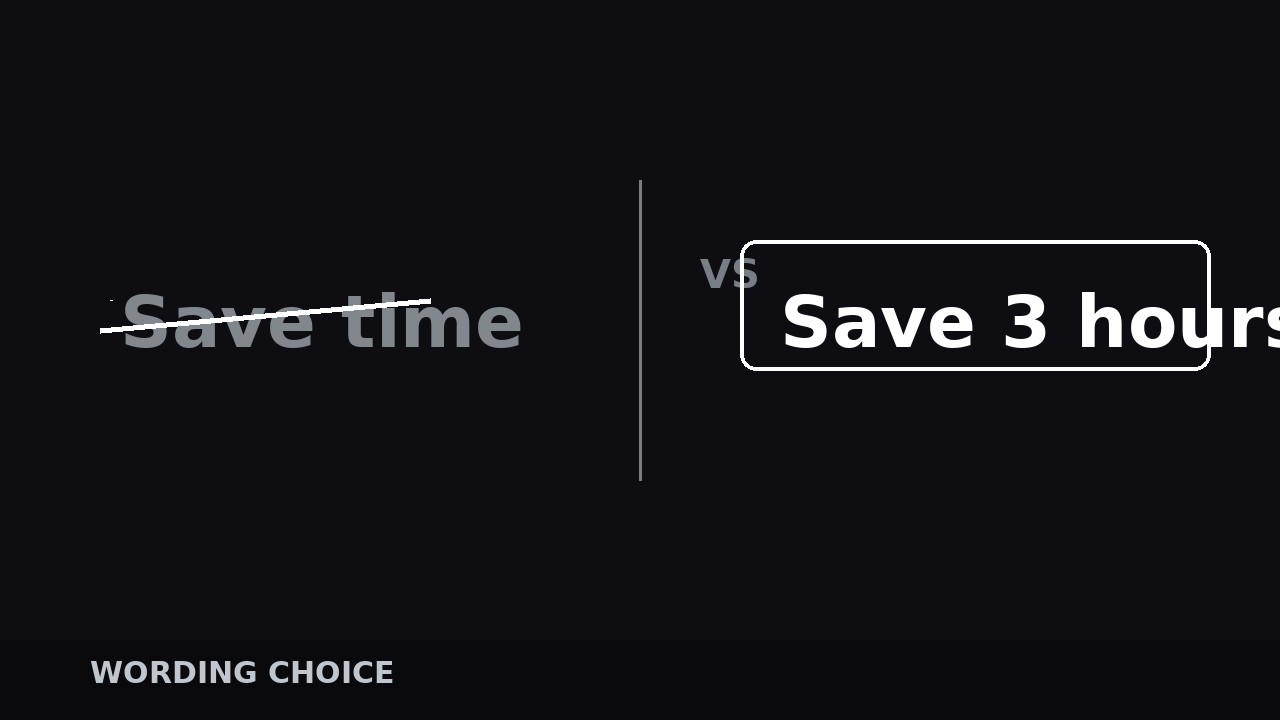
Pull genuine alternatives from the actual draft — pairs you really debated, not straw men you invented to knock down. Each pair must differ in exactly one decision: one verb ("Get" vs "Unlock"), one framing ("Save time" vs "Stop wasting time"), one specificity ("Better results" vs "12% more signups"), one audience ("For teams" vs "For solo founders"). If a pair differs in three ways at once, split it into three pairs or the audience cannot tell which change mattered. Aim for 3–7 pairs per video: fewer than 3 is not a pattern, more than 7 turns the video into a list. For each pair, write the one-sentence reason the winner wins — not "it sounds better", but the mechanism: "specific number beats vague promise", "active verb beats passive noun", "the reader's word beats the company's word". - Stage the duel (input: wording pairs → output: side-by-side layout)
Lay the two options out as a duel, not a list: Option A on the left, Option B on the right, same typeface, same size (6–8% of frame height), same neutral color at the start, separated by a thin divider or a "VS" marker. Keep each option to 1–6 words — longer lines wrap, break the symmetry, and turn the duel into a paragraph comparison. Both options start equal: no color, no size advantage, no hint which one wins. The audience should feel the tension of a fair fight for the first beat. If the options are different lengths, center each in its own half so the layout stays balanced — never let the longer option look more important just because it takes up more space. - Run the verdict (input: staged pair → output: timed verdict animation)
Give the audience 1.5–2.5 s to read both options and form their own opinion before the verdict — the pause is what makes the reveal satisfying. Then run the verdict in three beats: (a) the losing option gets crossed out over 0.4–0.6 s — a hand-drawn strike line that draws left to right, with a soft scratch sound, and the text dims to 35–45% opacity; (b) a 0.3 s beat of silence where the loser sits crossed out; (c) the winner locks in — it brightens to full, scales 100% → 104% and back over 0.3 s, and gains the accent color, with a clean click or chime sound. The strike line must visibly draw across the loser: a line that fades in reads as a formatting change, a line that draws reads as a judgment. Never reverse the order — a winner announced before the loser is crossed out feels rigged, because the audience never got to compare. - Show the reason (input: verdict → output: one-line reason under the winner)
The verdict without the reason is just taste; the reason is the lesson. After the winner locks in, fade in the one-sentence reason under it (0.4 s fade, 3–4% frame height, muted color): "Specific number beats vague promise." The reason must name the mechanism, not restate the winner — "Unlock is stronger than Get" teaches nothing, "Active verb beats vague verb" teaches a rule the viewer can reuse. Hold the full state — crossed-out loser, locked-in winner, reason line — for 2–3 s so the viewer can absorb the rule. If the video is a lesson, consider a 0.5 s "rule card" beat where the reason line alone grows slightly (100% → 105%) to mark it as the takeaway before moving on. - Chain the pairs into a lesson (input: judged pairs → output: full comparison sequence)
Run the pairs in a deliberate order: start with the clearest, most obvious win (builds the audience's confidence in the game), put the subtlest or most surprising pair in the middle (the peak of attention), and end with the pair that matters most to the video's conclusion. Keep the exact same staging, timing, and sounds for every pair — the audience learns the format once and then spends every round on the words, not the packaging. Between pairs, clear the stage completely for 0.3–0.5 s (fade to neutral) so the next pair starts fresh; carrying the previous winner into the next duel muddies both. At the end, show a 2–3 s recap: all winners stacked in a single list, no losers, no reasons — the video's final copy, assembled from its own verdicts, as a proof that the process produced something.
Aperçu du modèle
Wording Choice — Build Template
One decision per duel. Fill in the pairs from the real draft before staging anything.
Video: {title} | Pairs: {3–7}
Pairs (each differs in EXACTLY ONE decision)
Straw-man check: every pair is a real alternative debated in the draft? [ ] Order: {clearest win first → subtlest in the middle → most important last}
Staging (identical for every pair)
Layout: {side by side / stacked for vertical} | Divider: {thin line / VS marker} Typeface: {one family} | Size: {6–8% of frame height} | Start color: {same neutral for both} Option length: {1–6 words each} | Halves balanced: [ ] (center each in its half)
Le pack de compétence lui-même (SKILL.md + modèle) est rédigé en anglais.