Tiered Pyramid Notes
Des notes éparses qui s’empilent en une hiérarchie claire.
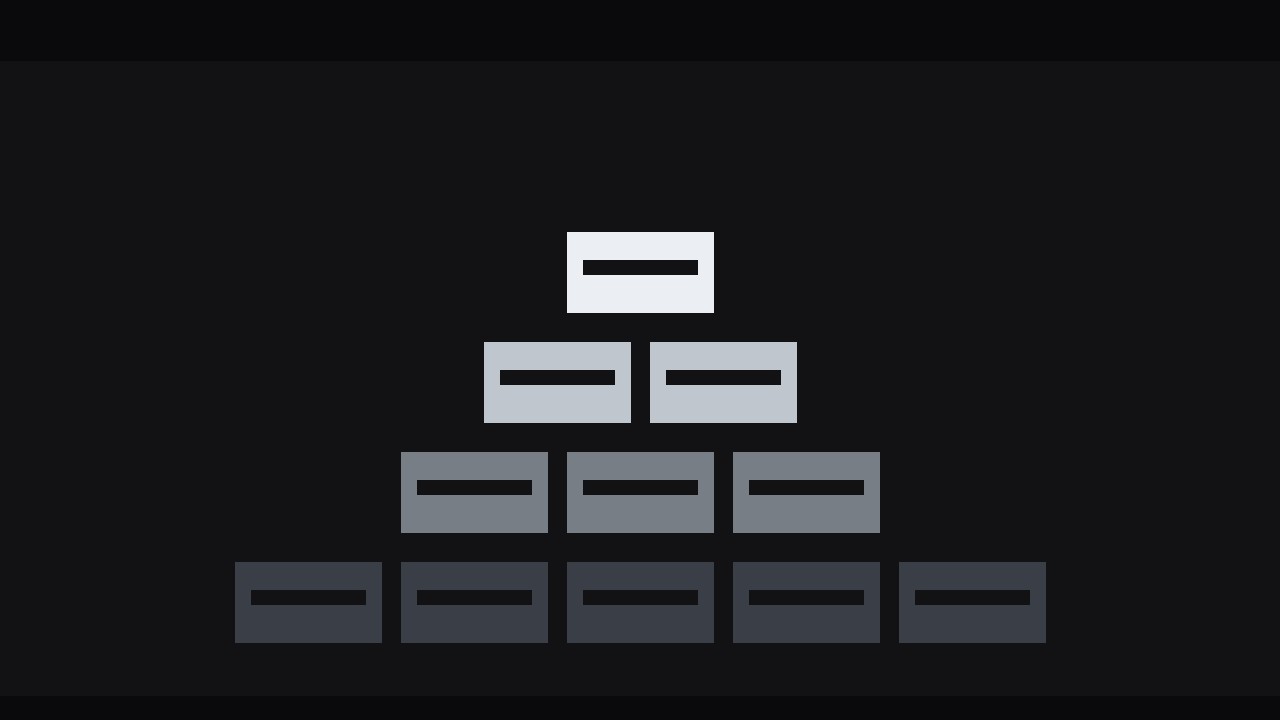
Des notes volent ligne par ligne et s’assemblent en pyramide — des preuves larges à la base, une conclusion au sommet — transformant un tas d’idées en une structure que le public peut retenir.
Installez-la en 3 étapes
Sans inscription. Sans outils en ligne de commande. Choisissez votre IA, copiez une ligne, collez-la.
Vous préférez le faire vous-même ? Achetez la compétence ($4.99), téléchargez le ZIP depuis votre confirmation d'achat, décompressez-le dans le répertoire indiqué ci-dessus, redémarrez votre session IA — même résultat. Vous l'avez déjà achetée ? Votre assistant IA peut la télécharger pour vous.
Contenu du pack
Un fichier SKILL.md (le guide pratique) + un modèle de départ. Aperçu :
Tiered Pyramid Notes
When to use
- The end of an explainer, when scattered points need to resolve into one structure the audience can remember
- A framework video: principles, layers, or priorities that naturally stack from broad base to single peak
- A meeting recap or lecture summary where the notes taken during the session become the takeaway diagram
- A pitch or proposal where the argument builds from evidence (wide) to recommendation (one point)
- A study or revision video where a mass of facts compresses into a hierarchy worth memorising
Workflow
- Sort the notes into tiers (input: raw notes or script points → output: 3–5 tiers, each with 1–6 notes)
Group every note by its level of generality. The bottom tier holds the foundation: facts, evidence, raw observations — the widest group. Each tier above it holds fewer, more abstract notes: patterns, principles, conclusions. The top tier holds exactly one note: the single takeaway. Aim for 3–5 tiers total; two tiers is barely a pyramid, six turns into a staircase nobody can read. A workable shape is 5–3–2–1 or 6–4–2–1. If a tier ends up with more notes than the one below it, your grouping is upside down — re-sort. Write each note as a short phrase (≤5 words); a note that needs a sentence is a paragraph, and paragraphs do not stack. - Design the pyramid (input: tiered notes → output: static pyramid layout with note cards)
Draw the pyramid as rows of note cards. The bottom row is the widest, each row above it narrower and centred, until the single top card caps the peak. Keep every card the same height; let widths vary slightly by row so the pyramid silhouette reads even before the text does. Leave a small, consistent gap between cards (8–12 px at 1080p) — cards that touch merge into stripes; cards too far apart float. Style the cards like notes, not buttons: a paper-like fill, a 1 px edge, a subtle shadow, and a small marker per tier (a colour tab, a number, a tiny icon) so the audience can tell tiers apart at a glance. The top card gets the strongest treatment — the darkest fill, the accent colour, or the boldest type — because it is the destination of the whole graphic. - Fly the notes in (input: static layout → output: fly-in pass with notes arriving row by row)
Notes arrive bottom-up, one row at a time, because a pyramid is built from its foundation. Within each row, cards fly in from alternating sides or from below, travelling 15–25% of frame width over 12–16 frames with ease-out, and land with a soft 2-frame settle (a 1–2 px overshoot downward, like a card being set down). Stagger the cards in a row by 3–4 frames so the row assembles rather than slams in. Hold each completed row for 6–10 frames before the next row starts, so the audience watches the pyramid grow instead of receiving it whole. The top card arrives last, alone, with a slightly longer flight (16–20 frames) and a 4-frame hold before anything else happens — the single card deserves a beat of its own. Total build: roughly 3–5 seconds for a 4-tier pyramid. - Label the tiers (input: fly-in pass → output: tier labels that appear as each row lands)
As each row lands, its tier label appears — a short phrase at the row's left or above the row: "Evidence," "Patterns," "Principles," "Decision." The label fades or slides in over 6–8 frames, timed to the row's landing, never before it: a label for a row that does not exist yet is a spoiler. Keep labels to one or two words; the notes themselves carry the detail. Optional but powerful: a thin bracket or side rule that grows upward alongside the pyramid as rows are added, visually tying the tiers into one structure. If the pyramid will be referenced later in the video, keep the tier labels on screen in the final state — they are the legend the audience will use to read it. - Land the takeaway (input: labelled pyramid → output: emphasis beat on the top card)
Once the pyramid is complete, give the top card its moment: a 1–2 frame accent pulse (a ring, a brief glow, a 103% scale pop) plus, if the format uses voiceover, a half-second of silence or a pause before the takeaway is spoken. If the top card's text is the video's thesis, hold the completed pyramid for at least 3 seconds — long enough for a screenshot. Do not animate anything else during this hold; the pyramid is the picture, and any extra motion competes with it. If the video continues, the pyramid can shrink to a corner as a persistent reference, but only after the full hold — shrinking it early tells the audience it did not matter. - Check readability and export (input: finished pyramid → output: final render verified at phone size)
Check the final frame at 360 px wide: every card's text must still be legible, and the pyramid silhouette must read. If the bottom row's cards are too small, cut a note or two — a pyramid with five readable foundation notes beats one with eight illegible ones. Check the fly-in at full speed: no card should cross over another mid-flight in a way that hides text, and no row should start before the row below it has settled. Export the main cut, plus a still of the completed pyramid for thumbnails, slides, or handouts.
Aperçu du modèle
Tiered Pyramid Notes — Build Template
Fill this in before animating. One pyramid per argument.
The argument
Topic: {topic} Single takeaway (top card): {one phrase, ≤5 words}
Tiers (bottom-up, each row narrower than the one below)
Tier count: {3–5} | Shape check: {e.g. 5–3–2–1, each row narrower}
Pyramid design
- Card height: {uniform, px} | Gap: {8–12 px}
- Card style: {paper fill / 1 px edge / subtle shadow}
- Tier markers: {colour tab / number / tiny icon} per row
- Top card treatment: {darkest fill / accent colour / boldest type}
Fly-in timing
Total build: {~3–5 s}
Le pack de compétence lui-même (SKILL.md + modèle) est rédigé en anglais.