Image Skills
Un message, toutes les tailles — un ensemble, pas un tas.
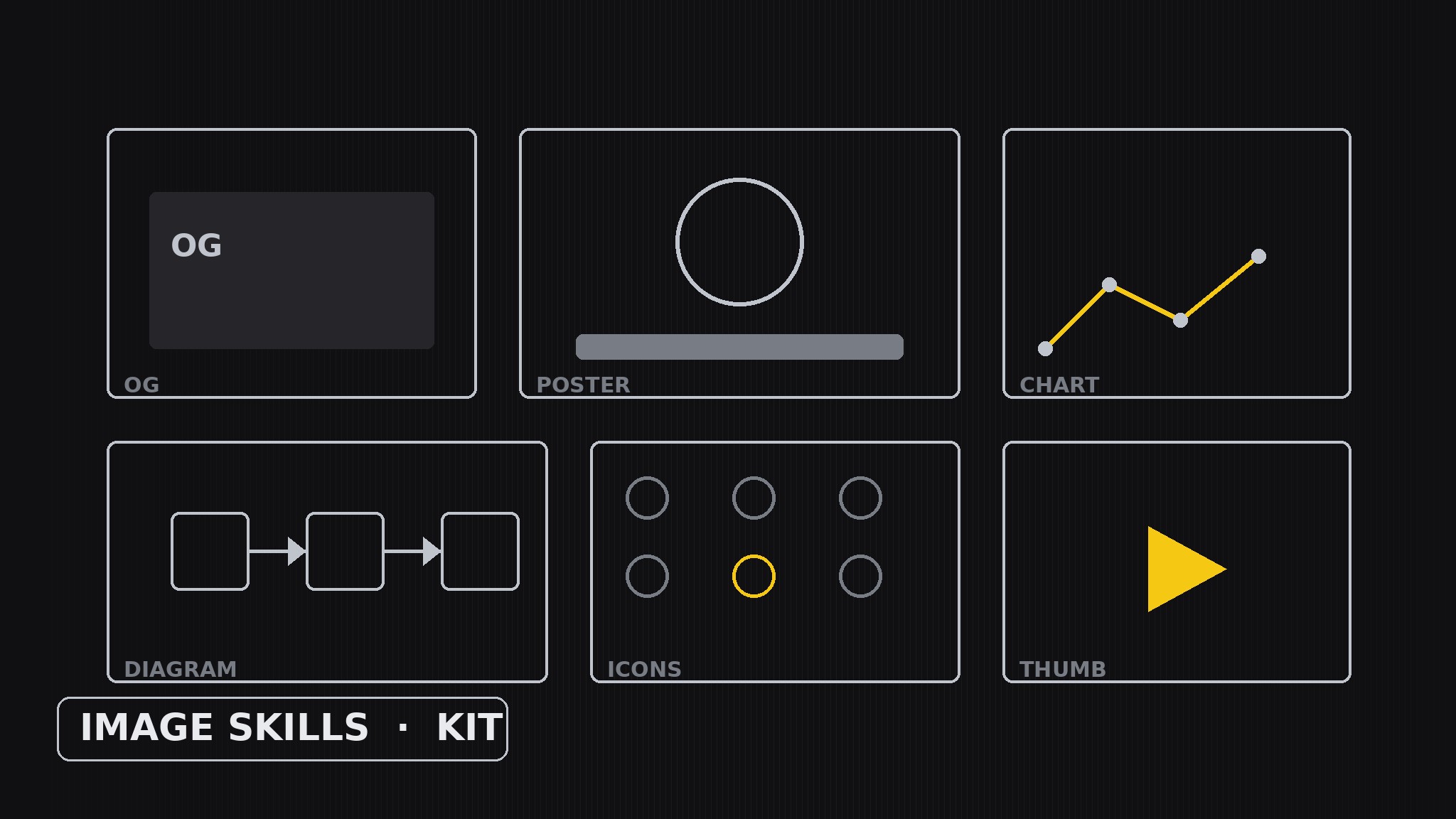
Transforme votre IA en créateur de kits d'images — définit, rédige et assemble un kit cohérent de skills d'assets visuels qui produisent un ensemble d'images assorties : un skill par type d'asset (image OG, graphique, affiche, schéma, et plus), chacun tenu à la même barre de qualité, qui se composent en un ensemble de campagne qu'on croirait fait d'une seule main.
Installez-la en 3 étapes
Sans inscription. Sans outils en ligne de commande. Choisissez votre IA, copiez une ligne, collez-la.
Vous préférez le faire vous-même ? Achetez la compétence ($4.99), téléchargez le ZIP depuis votre confirmation d'achat, décompressez-le dans le répertoire indiqué ci-dessus, redémarrez votre session IA — même résultat. Vous l'avez déjà achetée ? Votre assistant IA peut la télécharger pour vous.
Contenu du pack
Un fichier SKILL.md (le guide pratique) + un modèle de départ. Aperçu :
Image Skills
When to use
- You need a matching set of images for one launch, post, or report — not a series of unrelated one-offs
- The same message has to appear as an OG image, a poster, a chart, and a thumbnail, and they should look related
- A team keeps regenerating images that clash: different type, different palette, different density
- You want a reusable kit: pick the assets a campaign needs, produce them to one standard, ship
- You are standardizing how your AI makes images so every asset is readable at its real display size
Workflow
- Define the asset jobs (input: where the images will appear → output: kit brief)
Start size-first: list every surface the kit must serve — the social share card (small, crowded feed), the poster (large, viewed at distance), the chart inside a report (medium, read closely), the diagram in a doc (medium, studied), the thumbnail (tiny, must read in a list). For each surface, record its display size, its viewing distance, and its one job ("make someone stop scrolling", "make the trend obvious"). A kit scoped by real surfaces produces assets that work where they live; a kit scoped by vibes produces pretty images that fail at thumbnail size. - Inventory the skills (input: kit brief → output: asset inventory)
Give the kit one skill per asset type, each named for what it produces. A typical kit holds: OG Image (one message, readable at thumbnail size), Chart (one trend, every value labeled), Poster (one idea at distance, big type, one image), Diagram (how something works, labeled parts in order), Icon Set (small marks in one style), and Thumbnail (the hook frame, bold and simple). Cut any asset type no surface actually needs — a kit with a "brochure cover" skill nobody uses is clutter — and keep each skill to one asset type so quality stays checkable. - Write each skill to the bar (input: asset inventory → output: skill specs)
Every skill gets the same spec shape: when to use it, its inputs (the content it needs — e.g. Chart needs the data table and the one trend it must show), its output (the finished asset at its real size), and the shared quality bar. The bar is size-honest: type must read at the actual display size (test at that size, not zoomed in), one message per asset (an OG image with three messages has none), a shared palette and type system across the kit, no invented data (a chart plots only the numbers given; a diagram labels only what is known), and alt text describing the asset's message for every image. Write the specs so a new asset type can join the kit without breaking the look. - Compose a campaign set (input: skill specs + one message → output: matched asset set)
Produce the set from one message, not one asset at a time: state the single sentence every asset must carry, then make each asset in its own skill — the OG image compresses the sentence to five words, the poster gives it a headline, the chart proves it with numbers, the diagram explains how it works, the thumbnail shouts it in three words. Enforce the shared palette and type across all of them, and check the set side by side: different sizes, same voice. If one asset looks like it came from another campaign, it goes back — the set ships together or not at all. - Proof at real size (input: matched asset set → output: proven kit)
Proof every asset where it will actually appear: the OG image at thumbnail size in a feed mock, the poster at reading distance, the chart inside the real report page, the thumbnail in a real list. Check the three failures that matter: unreadable type, a message that needs explaining, and data that doesn't match its source. Log what broke — a skill whose inputs were vague, an asset type missing from the kit — and fix the kit, not just the image. The kit is done when a second campaign's set assembles faster than the first and looks like family.
Aperçu du modèle
Image Skills — Kit-Building Template
Scope by real surfaces. Proof at real size.
Kit brief — surfaces this kit must serve
Asset inventory (one skill per asset type)
Cut: {any asset type no surface actually needs — remove it}
Skill spec (copy per skill)
Skill: {name} When to use: {___} Inputs: {___} Output: {finished asset at its real size + alt text stating its message in one sentence} Quality bar: type reads at actual display size / one message per asset / shared palette + type / no invented data / alt text included
Campaign set — one message, many assets
The one sentence every asset must carry: {sentence}
Le pack de compétence lui-même (SKILL.md + modèle) est rédigé en anglais.
Vous aimerez aussi
 Autres
Continuity Asset Set
Un kit unique pour que chaque livrable donne l'impression de faire partie du même ensemble.
 Autres
Device-Canvas Product Launch
Un grand canevas d’appareil porte toute votre histoire de lancement.
 Autres
Frame-Token Editorial Launch
Un seul jeu de tokens, tous vos assets, zéro dérive.