Editorial Dev Portfolio
Trois études de cas approfondies qui se lisent comme des articles de magazine — pas cinquante cartes miniatures
Transforme votre liste de projets en un portfolio éditorial : une ligne de positionnement, trois études de cas narratives, et une expérience de lecture typographique qui montre votre jugement.
Installez-la en 3 étapes
Sans inscription. Sans outils en ligne de commande. Choisissez votre IA, copiez une ligne, collez-la.
Vous préférez le faire vous-même ? Achetez la compétence ($4.99), téléchargez le ZIP depuis votre confirmation d'achat, décompressez-le dans le répertoire indiqué ci-dessus, redémarrez votre session IA — même résultat. Vous l'avez déjà achetée ? Votre assistant IA peut la télécharger pour vous.
Contenu du pack
Un fichier SKILL.md (le guide pratique) + un modèle de départ. Aperçu :
Editorial Dev Portfolio
When to use
- Your portfolio is a grid of screenshots with one-line captions and hiring managers bounce off it in seconds
- You did the hard thinking on a project — the trade-offs, the constraints, the dead ends — but none of it shows
- You're applying for senior or staff roles where judgment matters more than output volume
- You have 3–5 strong projects and want them presented as stories, not as a trophy shelf
- A recruiter asked "send me your portfolio" and your GitHub README links don't read like a coherent narrative
Workflow
- Write the positioning line (input: your career so far → output: one-sentence positioning)
Before any layout, state who you are for and what you are best at, in one sentence: the kind of problems you solve, for whom, and how you solve them differently. "I build data pipelines" is a job description; "I turn messy operational data into systems operators trust" is positioning. Everything on the page must earn its place against this line — a project that doesn't support it gets cut, however proud of it you are. - Pick three proof projects (input: full project list → output: 3 selected projects with a reason each)
Three deep stories beat twelve shallow ones. Pick projects that together prove range: different problem types, different constraints, different skills. For each, write one line on why it made the cut — "proves I can ship under a hard deadline," "proves I can simplify a system others overbuilt." If two projects prove the same thing, keep the stronger and cut the other. - Draft each case study as a narrative (input: selected project + your memory of it → output: structured case-study draft)
Each case study follows the same spine: the situation (what existed, who it served), the problem (what was broken or missing, with numbers where you have them), the constraints (time, budget, legacy systems, team size — constraints are what make the story believable), the decisions (what you chose, what you rejected, and why), and the outcome (what changed, measured honestly). Aim for 400–700 words per case study: long enough to show judgment, short enough to actually get read. Write the decisions section first — it's the part only you can write, and it's what senior reviewers read. - Design the reading flow (input: positioning line + case studies → output: page structure)
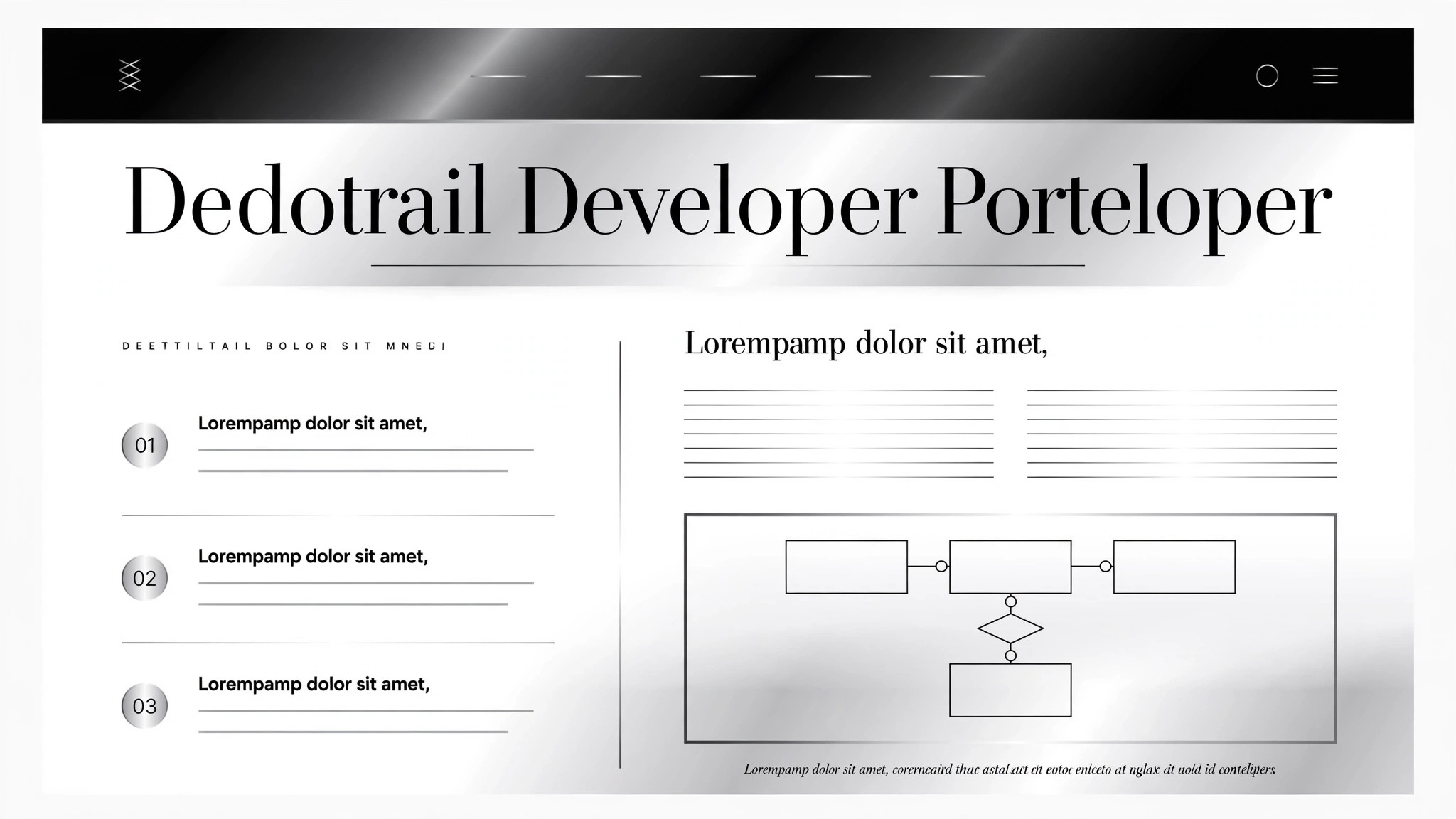
The page reads like a magazine feature, not a dashboard. Order: a hero with your positioning line and nothing else competing with it; a brief index of the three projects (title, one-line hook, outcome number); the full case studies in sequence; a short "how I work" section stating your principles; and a colophon-style footer with contact and links. Typography does the heavy lifting — one serif display face for headlines, one clean sans for body, generous line length limits, and whitespace instead of boxes and dividers. - Build for reading, then proof (input: page structure + drafts → output: publishable portfolio)
Build the pages with the typographic system applied consistently, images used sparingly (one strong visual per case study — a diagram, a before/after, a key screen — captioned, not decorative), and every link checked. Then proof like an editor: read every case study aloud, cut any sentence that only says "I was responsible for," verify every number you claim, and confirm the page reads cleanly on a phone, where most recruiters will actually open it.
Aperçu du modèle
Editorial Dev Portfolio — Template
Fill in the positioning line first. Every project below must support it, or it gets cut.
Positioning line
{One sentence: the kind of problems you solve, for whom, and how you solve them differently}
Hero subline (optional, one line): {a supporting fact — years, domain, or a single outcome}
Project index
Case study 1: {Project title}
Role: {your role} | Timeline: {dates} | Team: {size / solo} | Stack: {only what mattered}
Situation: {what existed, who it served}
Problem: {what was broken or missing, with numbers where you have them}
Le pack de compétence lui-même (SKILL.md + modèle) est rédigé en anglais.