Dot Avatar Maker
Toute une famille d’avatars à partir d’une seule grille de points.
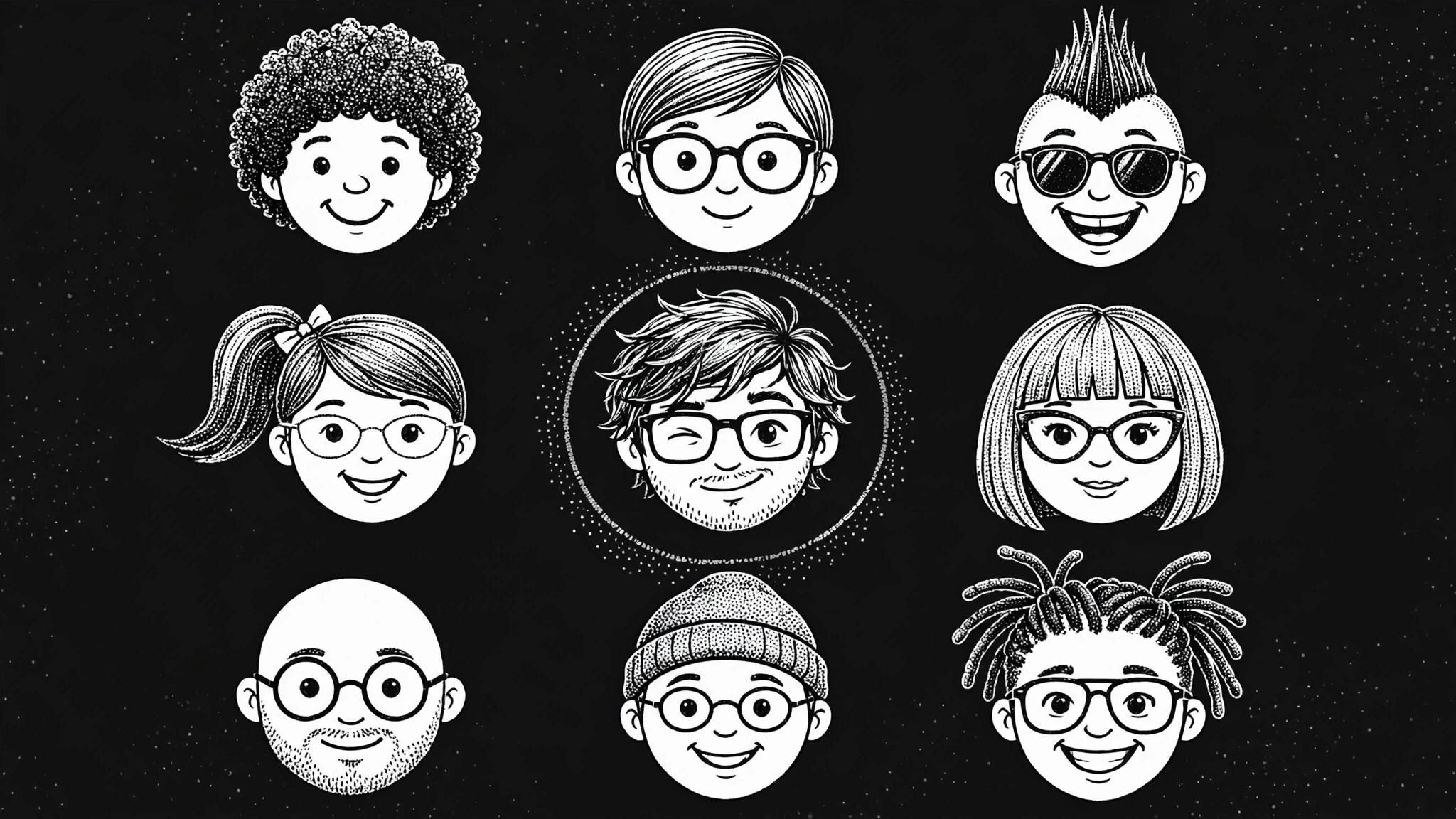
Construit un ensemble cohérent d’avatars en style points à partir d’une grille : un visage de base fixe, des cheveux, lunettes et chapeaux à combiner, une palette de couleurs resserrée, et des exports qui restent lisibles à partir de 32 px.
Installez-la en 3 étapes
Sans inscription. Sans outils en ligne de commande. Choisissez votre IA, copiez une ligne, collez-la.
Vous préférez le faire vous-même ? Achetez la compétence ($4.99), téléchargez le ZIP depuis votre confirmation d'achat, décompressez-le dans le répertoire indiqué ci-dessus, redémarrez votre session IA — même résultat. Vous l'avez déjà achetée ? Votre assistant IA peut la télécharger pour vous.
Contenu du pack
Un fichier SKILL.md (le guide pratique) + un modèle de départ. Aperçu :
Dot Avatar Maker
When to use
- You need avatars for a team page, a community, a game, or a comment section and want them to look like one designed set
- Your current avatars are a mix of photos, initials, and random illustrations that clash on the same page
- You want playful, friendly avatars that stay readable at tiny sizes (32 px) and charming at large ones
- You need a repeatable system so new members can get an avatar in the same style without a designer
- You want avatars with no likeness or privacy issues — stylized dots, not real faces
Workflow
- Fix the grid and the dot (input: where avatars will appear → output: grid spec)
Set the rules first: one square grid (for example 16×16 dots), one dot shape (round), and one rule for how dots combine (dots touch or sit with one gap — pick one). Decide the smallest size the avatar must survive (usually 32 px) and test the grid at that size before drawing anything. If the face doesn't read at 32 px, the grid is too fine. - Design the base face (input: grid spec → output: base face template)
Draw one neutral base face on the grid: two dot eyes, a small dot mouth, and a face outline in dots. This is the template every avatar starts from. Keep the eyes on the same rows and the mouth on the same row in every avatar — fixed feature positions are what make a set look like a set. - Build the mix-and-match parts (input: base face → output: parts library)
Create swappable parts that all sit on the same grid: hairstyles (short, long, curly, bald, ponytail), facial hair, glasses (round, square, sunglasses), hats, and earrings. Each part must fit the base face without moving the eyes or mouth. Aim for at least 5 hairstyles, 3 glasses, and 3 hats — that combination range alone produces dozens of distinct avatars. - Set the palette (input: parts library → output: color palette)
Pick one background treatment (a soft solid, a two-tone dot pattern, or transparent) and a small palette of dot colors: 4–6 skin tones, 4–6 hair colors, and 2–3 accent colors for accessories. Every avatar uses only these colors. A tight palette is what keeps fifty avatars looking like one family instead of fifty strangers. - Generate the set and export (input: palette + parts → output: avatar set)
Combine parts into the avatars you need — one per person, or a full library of combinations. Check each one at 32 px (readable face?), at 128 px (charming?), and next to two others (same family?). Export each avatar as a square PNG at 256 px and 64 px, plus an SVG if you want crisp scaling. Name files by person or by combination so the set stays findable.
Output spec
Aperçu du modèle
Dot Avatar Maker — Avatar Set Template
One grid, one dot style, one palette. Every avatar starts from the same base face.
Grid spec
- Grid: {e.g. 16×16 dots}
- Dot shape: {round}
- Dot spacing: {touching / one gap — pick one}
- Minimum display size: {e.g. 32 px}
- Background: {soft solid / two-tone dot pattern / transparent}
Base face (fixed for every avatar)
- Eyes: rows {n–n}, columns {n, n}
- Mouth: row {n}, column {n}
- Face outline: {dot outline description}
Rule: parts never move the eyes or mouth.
Parts library
Hairstyles (5+):
- {hairstyle 1} — {dot description}
- {hairstyle 2} — {dot description}
Le pack de compétence lui-même (SKILL.md + modèle) est rédigé en anglais.
Vous aimerez aussi
 Images
Social Cover
Des couvertures de publication avec 3 recettes de composition — prêtes à l'emploi
 Images
Infographic
Transformez un paragraphe en une image — sans jamais inventer de données
 Images
Product Poster
Affiches e-commerce : arguments de vente, ancrage prix et appel à l'action en une fois