Content Publishing Kit
Un pipeline de publication qui livre à l'heure, à chaque fois.
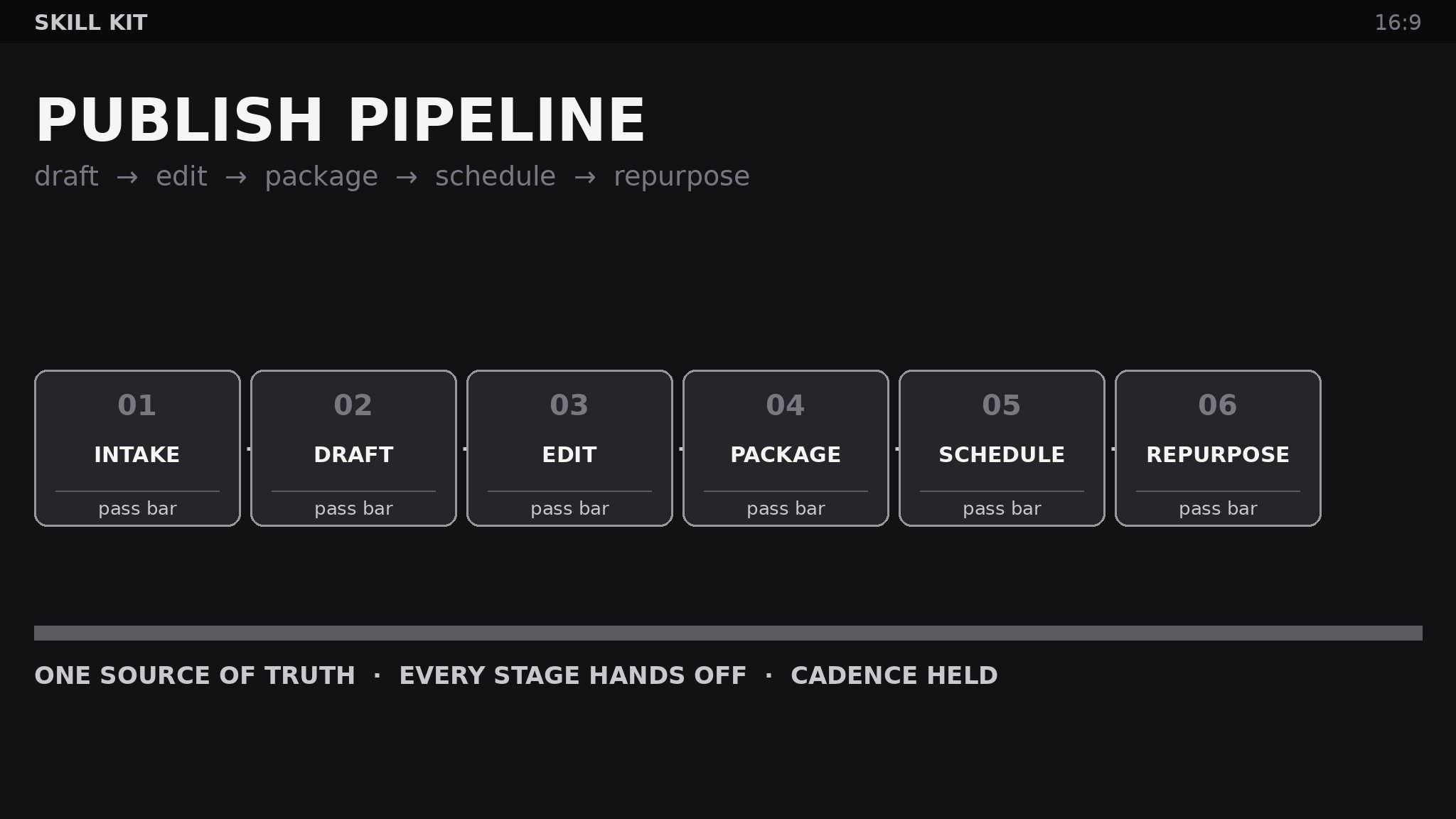
Transforme votre IA en créateur de kits de publication — définit un pipeline de publication reproductible pour vos canaux, assemble le kit de skills dont il a besoin (rédiger, éditer, packager, planifier, recycler) et fixe la barre de qualité que chaque skill doit franchir pour que chaque publication parte à l'heure et dans le ton.
Installez-la en 3 étapes
Sans inscription. Sans outils en ligne de commande. Choisissez votre IA, copiez une ligne, collez-la.
Vous préférez le faire vous-même ? Achetez la compétence ($4.99), téléchargez le ZIP depuis votre confirmation d'achat, décompressez-le dans le répertoire indiqué ci-dessus, redémarrez votre session IA — même résultat. Vous l'avez déjà achetée ? Votre assistant IA peut la télécharger pour vous.
Contenu du pack
Un fichier SKILL.md (le guide pratique) + un modèle de départ. Aperçu :
Content Publishing Kit
When to use
- You publish regularly but every post feels rebuilt from scratch — new doc, new checklist, new decisions
- Your content lives in five tools and nobody can say what the next post is, who owns it, or when it ships
- You want to hand publishing to someone else (or to your AI) without quality collapsing
- You already have drafts piling up but no pipeline that turns them into scheduled, packaged posts
- Your posts go out inconsistently — bursts, then silence — because there is no cadence, only good intentions
Workflow
- Scope the kit (input: your channels and cadence → output: kit scope sheet)
Name the channels the kit covers (blog, newsletter, one social channel — not all of them), the publishing cadence each channel must hold (e.g. blog weekly, newsletter biweekly), and who does what: who drafts, who edits, who approves, who hits publish. A kit with no named owner per stage is a wish list. The scope sheet also fixes the voice rules in one paragraph: who you write for, what you never say, and the sentence length you default to. Everything downstream is judged against this sheet. - Inventory the pipeline skills (input: scope sheet → output: skill inventory)
List the skills the pipeline needs, one per stage, and no more: Idea intake (turns raw notes into a pitched idea with an angle), Draft (turns a pitch into a structured first draft), Edit (turns a draft into a publishable piece against the voice rules), Package (turns a finished piece into title, thumbnail or hero image brief, meta description, and tags), Schedule (turns packaged pieces into a dated calendar with owners and deadlines), Repurpose (turns one published piece into channel-native derivatives). If a stage has no skill, the pipeline stops there — that is usually why publishing stalls. - Write the contract for each skill (input: skill inventory → output: per-skill input/output contracts)
For every skill in the inventory, write three lines: what it takes in (exact input, e.g. "pitch + source notes + voice rules"), what it hands over (exact output, e.g. "800–1200 word draft with headline options and pull quotes marked"), and its pass bar (e.g. "no sentence over 25 words without a reason, every claim traceable to a source note"). A skill without a pass bar cannot be judged, so it cannot be trusted. This is the step most kits skip, and the reason most kits rot. - Build the pipeline document (input: contracts → output: pipeline doc + template pack)
Assemble one document that runs the whole pipeline end to end: the stage order, the handoff format between stages, the template for each stage (idea card, draft skeleton, edit checklist, packaging sheet, calendar row, repurpose map), and the single source of truth — one folder or doc where the canonical version of each piece lives. The pipeline doc is what a new person (or a new AI session) reads to run publishing without asking you anything. - Run one full cycle and harden (input: pipeline doc → output: hardened kit + fixes log)
Push one real piece through every stage, timed, and log every place the pipeline broke: a template field nobody filled in, a handoff that lost information, an edit pass that took twice as long as budgeted. Fix the templates and contracts, not the people. A kit is only real after one full cycle — before that it is a plan. Schedule a monthly kit review: retire stages nobody uses, tighten the pass bars that let weak pieces through.
Aperçu du modèle
Content Publishing Kit — Pipeline Pack
One kit, one pipeline. Fill in the scope sheet once; every piece then runs through the same stages.
1. Kit scope sheet
Channels covered: {channel 1 + cadence} | {channel 2 + cadence} Owners: Draft: {name} | Edit: {name} | Approve: {name} | Publish: {name} Voice rules (one paragraph): {who you write for, what you never say, default sentence length} Single source of truth: {folder / doc link where canonical versions live}
2. Idea card
Idea: {one line} Angle: {what makes this piece different from the obvious take} Pillar / channel: {pillar} | {channel} Source notes: {links, quotes, data the draft may use}
Le pack de compétence lui-même (SKILL.md + modèle) est rédigé en anglais.
Vous aimerez aussi
 Autres
Continuity Asset Set
Un kit unique pour que chaque livrable donne l'impression de faire partie du même ensemble.
 Autres
Device-Canvas Product Launch
Un grand canevas d’appareil porte toute votre histoire de lancement.
 Autres
Frame-Token Editorial Launch
Un seul jeu de tokens, tous vos assets, zéro dérive.