Consulting Storyline Deck
La réponse d'abord, les preuves ensuite — un deck qui fait décider.
Structure un deck narratif percutant, guidé par les hypothèses, qui mène les dirigeants de la situation à la recommandation en 12 à 20 diapositives.
Installez-la en 3 étapes
Sans inscription. Sans outils en ligne de commande. Choisissez votre IA, copiez une ligne, collez-la.
Vous préférez le faire vous-même ? Achetez la compétence ($4.99), téléchargez le ZIP depuis votre confirmation d'achat, décompressez-le dans le répertoire indiqué ci-dessus, redémarrez votre session IA — même résultat. Vous l'avez déjà achetée ? Votre assistant IA peut la télécharger pour vous.
Contenu du pack
Un fichier SKILL.md (le guide pratique) + un modèle de départ. Aperçu :
Consulting Storyline Deck
When to use
- You need to recommend a decision to executives — a market entry, a cost cut, a reorganisation — not just present findings
- Your deck has 60 slides of analysis and the meeting still ends with "so what do you recommend?"
- You're writing a proposal or a steering-committee update where the audience has 20 minutes and low patience for background
- Your analysis is solid but the story is missing — findings don't build to a conclusion
- You need a deck that works both presented live and read alone afterwards
- You're preparing a case interview, a board update, or an internal strategy review
Workflow
- Frame the storyline (input: situation + audience + decision needed → output: SCQ + answer)
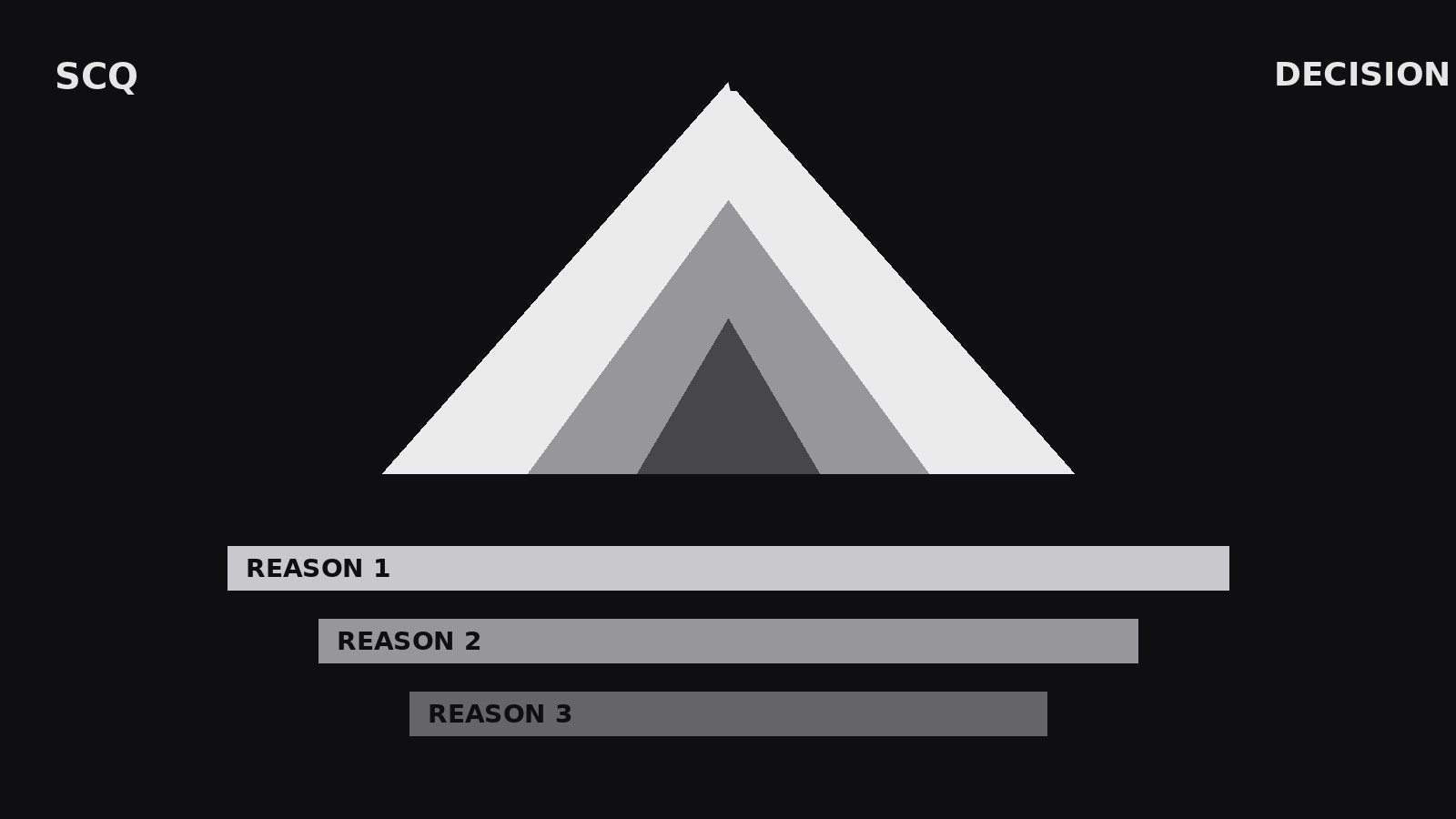
Write the SCQ before any slide: Situation (the agreed context, one sentence), Complication (what changed or what's at stake, one sentence), Question (the decision the audience must make, one sentence), and the Answer (your recommendation, one sentence). Example: "Sales grew 20% (S), but delivery costs grew 45% and margin fell 3 points (C). Should we reprice, cut service levels, or both (Q)? Reprice the bottom tier now and hold service levels (A)." If the answer isn't one sentence, you don't have a recommendation yet — go back to the analysis. - Build the argument tree (input: SCQ + answer → output: MECE argument tree)
Support the answer with 2–4 mutually exclusive, collectively exhaustive reasons — each one a complete assertion, not a topic ("Repricing the bottom tier recovers 2.1 points of margin" not "Pricing"). Under each reason, hang the 2–3 strongest pieces of evidence. Test the tree: if a reason overlaps another, merge them; if a piece of evidence fits under two reasons, it's in the wrong place or the reasons aren't clean. The tree is the deck's skeleton — every slide maps to one branch. - Write the slide headlines first (input: argument tree → output: headline outline)
Draft every slide as a headline sentence that states its message ("The bottom tier loses money on 40% of orders"), with the evidence as support beneath. A reader who reads only the headlines top-to-bottom should be able to follow the whole argument without looking at a single chart. If a headline says "Pricing analysis" or "Results," it's a label, not a message — rewrite it until it asserts something. Aim for 12–20 slides total, including title and appendix pointer. - Build the evidence slides (input: headline outline → output: draft deck)
One slide, one message, one visual: the chart or table that proves the headline, nothing else. Strip every chart to its argument — delete gridlines, legends, and series that don't serve the headline; highlight the one bar, line, or cell that matters. Put the "so what" in the headline, not in a footnote. If a slide needs two charts to make its point, it needs two slides — or the headline is trying to do too much. - Add the recommendation and next steps (input: argument tree → output: decision slides)
Give the recommendation its own slide: the answer restated, the 2–4 reasons in one line each, the expected impact (numbers), and the risks honestly named. Follow it with a next-steps slide: owner, action, and date for each step ("M. Chen — publish new price list — 1 Nov"). Executives decide on the recommendation slide and act on the next-steps slide — if either is vague, the deck has failed at the only two moments that matter. - Add the appendix, then cut (input: draft deck → output: tight deck + appendix)
Move every supporting detail that isn't needed for the decision — methodology, full data tables, backup charts — into a clearly labelled appendix. Then cut the main deck again: remove any slide whose headline duplicates another, any chart the headline doesn't need, any adjective that inflates a number. A consulting deck earns trust by what it leaves out as much as by what it includes. The appendix is where rigour lives; the main deck is where the decision lives. - Test it cold (input: tight deck → output: verified deck)
Give the deck to someone unfamiliar with the work and ask them, after reading only the headlines: what's the recommendation, why, and what's the first next step? If they can't answer in 30 seconds, the headlines or the structure are wrong. Then rehearse aloud with a timer: a 20-minute meeting means ~15 minutes of talking — if the deck takes longer to present, cut slides, not speaking speed.
Aperçu du modèle
Consulting Storyline Deck — Starter Template
Answer first, reasons next, evidence last. 12–20 slides in the main deck; everything else goes to the appendix.
SCQ + Answer (write before any slide)
- Situation: {situation_one_sentence}
- Complication: {complication_one_sentence}
- Question: {question_one_sentence}
- Answer (recommendation, one sentence): {answer_one_sentence}
Argument tree (2–4 MECE reasons)
- Reason 1: {reason_1_assertion}
- Evidence: {evidence_1a} | {evidence_1b} | {evidence_1c}
- Reason 2: {reason_2_assertion}
- Evidence: {evidence_2a} | {evidence_2b} | {evidence_2c}
- Reason 3: {reason_3_assertion}
Le pack de compétence lui-même (SKILL.md + modèle) est rédigé en anglais.
Vous aimerez aussi
 Présentations
Pitch Deck
10 diapositives, une seule histoire — les investisseurs restent jusqu'à la dernière page
 Présentations
Work Report
Hebdomadaire, mensuel, bilans — la conclusion d'abord, compris en 3 minutes
 Présentations
Academic Argument Deck
Une présentation qui argumente — et qui répond aux objections.