Client Reporting Kit
Chaque rapport se termine par une décision, pas par un haussement d'épaules.
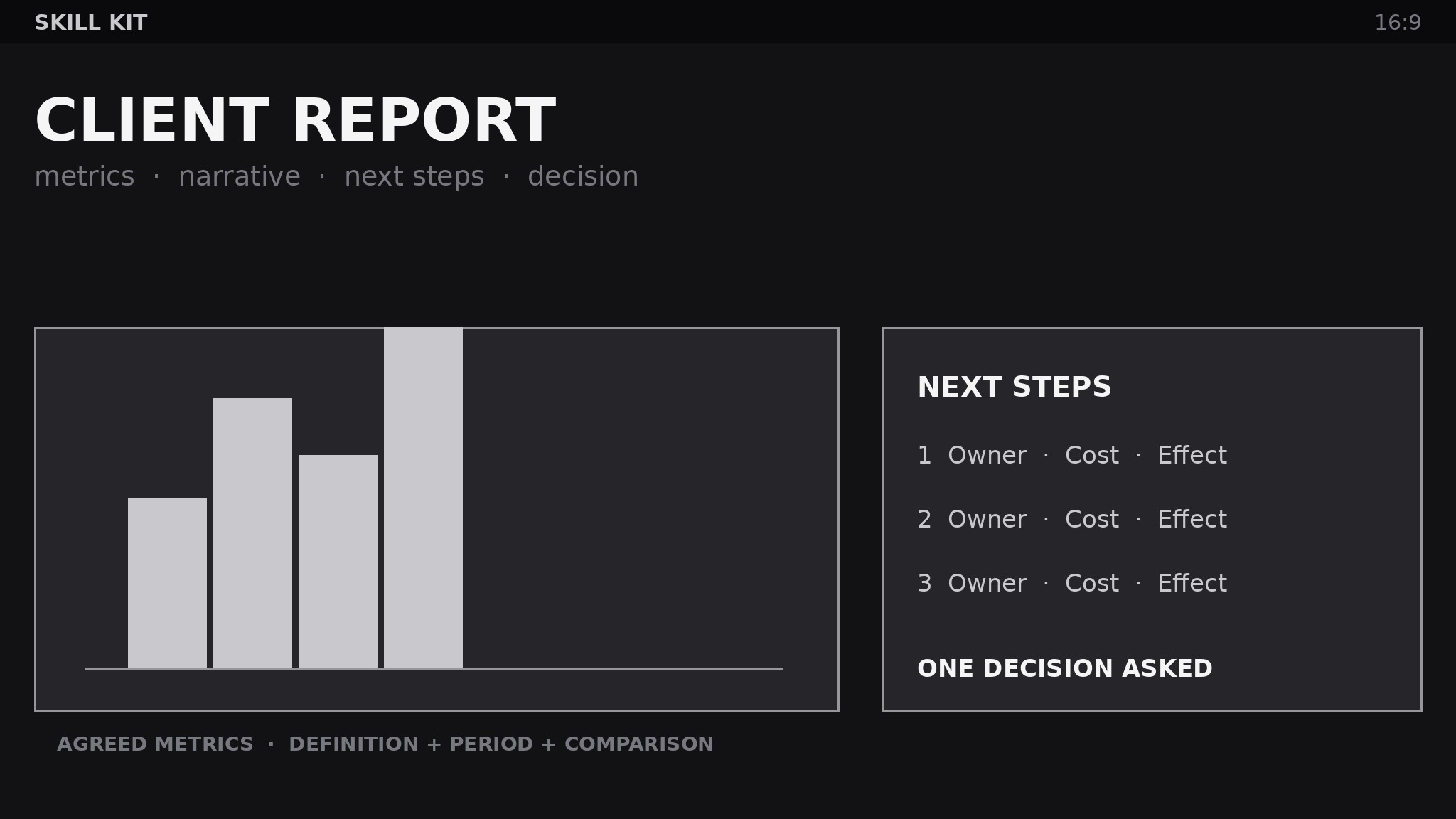
Transforme votre IA en créateur de kits de rapports clients — définit un kit de reporting autour des métriques que votre client a vraiment validées, assemble les skills dont il a besoin (instantané des métriques, récit, présentation, prochaines étapes, livraison) et fixe la barre que chacun doit franchir pour que chaque rapport se termine par une décision, pas par un haussement d'épaules.
Installez-la en 3 étapes
Sans inscription. Sans outils en ligne de commande. Choisissez votre IA, copiez une ligne, collez-la.
Vous préférez le faire vous-même ? Achetez la compétence ($4.99), téléchargez le ZIP depuis votre confirmation d'achat, décompressez-le dans le répertoire indiqué ci-dessus, redémarrez votre session IA — même résultat. Vous l'avez déjà achetée ? Votre assistant IA peut la télécharger pour vous.
Contenu du pack
Un fichier SKILL.md (le guide pratique) + un modèle de départ. Aperçu :
Client Reporting Kit
When to use
- Your client reports take a day to build and get a "thanks!" — no decision, no reply, no action
- Every report is rebuilt from scratch because there is no template, no agreed metrics, no standard
- You dread reporting week because it means re-deciding what to show, how to show it, and what it means
- Your reports are full of charts the client never asked for and short on the one number they care about
- You want a kit that turns reporting from a monthly scramble into a repeatable, decision-producing routine
Workflow
- Scope the kit (input: client, contract, goals → output: kit scope sheet)
Agree the metrics before the first report is ever built: three to five numbers, each tied to a goal the client named, each with an owner and a definition nobody can argue about ("qualified leads = form submissions from the contact page, excluding internal test entries"). The scope sheet also names the report's cadence (weekly, monthly), its reader (the one person whose decision it must inform), and its job in one sentence: "this report tells the client what happened, what it means, and what we do next." A report whose metrics were never agreed is a report that gets argued about instead of acted on. - Inventory the reporting skills (input: scope sheet → output: skill inventory)
List the skills the kit needs, one per reporting job: Metrics snapshot (turns raw data into the agreed numbers, each with its definition, its period, and its comparison — last period and same period last year where it means something), Narrative (turns the numbers into plain-language story: what moved, why it moved, what did not move and why that is fine), Deck (turns narrative + numbers into a readable report: one idea per page, every chart labeled with its takeaway), Next steps (turns the narrative into two to four proposed actions, each with an owner, a cost, and an expected effect), Appendix (turns everything else into an appendix — raw tables, method notes, definitions — so the main report stays short without hiding anything), Delivery (turns the finished report into the send: a short email with the headline, the decision needed, and the deadline for it). If the kit has no next-steps skill, the report is a history lesson: interesting, then filed. - Write the contract for each skill (input: skill inventory → output: per-skill input/output contracts)
For every skill, write the input, the output, and the pass bar. The pass bars are decision bars: Metrics snapshot — "every number carries its definition, its period, and its comparison; no number appears without all three"; Narrative — "a non-expert client can explain what happened after one read, without calling you"; Deck — "every chart's takeaway is written on the chart itself — a chart that needs you in the room to explain it is a failed chart"; Next steps — "every action names an owner, a cost, and what happens if we do nothing; no action is 'monitor' or 'keep an eye on'"; Appendix — "anything a skeptical reader would ask for is findable in under a minute"; Delivery — "the email asks for exactly one decision, with a deadline." - Build the report template (input: contracts → output: kit playbook + report template)
Assemble one template that runs the whole report: cover (headline result + decision needed), snapshot (the agreed metrics, one table), narrative (what moved, why, what did not), next steps (actions with owners and costs), appendix (raw data, definitions, method). Fix the length ceiling (e.g. six pages plus appendix) — a report that can grow without limit will grow without limit. Provide the skeleton with real placeholder content so the first report starts from a shape, not a blank page. - Run one real report and harden (input: playbook → output: hardened kit + fixes log)
Produce the first report with the kit, send it, and log what actually happened: did the client decide, what did they ask that the report did not answer, which section did they skip, which chart confused them. Fix the template and the contracts, not the client. A kit is only real after one report has produced (or failed to produce) a decision. Review the agreed metrics every quarter — goals move, and a report measuring last quarter's goals is a report about someone else's business.
Aperçu du modèle
Client Reporting Kit — Report Pack
One report, one decision. Metrics agreed before the first number is ever pulled.
1. Kit scope sheet
Client: {name} | Reader (one person whose decision this informs): {name, role} Cadence: {weekly / monthly} | Length ceiling: {e.g. 6 pages + appendix} The report's job (one sentence): This report tells the client what happened, what it means, and what we do next.
Agreed metrics (3–5, each with definition + owner):
2. Metrics snapshot
Rule: no number appears without its definition, its period, and its comparison.
3. Narrative
What moved: {what changed + why} Why it moved: {cause, stated plainly}
Le pack de compétence lui-même (SKILL.md + modèle) est rédigé en anglais.
Vous aimerez aussi
 Autres
Continuity Asset Set
Un kit unique pour que chaque livrable donne l'impression de faire partie du même ensemble.
 Autres
Device-Canvas Product Launch
Un grand canevas d’appareil porte toute votre histoire de lancement.
 Autres
Frame-Token Editorial Launch
Un seul jeu de tokens, tous vos assets, zéro dérive.