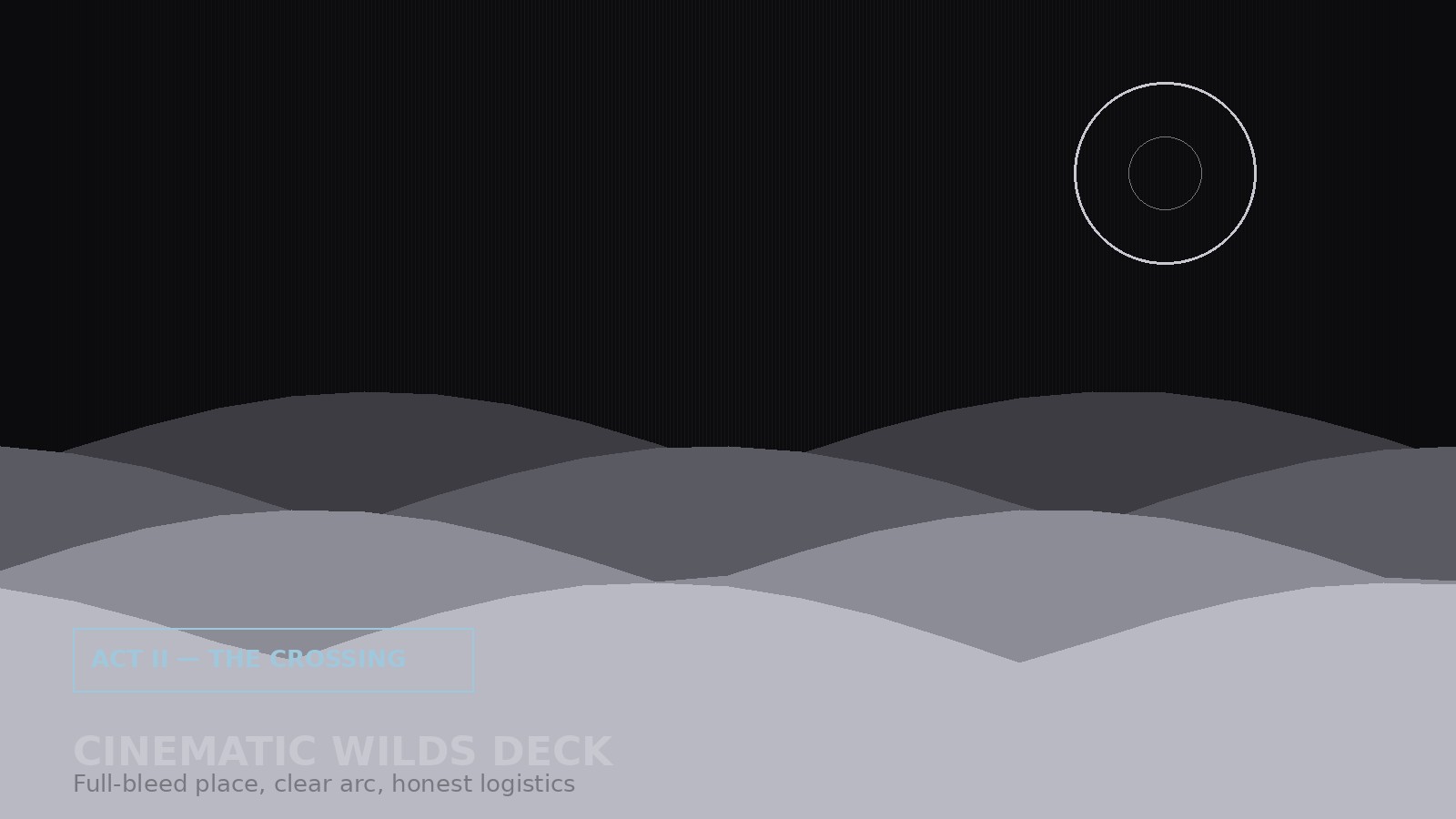
Cinematic Wilds Deck
Un pitch qui fait ressentir le lieu aux financeurs avant même qu'ils lisent un mot.
Crée un pitch cinématographique pour les récits de nature et de grands espaces — images de paysages en plein écran, un arc narratif clair, une logistique honnête sur l'accès, les permis et la sécurité, et des légendes qui rendent chaque image digne de confiance.
Installez-la en 3 étapes
Sans inscription. Sans outils en ligne de commande. Choisissez votre IA, copiez une ligne, collez-la.
Vous préférez le faire vous-même ? Achetez la compétence ($4.99), téléchargez le ZIP depuis votre confirmation d'achat, décompressez-le dans le répertoire indiqué ci-dessus, redémarrez votre session IA — même résultat. Vous l'avez déjà achetée ? Votre assistant IA peut la télécharger pour vous.
Contenu du pack
Un fichier SKILL.md (le guide pratique) + un modèle de départ. Aperçu :
Cinematic Wilds Deck
When to use
- You are pitching a nature documentary, expedition film, or wildlife series and the deck has to make a funder feel the place before they read a word
- Your conservation project needs a deck that shows the landscape at stake, not just the budget line
- You are presenting an outdoor expedition or adventure brand and your current slides look like a gear catalogue
- You need to pitch a wild-location shoot to a client or broadcaster who will ask hard questions about access, safety, and permits
- Your existing deck is all text about nature — and nobody in the room can picture the place
Workflow
- Find the place's story (input: location, subject, and purpose → output: story spine)
Write the deck's spine as one sentence per act: the place as it is, the pressure or question hanging over it, and what the audience will understand by the end. A wild place is not a backdrop — it is the subject. If the spine works with any location swapped in, it is too generic; rewrite it until only this place fits it. - Set the visual system (input: story spine → output: design rules)
Fix the system before laying out slides: full-bleed landscape imagery as the default, one restrained display typeface for headlines, one plain face for body text, and a rule that text never sits on busy detail — it goes on darkened sky, water, shadow, or a solid panel. Pick a restrained accent color drawn from the landscape itself (glacier blue, lichen green, desert ochre) and use it sparingly for labels and the arc thread. - Structure the arc (input: spine + material → output: slide outline)
Order the deck as a journey, not a brochure: open on the place (one image, one line), introduce what lives or happens there, raise the stakes (the threat, the mystery, the expedition's crux), show how you will tell it, then close on what the audience is being asked to do. Aim for 10–14 slides. One idea per slide; let the images carry the emotion and the text carry the facts. - Lay out for the room (input: outline → output: full deck)
Give each spread room to breathe: one dominant image per slide, headlines short enough to read at a glance, and body text limited to what a presenter would actually say in one breath. Put the honest logistics on their own slides — access, season, permits, safety, crew footprint — presented as competence, not fine print. Every image gets a caption: where it was taken, and whether it is your own material or a reference. - Make the forward work (input: full deck → output: send-ready PDF)
Read the deck with no presenter in the room: does the arc still land as a forwarded PDF? Add slide titles that state each slide's point, a one-line arc thread (e.g., "Act II — the crossing") on each slide, and a final slide with the ask and the next step. Export, check it on a phone screen, and fix anything that only worked at presentation size.
Aperçu du modèle
Cinematic Wilds Deck — Pitch Template
One place = one deck. The spine must fit only this place — if it works with any location swapped in, rewrite it.
The pitch
Place: {place} | Subject: {subject} | Audience / funder: {who} | The ask: {what you want} Story spine (one sentence per act):
- Act I — the place as it is: {sentence}
- Act II — the pressure or question: {sentence}
- Act III — what the audience will understand: {sentence}
Design system (fixed before layout — follow literally)
Slide outline (10–14 slides, one idea each)
Image log (every image captioned — no exceptions)
Le pack de compétence lui-même (SKILL.md + modèle) est rédigé en anglais.
Vous aimerez aussi
 Présentations
Pitch Deck
10 diapositives, une seule histoire — les investisseurs restent jusqu'à la dernière page
 Présentations
Work Report
Hebdomadaire, mensuel, bilans — la conclusion d'abord, compris en 3 minutes
 Présentations
Academic Argument Deck
Une présentation qui argumente — et qui répond aux objections.