Cadence Marketing Landing
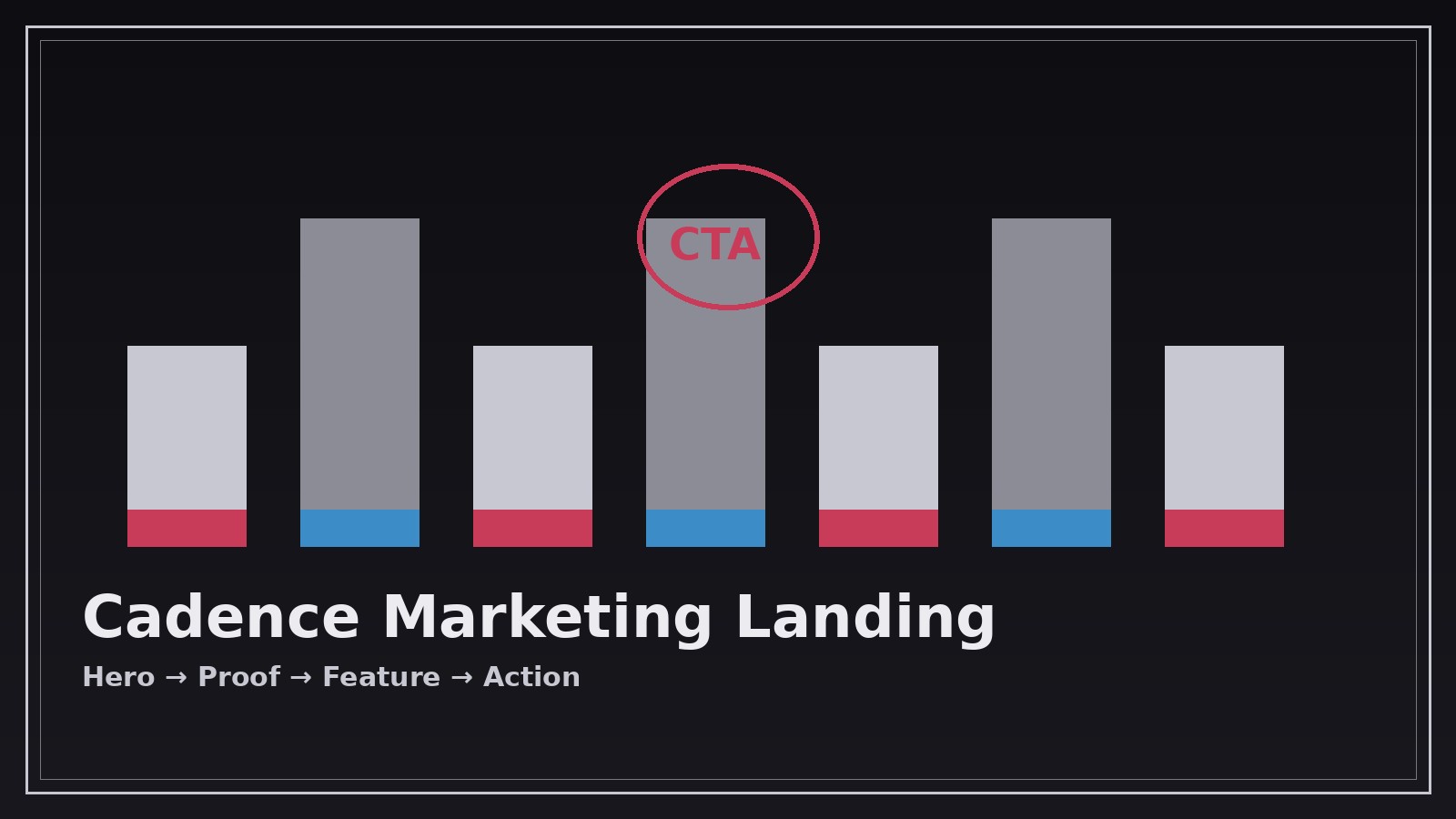
Une page d'atterrissage au rythme régulier : hero, preuve, fonctionnalité, action.
Un créateur de pages d'atterrissage qui produit une page marketing au rythme cadencé — hero, bande de preuves, alternance de temps forts fonctionnalités et preuves, et un appel à l'action à chaque temps — pour les lancements, les campagnes et les offres.
Installez-la en 3 étapes
Sans inscription. Sans outils en ligne de commande. Choisissez votre IA, copiez une ligne, collez-la.
Vous préférez le faire vous-même ? Achetez la compétence ($4.99), téléchargez le ZIP depuis votre confirmation d'achat, décompressez-le dans le répertoire indiqué ci-dessus, redémarrez votre session IA — même résultat. Vous l'avez déjà achetée ? Votre assistant IA peut la télécharger pour vous.
Contenu du pack
Un fichier SKILL.md (le guide pratique) + un modèle de départ. Aperçu :
Cadence Marketing Landing
When to use
- A product or feature is launching and you need a page that carries visitors from curiosity to signup
- A campaign (sale, event, webinar) needs one page with one job, not a whole website
- An ad is sending paid traffic somewhere and the current page leaks visitors before the call to action
- A waitlist or early-access offer needs to convert interest into email addresses
- A pricing change or new plan needs a page that explains it without a sales call
Workflow
- Define the one job (input: offer details or campaign brief → output: page brief)
Write down the single action the page must produce (buy, sign up, join the waitlist, book a call), who it's for, and the one promise that makes them act. Then list the top three objections a sceptical visitor would have. If the page has two jobs, it has none — split it. Everything below serves this brief. - Set the cadence (input: page brief → output: section map)
Lay out the page in a repeating beat that carries the scroll: hero (promise + action) → proof strip (logos, numbers, or one testimonial) → feature block (one benefit, one visual) → proof (a quote that answers objection #1) → feature block → proof → offer details → final action. Alternate show and tell: never stack three feature blocks without a proof beat between them. The call to action repeats at every beat — a visitor who is convinced at section three should never have to hunt for the button. - Write the hero (input: page brief → output: hero copy)
The hero carries four elements and nothing else: a headline stating the promise in the visitor's words (≤ 10 words), a one-line subhead with the concrete payoff, a primary button with a verb ("Start free", "Join the waitlist"), and one trust line (price, guarantee, or "no card required"). Write five headlines, pick the clearest — clever loses to clear on landing pages every time. - Build the page (input: section map + hero copy → output: working landing page)
Build mobile-first: one column, large type, one idea per screen, images that load fast. Each feature block pairs one benefit with one visual and ends with the same primary button. Each proof beat uses a real quote with a real name and role, or a verifiable number with its source. Forms ask for the minimum — every extra field costs conversions. Page weight stays light: no autoplay video, no heavy animations, no popups before the visitor has read anything. - Test and launch (input: working landing page → output: live page + verification pass)
Walk the page as a stranger on a phone: does the hero make sense in five seconds, does the button work, does the form submit and confirm, does the page load fast on a slow connection? Check the proof (names, numbers, logos — all real and approved), confirm analytics and the form destination, and publish. After launch, watch where visitors drop off before redesigning anything.
Aperçu du modèle
Cadence Marketing Landing — Template
One page = one page brief + one section map. Fill both in before writing copy.
Page: {offer / campaign}
URL: {url} | Launch date: {date}
Page brief
The ONE action: {buy / sign up / join waitlist / book a call}
Audience: {who it's for}
Promise (one sentence): {the payoff that makes them act}
Top 3 objections:
- {objection} — answered by: {proof / section}
- {objection} — answered by: {proof / section}
- {objection} — answered by: {proof / section}
Hero copy
Headline (≤ 10 words, visitor's words): {headline} — alternates tried: {4 others}
Subhead (one line, concrete payoff): {subhead}
Le pack de compétence lui-même (SKILL.md + modèle) est rédigé en anglais.