Agent Commerce Risk Checklist
La vérification pré-vol avant que les agents touchent à l'argent
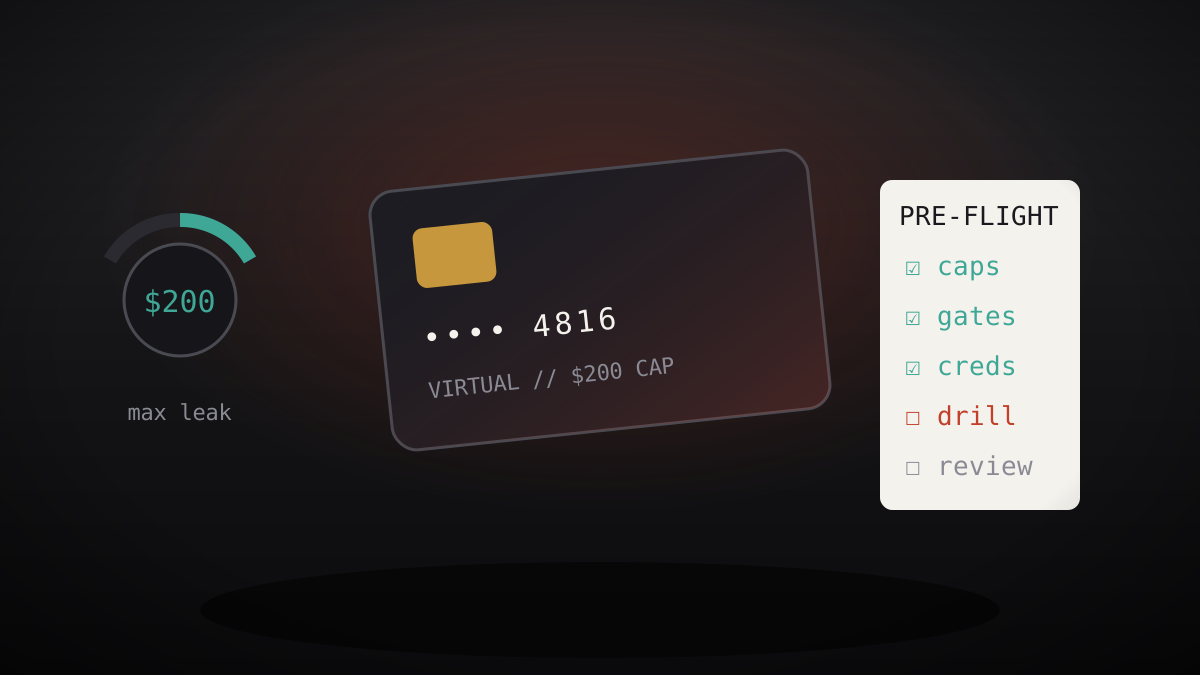
La checklist avant qu'un agent IA reçoive des identifiants de paiement : carte de l'argent, plafonds appliqués dans votre système (pas dans l'invite), portes d'approbation humaine, identifiants les plus restreints possible, journaux d'audit de 13 mois et une page « mauvais jour ».
Installez-la en 3 étapes
Sans inscription. Sans outils en ligne de commande. Choisissez votre IA, copiez une ligne, collez-la.
Vous préférez le faire vous-même ? Achetez la compétence ($4.99), téléchargez le ZIP depuis votre confirmation d'achat, décompressez-le dans le répertoire indiqué ci-dessus, redémarrez votre session IA — même résultat. Vous l'avez déjà achetée ? Votre assistant IA peut la télécharger pour vous.
Contenu du pack
Un fichier SKILL.md (le guide pratique) + un modèle de départ. Aperçu :
Agent Commerce Risk Checklist
When to use
- Before any AI agent gets payment credentials, card access, or "buy" buttons.
- After a surprise charge, a duplicate order, or an agent buying something nobody wanted.
- You're reviewing a vendor's "agentic commerce" feature and need the questions that matter.
- Quarterly: re-run it, because commerce agents accrete permissions silently.
Workflow
- Scope the money (input: what the agent can spend → output: money map)
List every payment path: stored cards, bank connections, platform credits, crypto wallets, "buy now" buttons in tools it can click. For each: whose money, what limits exist today (card limits don't count — they're the bank's, not yours), and what a single runaway session could spend. If you can't enumerate the paths, the agent doesn't get credentials yet. - Cap every transaction (input: money map → output: cap table)
Set three caps: per-transaction (above this = human approval, no exceptions), per-day, and per-merchant-per-week (catches the slow drip). Caps live in your system, not in the agent's prompt — a cap the agent can talk itself out of isn't a cap. Include subscriptions and auto-renewals explicitly: "buy" is not the only way money leaves. - Gate the consequential (input: cap table → output: approval matrix)
Define what always needs a human: over-cap amounts, new merchants, non-refundable purchases, anything affecting someone else's money, and any order the agent can't explain in one sentence. Approval goes to the human's own device with the full order visible; timeout = deny; the agent may not re-ask for the same order in the same session (no approval nagging into a yes). - Shrink the credentials (input: approval matrix → output: credential spec)
The agent gets the narrowest payment capability that works: virtual single-merchant cards, scoped tokens with spending limits, or a dedicated low-balance funding source — never the primary card, never the business account. Credentials are per-agent-instance, rotated on schedule, and revoked the moment the job ends. Test: if this credential leaked today, what's the maximum damage? That number must be boring. - Log everything money-adjacent (input: credential spec → output: audit spec)
Every quote, cart, order attempt, approval, decline, refund, and subscription change — timestamped, with the agent version and the human principal attached. Keep 13 months minimum (chargeback windows). Review weekly: total spend per agent, decline rate, and any merchant you don't recognize. The weekly review is the control; the log is just the evidence. - Rehearse the bad day (input: full checklist → output: incident one-pager)
Write the one-pager before you need it: runaway ordering (kill switch → which credentials to revoke → who refunds), credential leak (revoke → assess max damage → notify), disputed charge (receipt lookup → refund rule). Name the human who owns money incidents and the maximum time to containment. Then run the drill once — revoking a test credential — so the one-pager isn't fiction.
Aperçu du modèle
Agent Commerce Risk Worksheet
Run before the agent touches money. Re-run quarterly.
1. Money map
Can't enumerate the paths? No credentials yet.
2. Cap table (enforced in YOUR system, not the agent's prompt)
- Per-transaction cap (above = human approval, no exceptions):
- Per-day cap:
- Per-merchant-per-week cap:
- Subscriptions / auto-renewals / free trials: gated like purchases [ ] yes
3. Approval matrix
Always needs a human: over-cap / new merchant / non-refundable / someone else's money / unexplainable order.
- Approval goes to the human's own device, full order visible: [ ] yes
- Timeout = deny: [ ] yes
- No re-asking the same order in one session: [ ] yes
Le pack de compétence lui-même (SKILL.md + modèle) est rédigé en anglais.