Vehicle Anatomy Poster
Un vehículo completo, etiquetado, de un vistazo.
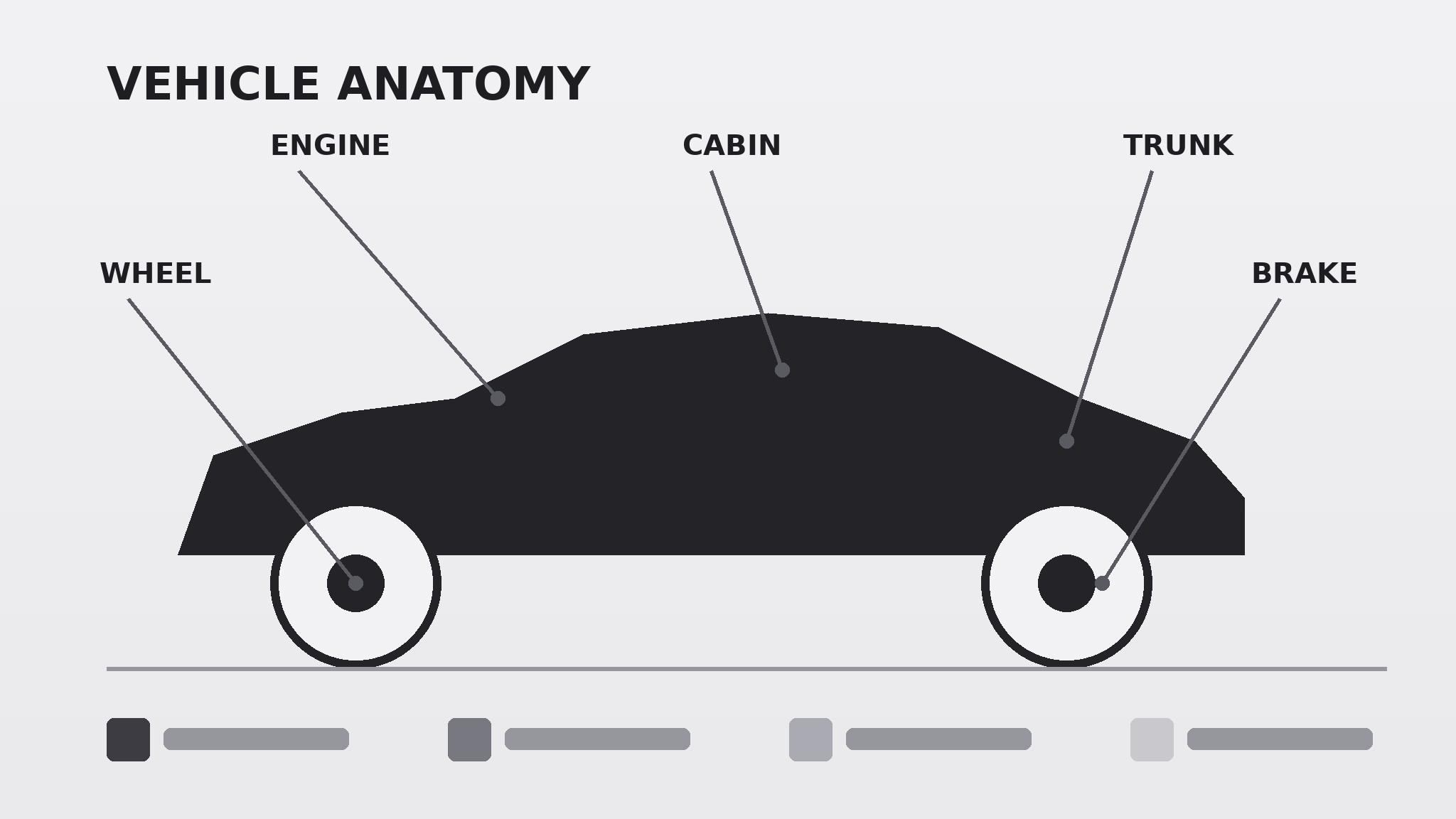
Convierte tu IA en diseñadora de pósteres que descompone un vehículo en un diagrama anatómico etiquetado (carrocería, transmisión, cabina y sistemas de seguridad), con anotaciones claras y una leyenda, para que una máquina compleja se entienda de un vistazo.
Instálala en 3 pasos
Sin registro. Sin herramientas CLI. Elige tu IA, copia una línea y pégala.
¿Prefieres hacerlo tú mismo? Compra la habilidad ($4.99), descarga el ZIP desde la confirmación de compra, descomprímelo en el directorio que se muestra arriba y reinicia tu sesión de IA — el mismo resultado. ¿Ya la compraste? Tu asistente de IA puede descargarla por ti.
Qué incluye
Un SKILL.md (la guía paso a paso) + una plantilla inicial. Una vista previa:
Vehicle Anatomy Poster
When to use
- You need a teaching poster for a classroom, garage, showroom, or training room that explains how a vehicle fits together
- You are writing a buyer's guide, a maintenance manual, or a beginner's explainer and need one diagram that orients the reader
- You want a wall-worthy poster that a curious person can read in two minutes and a student can study for an hour
- You are comparing vehicle types (sedan, SUV, hatchback, pickup, electric) and need a consistent diagram style across all of them
- You need a reference that names parts correctly — for new drivers, new technicians, or anyone who has ever nodded along while a mechanic talked
Workflow
- Pick the vehicle and the view (input: your audience + purpose → output: vehicle type + view choice)
Choose one vehicle type and one view: a side profile is the best all-rounder because it shows body, wheels, drivetrain, and cabin in one silhouette. A front three-quarter view looks more dramatic but hides half the parts; save it for a decorative poster, not a teaching one. Name the exact vehicle class on the poster ("Mid-size sedan" beats "Car") so the reader knows how far the diagram generalizes. - Group the systems (input: vehicle type → output: system groups + part list)
Sort the parts into four to six system groups: Body & chassis, Drivetrain & power, Suspension & steering, Braking, Cabin & controls, and Safety systems. Pick 12–20 parts total — enough to be genuinely useful, few enough that the labels stay readable. For each part, write one plain-language line: what it is and what it does, in under 12 words. If a part needs a paragraph to explain, it belongs in the manual, not on the poster. - Draw the silhouette and place the callouts (input: part list → output: composed diagram)
Draw one clean side-profile silhouette in a single dark tone, with wheels, windows, and the ground line clearly visible. Place callout lines from each part to its label, keeping the lines short, straight or single-elbowed, and never crossing. Put labels outside the silhouette in two columns — front systems on one side, rear and cabin systems on the other — so the eye travels naturally around the vehicle instead of hunting for labels. - Color-code by system (input: composed diagram → output: color-coded poster)
Give each system group one color and use it consistently: the callout line, the label marker, and the legend swatch all share the group's color. Keep the palette to four to six muted colors on a light background, or light colors on a dark background — never both. The silhouette itself stays one neutral tone so the color means "system," not "decoration." - Add the legend and the reading path (input: color-coded poster → output: print-ready poster)
Add a legend naming each system group and its color, a title stating the vehicle class, and a one-line reading guide ("Start at the engine, follow the drivetrain back to the wheels."). Add a small scale or size note (length, wheelbase) and a footer line stating the drivetrain type shown (front-wheel drive, rear-wheel drive, all-wheel drive, or electric) so the reader knows what the diagram does and does not cover. Export at print resolution with margins for framing.
Vista previa de la plantilla
Vehicle Anatomy Poster — Template
One vehicle class, one clean diagram. Fill in the blanks, then draw the poster.
Vehicle and view
- Vehicle class (title): {e.g. Mid-size sedan}
- View: side profile
- Drivetrain shown: {front-wheel drive / rear-wheel drive / all-wheel drive / electric / hybrid}
- Size note (optional, real figures only): length {m} · wheelbase {m}
Part list (12–20 parts, 4–6 system groups)
Rule: parts must match the drivetrain shown — electric means battery pack and motors, no fuel tank or exhaust.
Diagram spec
- Silhouette: one neutral dark tone, wheels + windows + ground line visible
El paquete de la habilidad (SKILL.md + plantilla) está escrito en inglés.