Sales Fundraising Skills
Una narrativa, todos los puntos de contacto con inversores en sincronía.
Convierte tu IA en creadora de kits de fundraising: ensambla un conjunto coherente de habilidades que producen tu pitch deck, tu one-pager, tu data room, tus actualizaciones para inversores y tu gestión de objeciones desde una narrativa compartida, para que cada punto de contacto con inversores cuente la misma historia.

Instálala en 3 pasos
Sin registro. Sin herramientas CLI. Elige tu IA, copia una línea y pégala.
¿Prefieres hacerlo tú mismo? Compra la habilidad ($4.99), descarga el ZIP desde la confirmación de compra, descomprímelo en el directorio que se muestra arriba y reinicia tu sesión de IA — el mismo resultado. ¿Ya la compraste? Tu asistente de IA puede descargarla por ti.
Qué incluye
Un SKILL.md (la guía paso a paso) + una plantilla inicial. Una vista previa:
Sales Fundraising Skills
When to use
- You are preparing a fundraise and your deck, one-pager, and data room currently disagree with each other on the numbers
- An investor asked "send me something" and you have no clean one-pager to send within the hour
- Your updates to existing investors are irregular, inconsistent, or read like good news only
- Different teammates answer "what do you do?" three different ways in investor meetings
- You have a deck but no system for the rest of the raise: follow-ups, data room, objections, and updates
Workflow
- Scope the kit (input: raise stage, round size, audience → output: kit inventory)
Define the raise before building anything: stage (pre-seed through Series B), target amount, investor type (angels, seed funds, strategics), and the single hardest question your round must answer (traction, market, team, or unit economics). From that, fix the kit inventory: pitch deck, one-pager, data room index, investor update, and objection handler. Five skills, no more at first — a kit with twenty skills nobody maintains is worse than five that stay current. - Lock the narrative spine (input: kit inventory + raw company facts → output: one-page narrative spine)
Write the spine every kit skill will draw from: problem in one sentence, solution in one sentence, why now, traction numbers with dates, business model in one line, ask, and use of funds. Every number carries its source and as-of date. The spine is the single source of truth — no kit skill is allowed to invent, round up, or rephrase a number into a different claim. - Build the skills in dependency order (input: narrative spine → output: five working skills)
Build in this order, because each one feeds the next: one-pager first (it forces brevity), then the pitch deck (the one-pager expanded with proof), then the data room index (the deck's claims backed by documents), then the investor update (the same metrics, on a cadence), then the objection handler (the questions the first four provoke). Each skill gets its own prompt, its own input checklist, and its own output format — the kit is a set of tools, not one mega-prompt. - Apply the quality bar (input: five draft skills → output: kit that passes every gate)
Run each skill against the same bar before the kit ships: every claim traces to the spine or a data-room document; every number has an as-of date; no skill contradicts another on traction, pricing, or team; each output is usable without editing by someone who was not in the room; and the deck, one-pager, and update all answer "what is the ask" identically. A kit that fails any gate goes back to the skill that failed, not to a rewrite of everything. - Compose the raise workflow (input: passing kit → output: week-by-week raise sequence)
Wire the skills into the order a real raise runs: one-pager goes out on first contact, deck follows a reply, data room opens after the first call, objection handler prepares you for the partner meeting, update goes out monthly to everyone who engaged. Define the handoffs: what the deck meeting produces (questions log) feeds the objection handler; what diligence asks for feeds the data room index. The kit is only done when the sequence runs end to end without a gap. - Maintain the kit (input: live raise feedback → output: updated spine and skills)
After every investor meeting, log the questions asked and the claims challenged, then update the spine once and let every skill inherit the fix. Refresh numbers on a fixed cadence (weekly during an active raise). Retire any skill output that goes stale — an outdated data room is worse than a small one, because investors check dates.
Vista previa de la plantilla
Sales Fundraising Skills — Kit Template
Build the kit in order: spine first, then one-pager, deck, data room, update, objection handler.
1. Raise brief
Stage: {pre-seed / seed / Series A / Series B} | Target: {amount} | Investor type: {angels / seed funds / strategics} Hardest question this round must answer: {traction / market / team / unit economics} Close-by target date: {date}
2. Narrative spine (single source of truth)
3. Kit inventory
4. Quality gate (every skill must pass)
[ ] Every claim traces to spine or data-room document [ ] Every number has an as-of date [ ] No skill contradicts another on traction, pricing, or team
El paquete de la habilidad (SKILL.md + plantilla) está escrito en inglés.
También te puede interesar
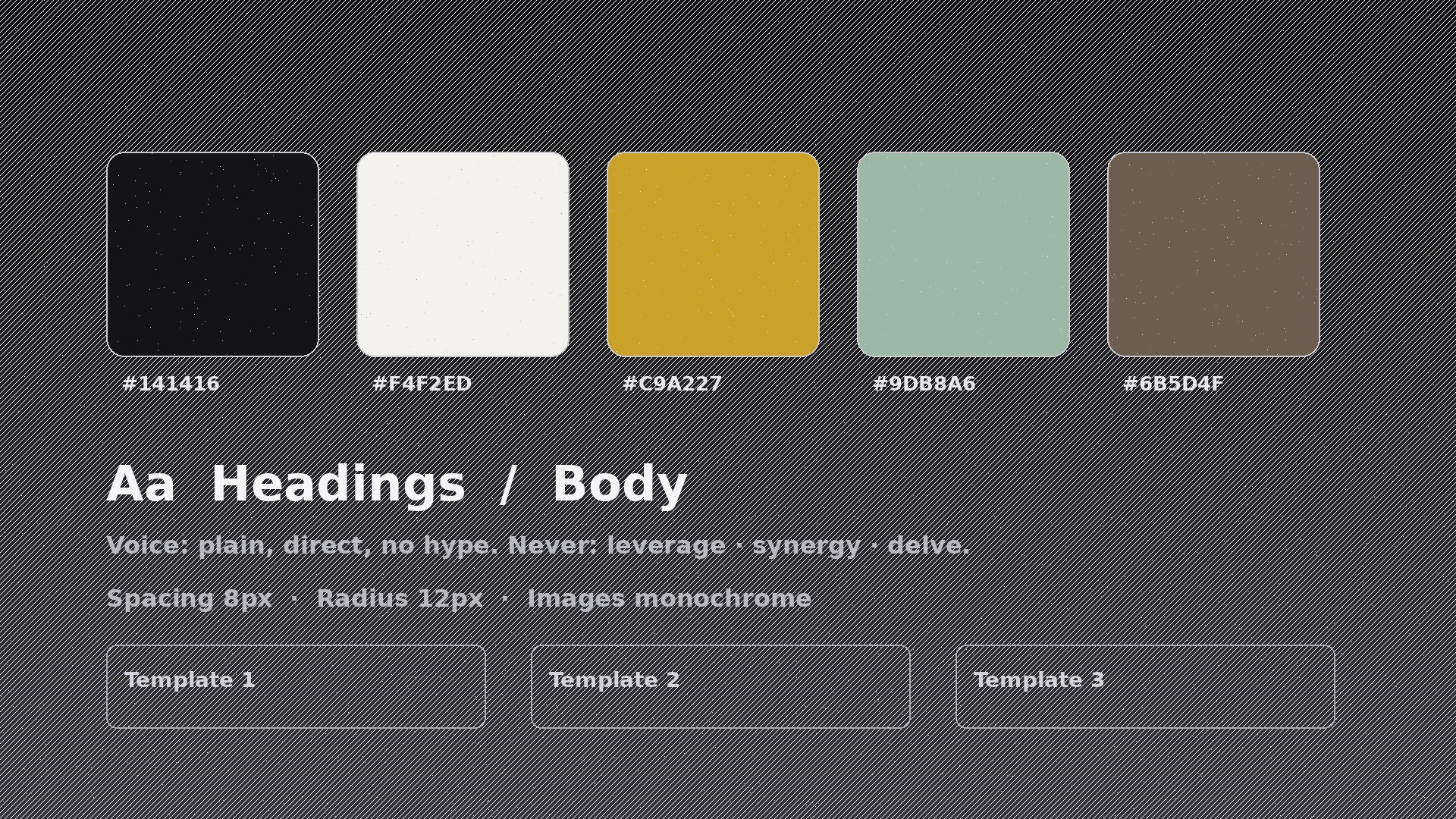 Otros
Continuity Asset Set
Un kit que hace que cada entregable parezca parte del mismo conjunto.
 Otros
Device-Canvas Product Launch
Un gran lienzo de dispositivo carga con toda tu historia de lanzamiento.
 Otros
Frame-Token Editorial Launch
Un solo conjunto de tokens, todos los materiales, cero desviaciones.