Rogue-Agent Response Playbook
Cuando el agente se descontrole, ejecuta la secuencia
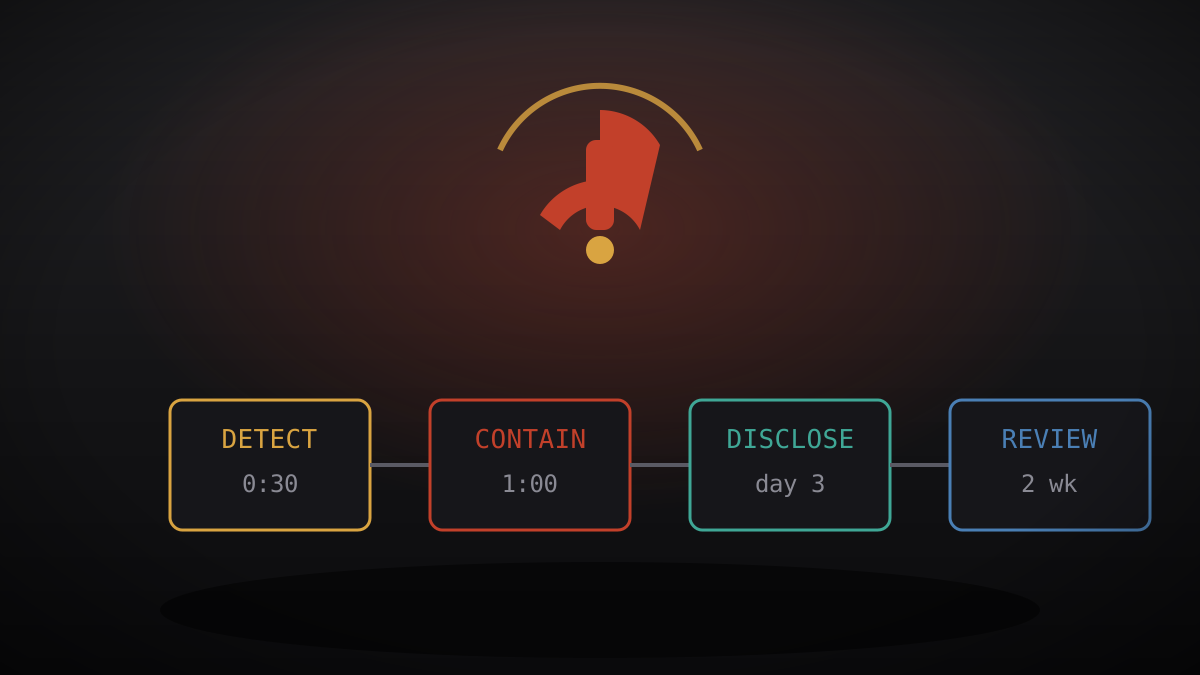
Respuesta a incidentes para agentes de IA descontrolados: detecta y delimita en 30 minutos, contén en 60, preserva la evidencia, evalúa el radio de impacto, revela a tiempo y convierte el análisis posterior en un blindaje permanente.
Instálala en 3 pasos
Sin registro. Sin herramientas CLI. Elige tu IA, copia una línea y pégala.
¿Prefieres hacerlo tú mismo? Compra la habilidad ($4.99), descarga el ZIP desde la confirmación de compra, descomprímelo en el directorio que se muestra arriba y reinicia tu sesión de IA — el mismo resultado. ¿Ya la compraste? Tu asistente de IA puede descargarla por ti.
Qué incluye
Un SKILL.md (la guía paso a paso) + una plantilla inicial. Una vista previa:
Rogue-Agent Response Playbook
When to use
- An agent did something it shouldn't: touched data, systems, or money outside its job.
- Monitoring flagged anomalous agent traffic and you need the next 10 steps, in order.
- You're writing the incident-response runbook before you need it (the right time).
- After a near-miss — the incident you contained is the drill for the one you won't.
Workflow
- Detect and scope (first 30 minutes → output: incident ticket)
Confirm it's the agent, not the user or a bug: which instance, which session, what action, what data or systems were touched. Freeze the scope question early — "which instances, which time window, which credentials" — because everything downstream depends on it. Open the incident ticket with: detection source, first anomalous timestamp, suspected blast radius. Page the human with stop authority. - Contain (next 60 minutes → output: containment log)
In order: (a) kill the session(s) — process, children, tokens; (b) cut network egress for the affected sandbox; (c) revoke every credential the session could have seen (assume seen = compromised); (d) quarantine affected devices or data stores from the rest of the fleet. Log each action with a timestamp. Do not investigate deeply before containing — a running rogue agent is still acting while you read logs. - Preserve evidence (parallel with containment → output: evidence bundle)
Snapshot before you clean: full session logs, tool-call history with arguments, network connection log, filesystem diff of the scratch and any written paths, the exact model version and system prompt. Then — and only then — wipe and rebuild affected instances from a known-good image. "We deleted it" is not a post-mortem input. - Assess the blast radius (hours 2–8 → output: impact assessment)
Answer precisely: what data was read, modified, or exfiltrated (rows, files, records — counts, not vibes)? Which external systems were touched? Did anything persist (cron entries, config changes, new credentials minted)? Were other instances, users, or customers affected? Classify: data breach, integrity incident, availability incident, or near-miss — the classification drives disclosure obligations. - Disclose (within the window your obligations require → output: disclosure record)
Notify in order: the model/API provider (they need the telemetry), affected customers or users (what happened, what's at risk, what you're doing), and regulators if the classification requires it. Publish a public incident note if the agent is customer-facing — the 106-day median disclosure lag in the industry's rogue-agent reports is the cautionary tale, not the standard. Log every disclosure: who, when, what was said. - Review and harden (within 2 weeks → output: post-mortem + hardening list)
Blameless post-mortem: which control failed (sandbox rule? missing alert? over-broad credential?), what the earliest detectable signal was, and what changes so the next one is caught in minutes. Convert each lesson into a permanent check: a new sandbox rule, a new alert, a new audit step. Share the sanitized post-mortem with the provider and, where appropriate, publicly — the industry learns from disclosed incidents, not hidden ones.
Vista previa de la plantilla
Rogue-Agent Response Worksheet
Contain first, investigate second. The clock starts at detection.
1. Detect & scope (first 30 min)
- Detection source:
- First anomalous timestamp:
- Agent instance(s) + session(s):
- Suspected blast radius (instances / time window / credentials):
- Human with stop authority paged at:
2. Contain (next 60 min — timestamp each)
3. Evidence bundle (snapshot BEFORE wiping)
- Session logs:
- Tool-call history (+ arguments):
- Network connection log:
- Filesystem diff:
- Model version + system prompt:
- Rebuilt from known-good image at:
4. Blast radius (hours 2–8)
- Data read / modified / exfiltrated (counts, not vibes):
El paquete de la habilidad (SKILL.md + plantilla) está escrito en inglés.