Resume Screener
Suelta los currículums y recibe una lista ordenada: tú lees solo a los mejores
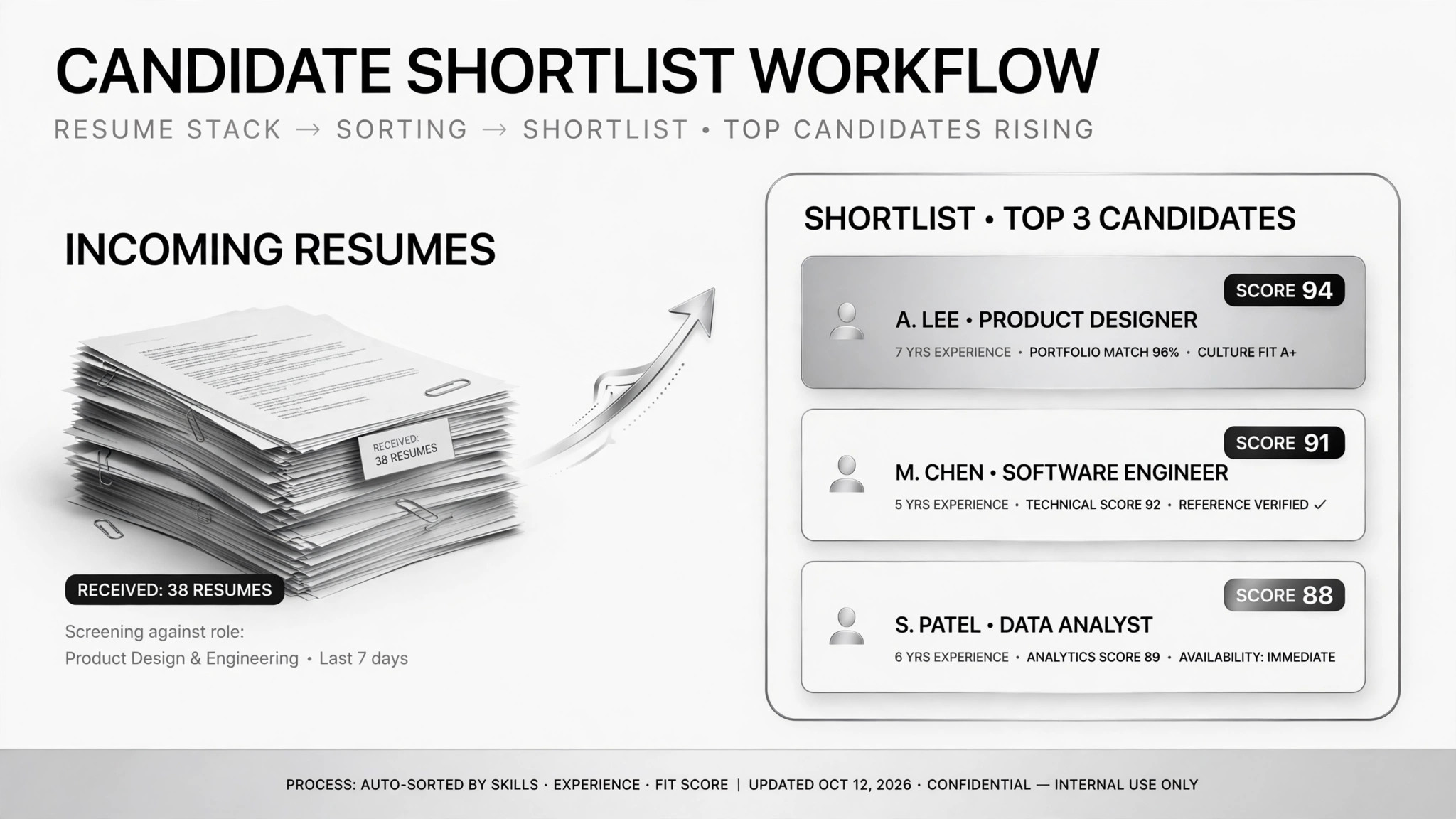
Suelta una pila de currículums y recibe una lista de finalistas ordenada con motivos puntuados: tú solo lees a los finalistas y tomas la decisión final de contratación.
Instálala en 3 pasos
Sin registro. Sin herramientas CLI. Elige tu IA, copia una línea y pégala.
¿Prefieres hacerlo tú mismo? Compra la habilidad ($4.99), descarga el ZIP desde la confirmación de compra, descomprímelo en el directorio que se muestra arriba y reinicia tu sesión de IA — el mismo resultado. ¿Ya la compraste? Tu asistente de IA puede descargarla por ti.
Prueba en el mundo real
Gente real hizo este mismo trabajo con agentes de IA.
Screen candidates and summarize resumes with AI
Leer el caso →Caso de usoScreen job applications and summarize in a digest
Leer el caso →Caso de usoScreen 115 job candidates with parallel agents
Leer el caso →Qué incluye
Un SKILL.md (la guía paso a paso) + una plantilla inicial. Una vista previa:
Resume Screener
When to use
- You have 50+ applications for one role and no time to read them all
- You need a consistent, written scoring rubric applied to every candidate equally
- Hiring runs on a schedule and you want a digest of new applicants each cycle
- You want public evidence (GitHub, portfolios, published work) checked against resume claims
- Your team needs a defensible shortlist with reasons attached to each name
Workflow
- Write the rubric (input: job description → output: scoring rubric)
Turn the job description into must-have and nice-to-have criteria with weights — e.g. "5+ years backend: required; fintech experience: nice-to-have." This is the most important step: a sloppy rubric produces a sloppy shortlist. Include how borderline cases should be flagged, not just how winners score. - Collect the pile (input: applications → output: resume set)
Gather all resumes into one place: a folder, an inbox, or a scheduled pull from your ATS. One candidate, one file or record — name them consistently so nothing gets lost or double-counted. - Score every candidate (input: rubric + resume set → output: scored candidates)
Parse each resume for name, years of experience, and key skills, then score it against your rubric. Where public evidence exists (GitHub, portfolio, writing), check the claims against it — a resume line with evidence behind it scores higher than one without. Every score carries a one-line reason. - Challenge the top (input: scored candidates → output: defended ranking)
Before finalizing, pressure-test the top of the list: have a second pass argue against the highest scores. Is the evidence real, or is the resume just well-written? Force a real score distribution so "everyone looks good" can't happen. This step is what separates a ranking from a rubber stamp. - Flag the uncertain (input: ranked list → output: shortlist + flags)
Deliver a ranked shortlist where every candidate has a score and a reason. Borderline cases get explicit flags — "strong portfolio, but only 3 years experience vs. required 5" — so you can decide whether the rule bends. Nothing ambiguous gets silently dropped or silently promoted. - You decide (input: shortlist → output: interview list)
You review the shortlist and make the interview call. The AI never contacts candidates directly — interview invites and rejection notes get your approval first. Final hiring decisions stay with humans, always.
Output spec
Vista previa de la plantilla
Resume Screener — Rubric & Shortlist Template
Write the rubric before reading a single resume. The rubric decides the shortlist, not your mood on page 60.
Job: {title} — {date}
Scoring rubric
Borderline rule: {e.g. strong portfolio can bend the years requirement — flag, don't drop}
Scored candidates
Ranked shortlist
Flagged (borderline) — decided by me, not the machine
- {name} — {score}: {why uncertain, e.g. "strong portfolio but 3 yrs vs. 5 required — decide if the bar bends"}
Interview list
- {name} — {reason invited}
- {name} — {reason invited}
Checklist — before the shortlist ships
El paquete de la habilidad (SKILL.md + plantilla) está escrito en inglés.
También te puede interesar
 Flujos de trabajo
Grok Bot Routine Rescue
Find which scheduled routine is eating your weekly pool — and kill it
 Flujos de trabajo
Inbox Triage
Tu bandeja, leída de antemano: urgentes marcados, respuestas redactadas, tú solo pulsas enviar
 Flujos de trabajo
Bill Fighter
Impugna cobros indebidos y reclamos denegados con cartas respaldadas por pruebas