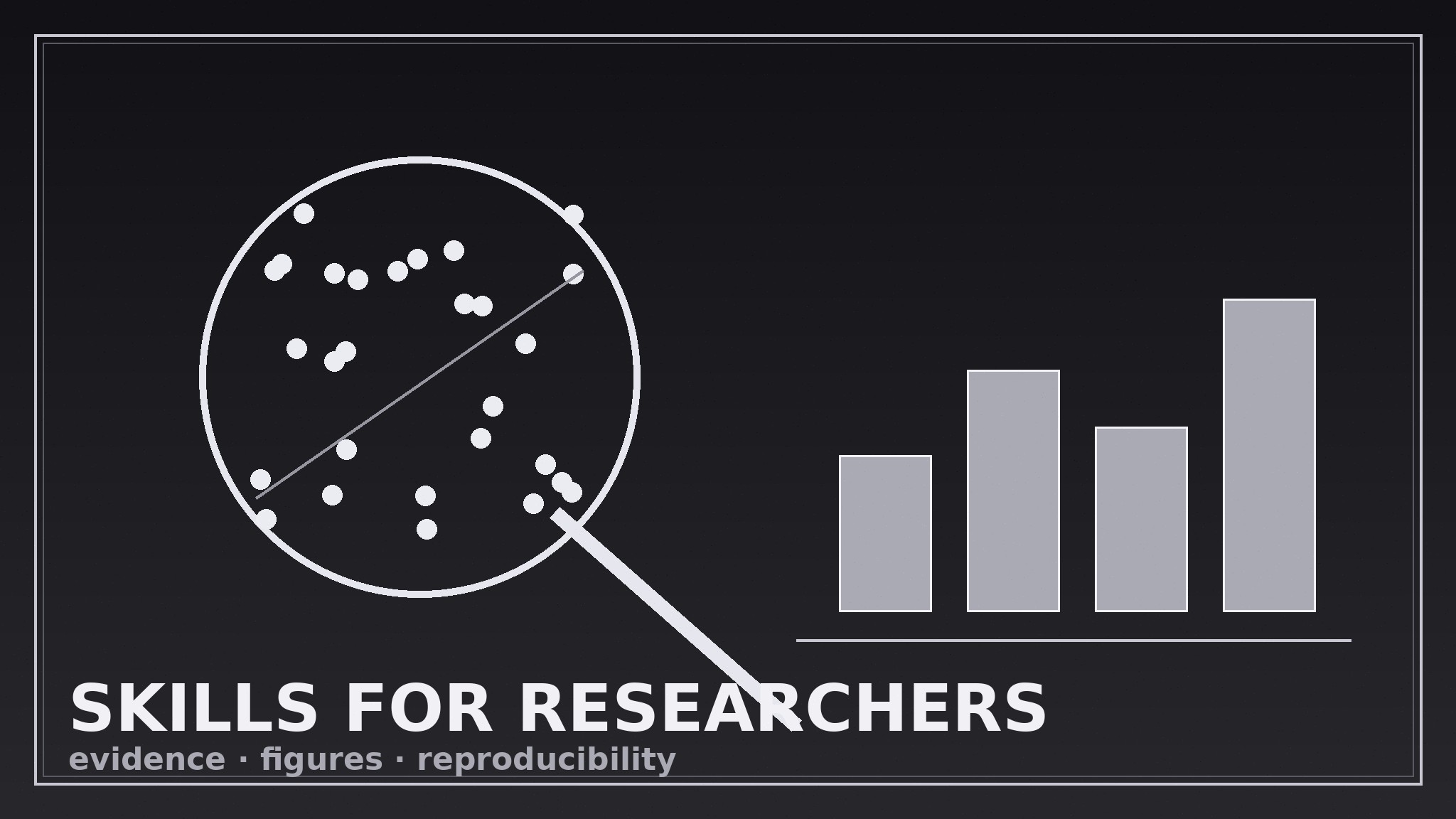
Skills for Researchers
Un kit para todo el estudio, de la pregunta a la reproducibilidad.
Convierte tu IA en creadora de kits de evidencia: define diez habilidades a lo largo de la cadena de evidencia, desde la selección de literatura y el análisis hasta las figuras, la redacción y la reproducibilidad, todas con el mismo estándar de calidad y compuestas en un solo flujo de estudio.
Instálala en 3 pasos
Sin registro. Sin herramientas CLI. Elige tu IA, copia una línea y pégala.
¿Prefieres hacerlo tú mismo? Compra la habilidad ($4.99), descarga el ZIP desde la confirmación de compra, descomprímelo en el directorio que se muestra arriba y reinicia tu sesión de IA — el mismo resultado. ¿Ya la compraste? Tu asistente de IA puede descargarla por ti.
Qué incluye
Un SKILL.md (la guía paso a paso) + una plantilla inicial. Una vista previa:
Skills for Researchers
When to use
- Your literature review is a folder of PDFs with filenames like "final_v3_REAL.pdf" and no record of what you kept or why
- Analysis decisions live in your head — which exclusions, which model, which sensitivity checks — so nobody, including future you, can reproduce them
- Figures get remade for every draft because the numbers behind them were never pinned down
- You want one kit that covers a whole study — question, literature, analysis, figures, write-up, reproducibility — to a single standard
- You're collaborating or supervising and need the study's methods written down so someone else can check or extend them
Workflow
- Audit a real study (input: one study you ran or are running → output: study inventory)
Pick a study you actually worked on and lay out everything it involved: the research question, search strategy, screened papers, extraction sheet, analysis code or steps, figures, drafts, and whatever reproducibility record exists (if any). Note where the study wobbled — papers re-screened because inclusion criteria were never written down, analyses rerun because an exclusion wasn't logged, a figure whose numbers nobody can regenerate. The audit decides what the kit must contain; a kit built for an ideal lab gets abandoned at the first deadline. - Scope the kit around the evidence chain (input: study inventory → output: kit scope)
A researcher's kit has one spine: question → literature → analysis → figures → write-up → reproducibility, where every later link must be traceable to the earlier ones. Scope ten skills around that spine: research question framer, search strategy builder, inclusion/exclusion screener, extraction sheet designer, analysis planner, figure maker, results writer, methods writer, reproducibility checker, and peer-review responder. Each skill owns exactly one artifact. Anything outside the chain — citation-count chasing, journal targeting — is a distraction; cut it. A kit that produces a polished write-up nobody can trace back to its data is a kit that manufactures doubt. - Set the quality bar (input: kit scope → output: quality standard)
Every skill in the kit must meet the same bar: every inclusion or exclusion decision cites the criterion it applied; every analysis choice names the alternative and why it was rejected; every figure states its data source, sample size, and what the reader should conclude; every methods paragraph is detailed enough that a competent peer could repeat the step. Write the bar as a checklist and run each skill's first output through it. A kit where the write-up is elegant and the analysis log is empty will not survive review — and shouldn't. - Build the inventory in study order (input: quality standard → output: ten working skills)
Build in the order a study runs: question framer first, then search strategy, screener, extraction sheet, analysis planner, figure maker, results writer, methods writer, reproducibility checker, peer-review responder. Test each skill on the audited study — re-screen its real papers with the new criteria, rebuild one of its real figures — because a kit tested on a toy dataset produces toy rigor. The test that matters: could a colleague reproduce your analysis from the artifacts alone, without asking you what you meant? - Compose the workflow and run one study end to end (input: ten skills → output: one finished study run)
Take one live study and run it through the full chain: question → search → screen → extract → analyze → figures → results → methods → reproducibility check → review responses. Watch the two seams where research kits usually break: literature-to-analysis (extracted data that doesn't match the analysis plan's variables) and figures-to-write-up (text describing numbers the figure doesn't show). Fix them by making each skill consume the previous skill's output — the analysis plan names the extraction sheet's columns, the results text quotes the figures' pinned numbers — then the kit is one study workflow, not ten prompts in a folder.
Vista previa de la plantilla
Skills for Researchers — Kit Template
One kit = ten skills along the evidence chain. Fill this in from one real study, then build in study order.
1. Study inventory (one study you ran or are running)
Study: {title / question} | Design: {e.g. systematic review / experiment / survey / qualitative}
Wobble found: {e.g. papers re-screened — criteria never written down; figure numbers unregenerable}
2. Kit scope (ten skills, one artifact each)
Cut list (outside the chain): {e.g. citation-count chasing, journal targeting}
3. Quality standard (checklist — every skill's output must pass)
El paquete de la habilidad (SKILL.md + plantilla) está escrito en inglés.
También te puede interesar
 Otros
Continuity Asset Set
Un kit que hace que cada entregable parezca parte del mismo conjunto.
 Otros
Device-Canvas Product Launch
Un gran lienzo de dispositivo carga con toda tu historia de lanzamiento.
 Otros
Frame-Token Editorial Launch
Un solo conjunto de tokens, todos los materiales, cero desviaciones.