Product Launch Kit
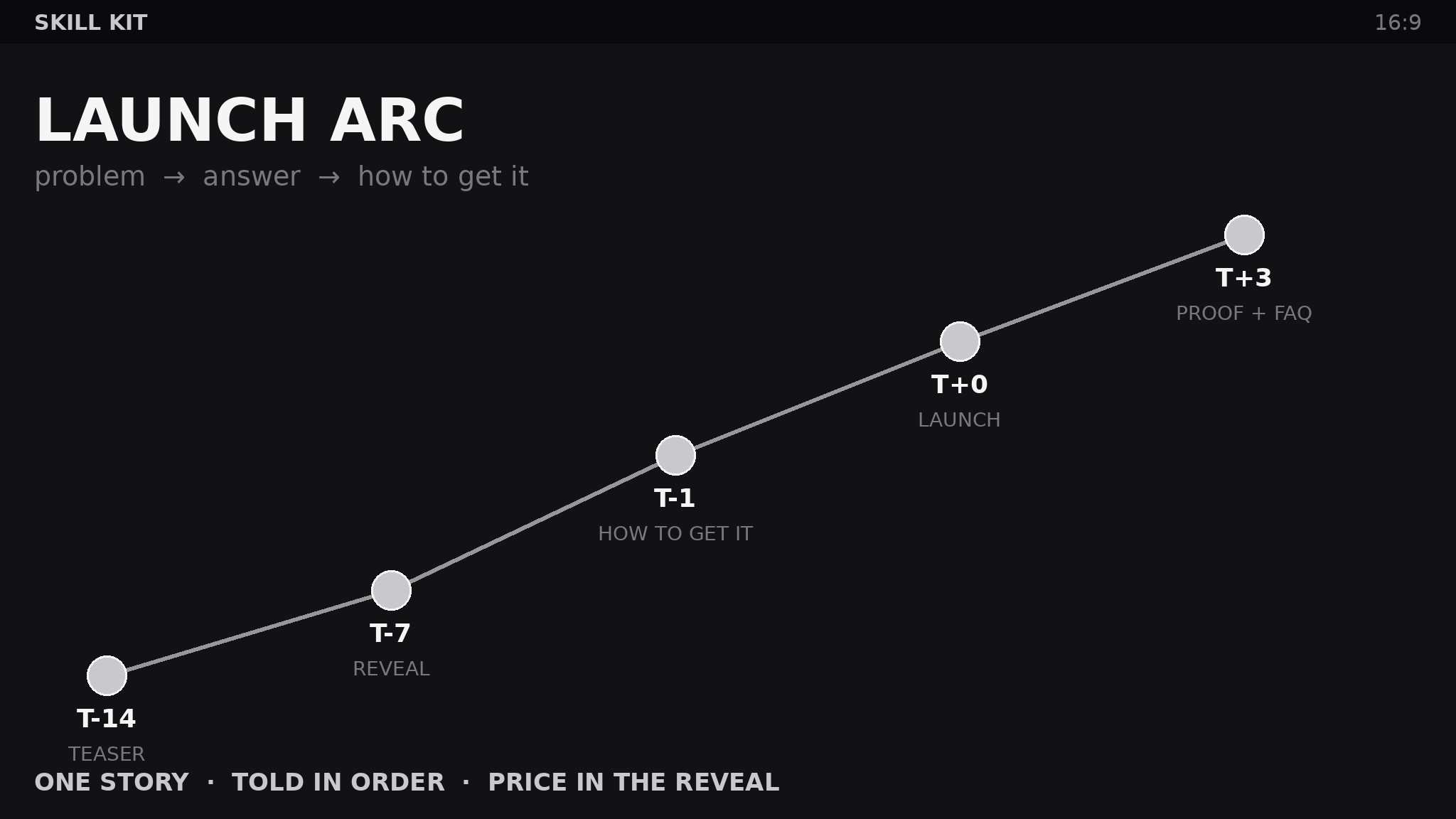
La semana de lanzamiento como una sola historia, contada en orden.
Convierte tu IA en creadora de kits de recursos de lanzamiento: define un kit de lanzamiento en torno a un arco narrativo claro, ensambla los recursos que necesita (teaser, revelación, landing, email, cortes para redes, lista de verificación del día de lanzamiento) y fija el estándar que cada uno debe superar para que la semana de lanzamiento se sienta como una sola historia, no un montón de publicaciones.
Instálala en 3 pasos
Sin registro. Sin herramientas CLI. Elige tu IA, copia una línea y pégala.
¿Prefieres hacerlo tú mismo? Compra la habilidad ($4.99), descarga el ZIP desde la confirmación de compra, descomprímelo en el directorio que se muestra arriba y reinicia tu sesión de IA — el mismo resultado. ¿Ya la compraste? Tu asistente de IA puede descargarla por ti.
Qué incluye
Un SKILL.md (la guía paso a paso) + una plantilla inicial. Una vista previa:
Product Launch Kit
When to use
- Your launch is four weeks away and the assets are a vague list in someone's head
- Your last launch felt like a pile of disconnected posts — teaser, then silence, then "it's live!" — and sales matched the confusion
- You want every launch asset to tell the same story, in the same order, on every channel
- You are launching to an existing audience and cannot afford to waste their attention on a muddled announcement
- You need a kit you can reuse for the next launch, not a one-off scramble you swear you will never repeat
Workflow
- Scope the kit (input: product, audience, launch date → output: kit scope sheet)
Fix the launch date, then plan backwards: every asset gets a ship date relative to launch day (T-14, T-7, T-1, T+0, T+3). The scope sheet names the product in one sentence, the one audience it is for, the single problem it solves, and the narrative arc in three beats: the problem is real (teaser), the answer exists (reveal), here is how to get it (launch). One product, one audience, one problem — a launch that tries to announce three things announces none of them. If the date cannot move, cut assets, never cut the arc. - Inventory the launch skills (input: scope sheet → output: skill inventory)
List the skills the kit needs, one per asset: Teaser (turns the problem beat into curiosity-building posts that never show the product), Reveal (turns the answer beat into the first full look — name, shape, price, and the one thing that makes it different), Landing page (turns the whole arc into one page: problem, answer, proof, price, FAQ, buy), Email sequence (turns the arc into three to five emails matched to the T-minus schedule), Social cuts (turns the reveal and landing into channel-native clips and cards), Objection handling (turns every "but…" you have heard into an FAQ answer and a one-line reply), Launch-day checklist (turns the schedule into a minute-by-minute run sheet with owners and fallbacks). If the kit has no objection skill, launch day is when you first discover what people actually worry about — too late. - Write the contract for each skill (input: skill inventory → output: per-skill input/output contracts)
For every skill, write the input, the output, and the pass bar. The pass bars are story bars: Teaser — "builds curiosity about the problem without leaking the product; a reader can say what problem is coming, not what the answer is"; Reveal — "a stranger can state the product, its price, and why it is different after one look"; Landing page — "every claim on the page is one a buyer can verify before paying"; Email sequence — "each email earns its send (one new piece of information, not a reminder wearing a subject line)"; Social cuts — "each cut works with the sound off and the caption unread"; Objection handling — "every answer is honest, including the ones that say 'not yet' or 'not for you'." A launch asset that fails its bar is not a draft — it is a leak in the story. - Build the launch run sheet (input: contracts → output: kit playbook + asset templates)
Assemble one run sheet: every asset, its ship date, its owner, its dependency (the landing page cannot ship before the reveal nails the price), and its fallback (if the video is late, the stills + caption ship instead). Provide templates: teaser post skeleton, reveal brief, landing wireframe, email skeleton per send, cut checklist, FAQ skeleton, run-sheet table. The run sheet is the kit's spine — during launch week nobody should have to ask what ships next or who ships it. - Rehearse and harden (input: playbook → output: hardened kit + fixes log)
Before launch week, rehearse the whole arc on five people from the audience: show the teaser, then the reveal, then the landing, and watch where they hesitate, what they ask, and where they click. Every hesitation is an asset that failed its bar — fix the asset and the template behind it, and log the change. A launch rehearsed on five real people beats a launch reviewed in ten internal meetings. After launch, run the post-mortem within a week: what shipped late, which asset did the selling, what gets cut next time.
Vista previa de la plantilla
Product Launch Kit — Run Sheet Pack
One product, one audience, one problem. One story, told in order.
1. Kit scope sheet
Product (one sentence): {what it is} Audience (one sentence): {who it is for} Single problem it solves: {problem} Launch date (T+0): {date} Narrative arc: Problem is real (teaser) → Answer exists (reveal) → Here is how to get it (launch) Rule: if the date cannot move, cut assets, never cut the arc.
2. Teaser brief
Ship date: {T-14} Problem beat: {the problem, made vivid — product never shown} Curiosity line: {what the reader will learn next week} Leak check: {can a reader name the product from this? must be no}
El paquete de la habilidad (SKILL.md + plantilla) está escrito en inglés.
También te puede interesar
 Otros
Continuity Asset Set
Un kit que hace que cada entregable parezca parte del mismo conjunto.
 Otros
Device-Canvas Product Launch
Un gran lienzo de dispositivo carga con toda tu historia de lanzamiento.
 Otros
Frame-Token Editorial Launch
Un solo conjunto de tokens, todos los materiales, cero desviaciones.