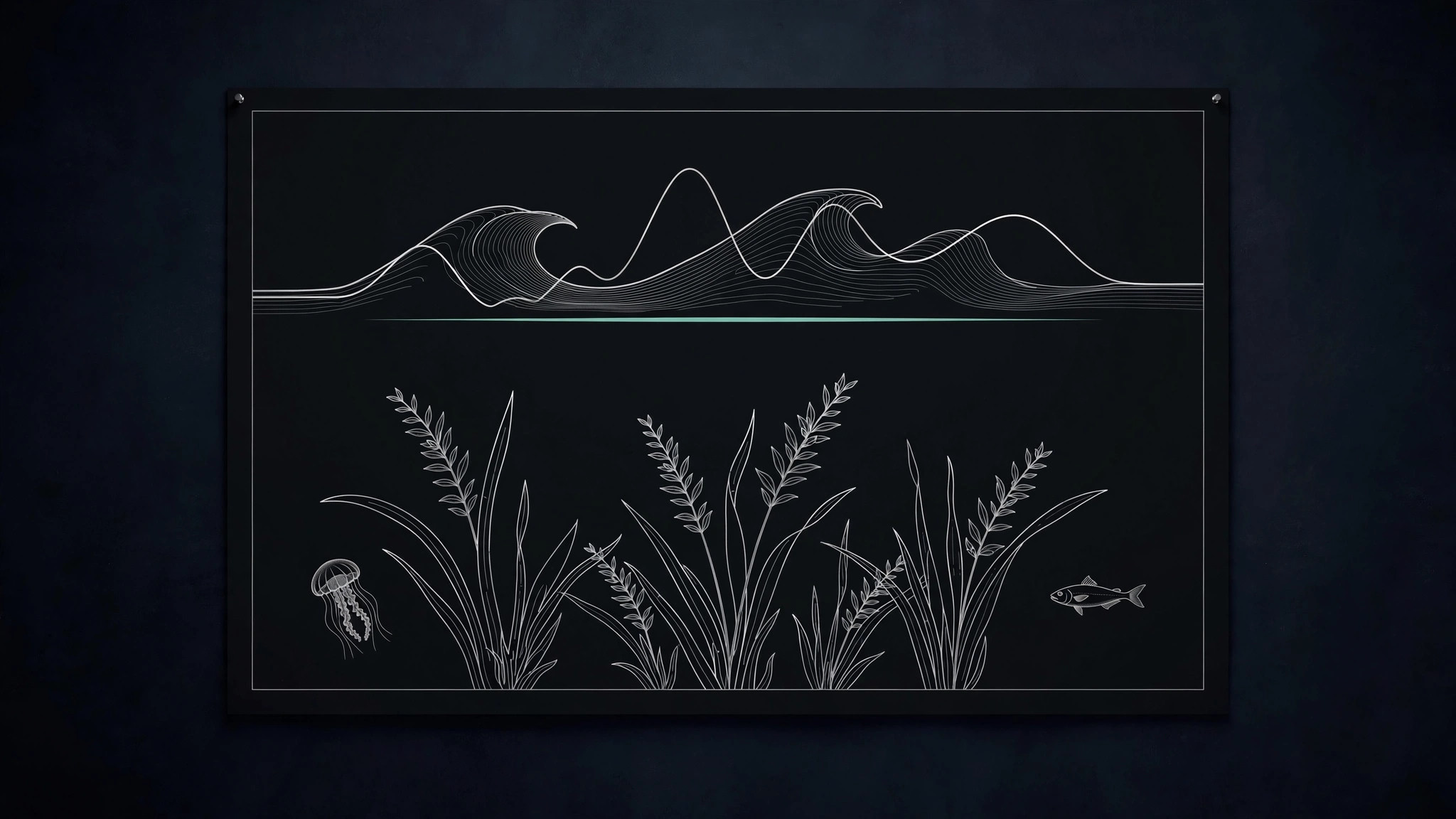
Marine Research Poster
Tu estudio, entendido en 60 segundos.
Convierte tu IA en un diseñador de pósteres científicos para investigación marina: estructura la pregunta, los métodos, los resultados y la conclusión en un póster de conferencia limpio y legible que un transeúnte puede captar en 60 segundos.
Instálala en 3 pasos
Sin registro. Sin herramientas CLI. Elige tu IA, copia una línea y pégala.
¿Prefieres hacerlo tú mismo? Compra la habilidad ($4.99), descarga el ZIP desde la confirmación de compra, descomprímelo en el directorio que se muestra arriba y reinicia tu sesión de IA — el mismo resultado. ¿Ya la compraste? Tu asistente de IA puede descargarla por ti.
Qué incluye
Un SKILL.md (la guía paso a paso) + una plantilla inicial. Una vista previa:
Marine Research Poster
When to use
- You are presenting marine biology, oceanography, fisheries, or coastal research at a conference and need a poster that communicates the study without you standing next to it
- A draft poster is a wall of dense paragraphs in 12-point type and nobody stops to read it during the poster session
- You need to turn a thesis chapter, journal paper, or field report into a single large-format poster (typically A0 or 36×48 in) for a symposium or department showcase
- A lab or research group wants a consistent poster template so every member's poster looks like it belongs to the same team
- You are preparing a public-outreach version of a marine study for an aquarium, museum, or school exhibit, where the audience is not specialists
Workflow
- Write the one-sentence story (input: paper/thesis/field report → output: question + answer in two sentences)
Before any layout, write two sentences: the question ("Do seagrass beds shelter more juvenile fish than bare sand?") and the answer ("Yes — 3× more juveniles, mostly at bed edges."). Everything on the poster must serve these two sentences. Any figure, paragraph, or method detail that doesn't serve them gets cut or moved to a handout/QR-linked supplement. - Plan the reading path (input: story → output: section plan with word budgets)
Lay out a top-to-bottom, left-to-right path a stranger can follow in 60 seconds: Title (≤15 words, states the finding, not just the topic) → Question & why it matters (≤60 words) → Methods in pictures (a diagram or 3-step strip, ≤60 words) → Results (1–3 figures, each with a takeaway caption) → Takeaway (one bold sentence, large type) → References + acknowledgements + contact/QR (small type, bottom strip). Assign a word budget per section and enforce it — posters fail from words, not from lack of words. - Build the figures first (input: data → output: 1–3 poster-ready figures)
Design figures for the poster, not for the paper: large axis labels (readable from 1.5 meters), high-contrast colors, no more than 3–4 data series per chart, and a takeaway title on each figure ("Juvenile fish concentrate at seagrass edges") instead of a neutral label ("Figure 2"). A map or field-site photo belongs here too — one strong image of the study site or organism earns more stops than any chart. If a figure needs a paragraph to explain it, redesign the figure. - Lay out the poster (input: sections + figures → output: print-ready layout)
Set the grid: generous white space, columns aligned, one background color (white or very light), one accent color for headings and figure highlights, one typeface family. Title at 80–120pt, section headings 36–48pt, body 24–32pt minimum for a conference poster — anything smaller is invisible at standing distance. Leave at least 15% of the area empty; white space is what makes the poster scannable. Put the takeaway at eye level or in a visually distinct box so a passerby gets the point without reading the whole poster. - Proof and print-check (input: layout → output: verified print-ready file)
Proof in three passes: facts and numbers against the source (every number on the poster traced to the paper or dataset), spelling and units (species names italicized, units consistent, axes labeled), and a distance test — print an A4 or Letter proof, tape it to a wall, step back 2 meters, and check that the title, figures, and takeaway still read. Export at full print size (300 dpi equivalent or vector PDF) and confirm the printer's bleed, paper, and mounting requirements before sending.
Vista previa de la plantilla
Marine Research Poster — Planning Template
Fill this in before any layout. The poster advertises the paper — it is not the paper.
The story (two sentences)
Question: {Do … ?} Answer: {Yes/No — …} Why it matters: {one sentence for a non-specialist}
Section plan (word budgets enforced)
Figures (design for the poster, not the paper)
Site/organism photo: {file} — {why it earns its space}
Layout
Size: [ ] A0 / [ ] 36×48 in / [ ] {other} Grid: {columns, reading path} Background: {white / very light} · Accent color: {name, hex} Typeface: {family} — title {80–120pt} · headings {36–48pt} · body {≥24pt} White space: ≥15% of area [ ]
El paquete de la habilidad (SKILL.md + plantilla) está escrito en inglés.