Skills for Consultants
Un kit para todo el proyecto con el cliente.
Convierte tu IA en creadora de kits de proyectos con clientes: define once habilidades que acompañan un proyecto desde las entrevistas de descubrimiento y el diagnóstico hasta las recomendaciones, los entregables y los seguimientos, todas con el mismo estándar de calidad y compuestas en un solo flujo de trabajo.
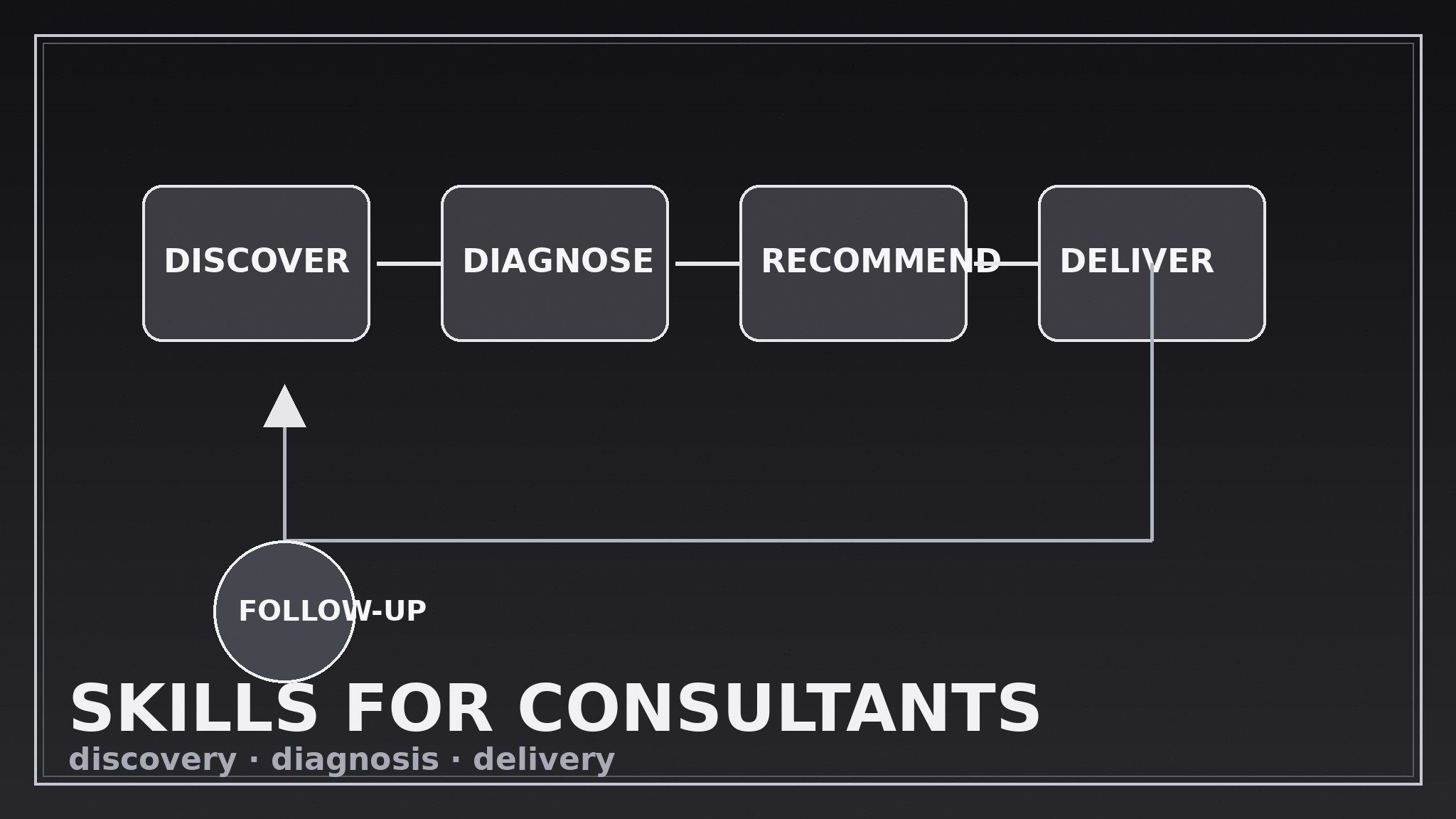
Instálala en 3 pasos
Sin registro. Sin herramientas CLI. Elige tu IA, copia una línea y pégala.
¿Prefieres hacerlo tú mismo? Compra la habilidad ($4.99), descarga el ZIP desde la confirmación de compra, descomprímelo en el directorio que se muestra arriba y reinicia tu sesión de IA — el mismo resultado. ¿Ya la compraste? Tu asistente de IA puede descargarla por ti.
Qué incluye
Un SKILL.md (la guía paso a paso) + una plantilla inicial. Una vista previa:
Skills for Consultants
When to use
- You run client engagements where discovery is a rambling first call and the proposal gets written from memory
- Your recommendations are sound but your deliverables read differently every time, so clients can't tell what's final
- Follow-ups fall through the cracks and a good engagement ends with silence instead of a next phase
- You want one kit that covers the whole engagement — discovery, diagnosis, recommendation, delivery, follow-up — to a single standard
- You're bringing a junior colleague onto engagements and need the way you work written down, not just demonstrated
Workflow
- Map the engagement arc (input: your last 3–5 engagements → output: engagement map)
Reconstruct how your engagements actually run, phase by phase: first contact, discovery, diagnosis, recommendation, delivery, follow-up. For each phase, list the artifacts you produced (or wish you had): call notes, problem statement, data request list, analysis, memo, deck, proposal, status updates. Note where work got redone — proposals rewritten because discovery was thin, analyses rerun because the data request missed a field. The map decides what the kit must contain; a kit that skips your messiest phase is decoration. - Scope the kit by phase, not by tool (input: engagement map → output: kit scope)
A consultant's kit follows the engagement, not a list of trendy techniques. Scope eleven skills, one per recurring job: discovery interview guide, problem framer, hypothesis tree builder, data request list, analysis planner, recommendation memo writer, proposal / statement-of-work writer, workshop facilitator, status update writer, final deliverable assembler, and follow-up sequencer. Each skill owns exactly one artifact and one handoff — the discovery guide produces call notes the problem framer consumes; the memo produces the decision the proposal prices. Skills that don't hand off to the next phase get cut. - Set the quality bar (input: kit scope → output: quality standard)
Every skill in the kit must meet the same bar: every claim names its source (client said, data showed, assumption flagged); every recommendation names the alternative considered and why it lost; every deliverable states what the client is being asked to decide, by when, and what happens if they don't. Write the bar as a checklist and run each skill's first output through it. Clients forgive a plain deliverable; they do not forgive one that hides its assumptions. - Build the inventory in engagement order (input: quality standard → output: eleven working skills)
Build in the order an engagement runs: discovery guide first, then problem framer, hypothesis tree, data request list, analysis planner, recommendation memo, proposal writer, workshop facilitator, status updates, deliverable assembler, follow-up sequencer. Test each skill on a real past engagement — rewrite that engagement's discovery notes with the new guide, reframe its problem statement — because a kit tested on hypothetical clients produces hypothetical rigor. The test that matters: could a colleague pick up the outputs and run the next phase without you in the room? - Compose the workflow and run one engagement end to end (input: eleven skills → output: one finished engagement run)
Take one live or recent engagement and run it through the full chain: discovery notes → problem statement → hypotheses → data request → analysis plan → memo → proposal → workshop → status updates → final deliverable → follow-up sequence. Watch the two seams where consulting kits usually break: discovery-to-diagnosis (notes that never become a crisp problem) and recommendation-to-proposal (a memo that never becomes priced scope). Fix them by making each skill's output the next skill's stated input, then the kit is one engagement workflow, not eleven prompts in a folder.
Vista previa de la plantilla
Skills for Consultants — Kit Template
One kit = eleven skills following the engagement arc. Fill this in from real past engagements, then build in engagement order.
1. Engagement map (your last 3–5 engagements)
Messiest phase: {the one this kit must fix first}
2. Kit scope (eleven skills, one artifact + one handoff each)
3. Quality standard (checklist — every skill's output must pass)
[ ] Every claim names its source: {client said / data showed / assumption flagged} [ ] Every recommendation names the alternative considered + why it lost: {alternative, reason}
El paquete de la habilidad (SKILL.md + plantilla) está escrito en inglés.
También te puede interesar
 Otros
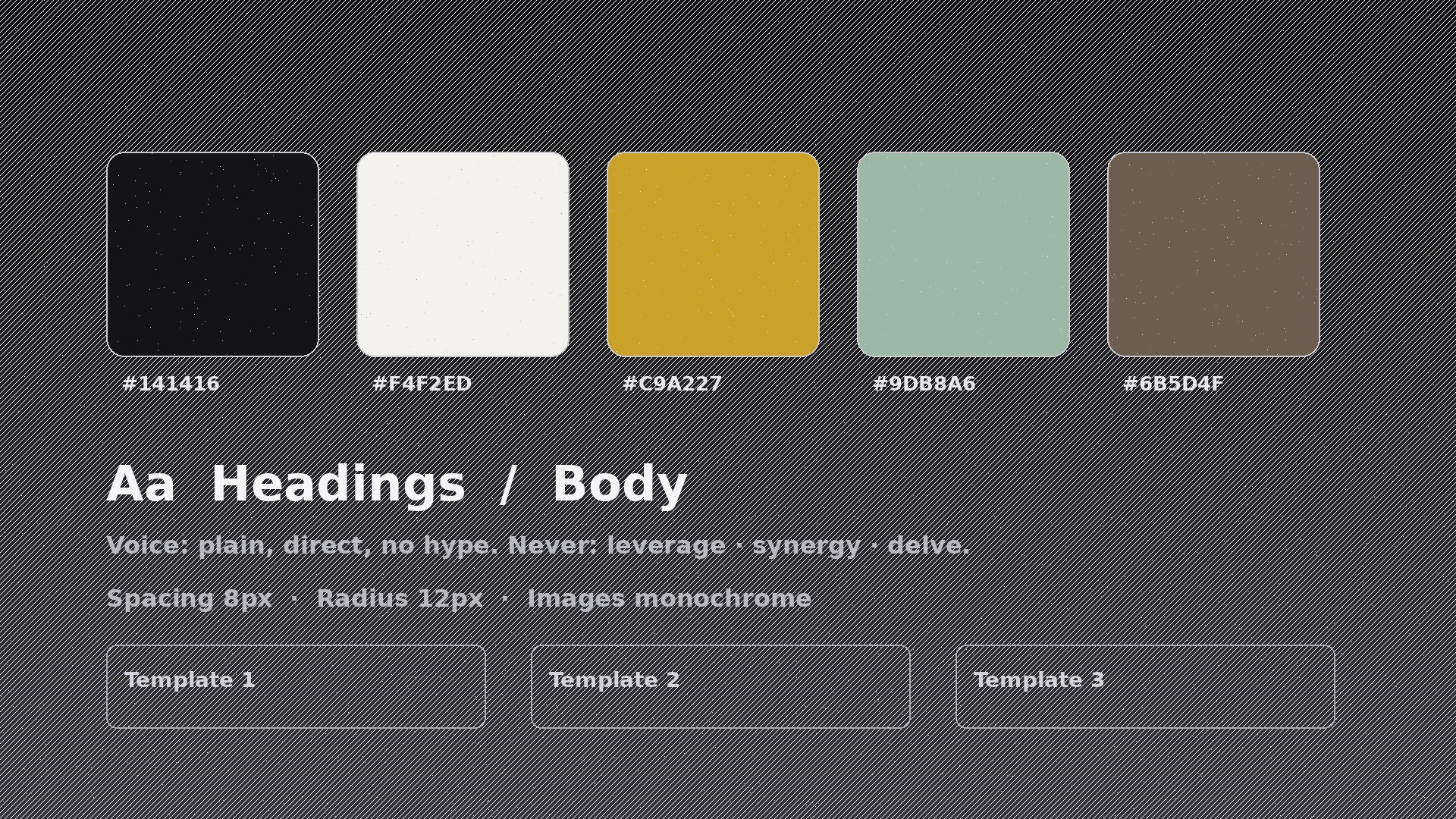
Continuity Asset Set
Un kit que hace que cada entregable parezca parte del mismo conjunto.
 Otros
Device-Canvas Product Launch
Un gran lienzo de dispositivo carga con toda tu historia de lanzamiento.
 Otros
Frame-Token Editorial Launch
Un solo conjunto de tokens, todos los materiales, cero desviaciones.