Citrus Loop Deck
Una presentación luminosa que abre, se desarrolla y vuelve a una sola frase: el círculo se cierra.
Crea una presentación fresca y cítrica en torno a un argumento circular: una única frase en bucle abre la presentación, la evidencia recorre el orden real del bucle y la diapositiva final repite la frase inicial palabra por palabra, ahora ganada a pulso.
Instálala en 3 pasos
Sin registro. Sin herramientas CLI. Elige tu IA, copia una línea y pégala.
¿Prefieres hacerlo tú mismo? Compra la habilidad ($4.99), descarga el ZIP desde la confirmación de compra, descomprímelo en el directorio que se muestra arriba y reinicia tu sesión de IA — el mismo resultado. ¿Ya la compraste? Tu asistente de IA puede descargarla por ti.
Qué incluye
Un SKILL.md (la guía paso a paso) + una plantilla inicial. Una vista previa:
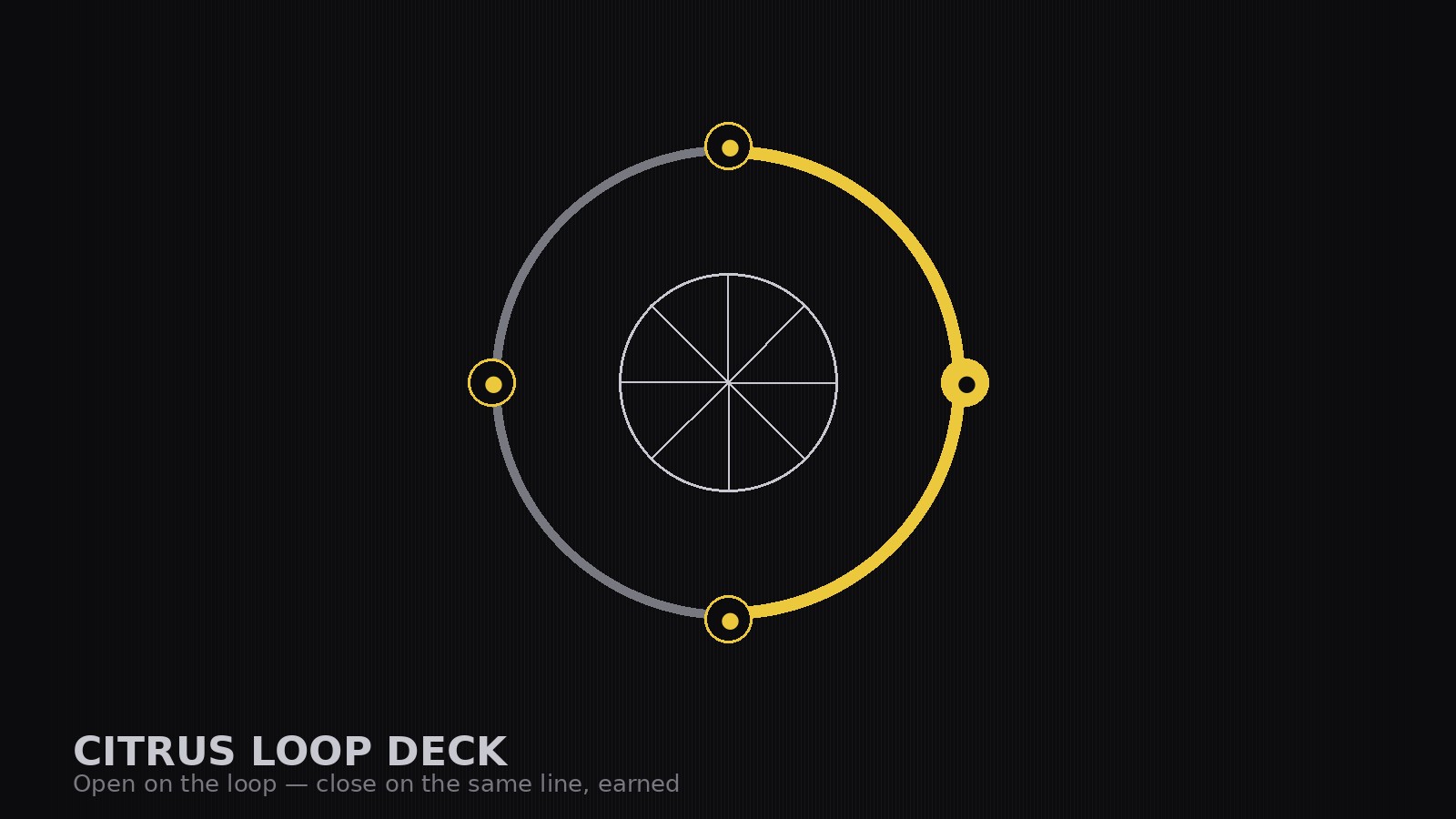
Citrus Loop Deck
When to use
- You are launching a product, campaign, or brand and want the deck to feel fresh, energetic, and memorable rather than corporate
- Your argument is circular by nature — a habit, a subscription, a flywheel, a season that comes around again — and a linear deck keeps flattening it
- You are pitching to an audience that has sat through five grey decks today and you need yours to be the one they remember
- You want a deck with a closing slide that echoes the opening slide, so the pitch lands as one complete thought
- Your current deck rambles: it ends wherever the slides ran out, not where the argument closes
Workflow
- Find the loop (input: pitch material → output: loop statement)
State the loop in one sentence: the idea that the deck opens with, develops, and returns to. "Fresh fruit, delivered weekly, so the week starts fresh" is a loop; "our product has five features" is a list. If you cannot state the loop in one sentence, the deck is not a loop deck yet — keep working until the return is obvious. - Set the system (input: loop statement → output: design rules)
Fix the system before laying out slides: a citrus palette (zest orange, lemon yellow, leaf green) on a light background with one dark ink color for text, one rounded display typeface for headlines, one plain face for body text, and a rule for the loop motif — a simple circular device (a ring, a wheel, a cycle diagram) that appears on the opening, transition, and closing slides. Bright colors with discipline: two citrus accents maximum per slide. - Structure the circle (input: loop + material → output: slide outline)
Order the deck as a circle, not a line: open on the loop (the promise, stated once, plainly), walk through the evidence in the order the loop actually runs (the problem, the product, the proof, the plan), then close by restating the opening line — same words, now earned. Aim for 8–12 slides. One idea per slide; if a slide doesn't move the loop forward, cut it. - Lay out for energy (input: outline → output: full deck)
Keep slides bright and airy: generous white space, short headlines, one visual per slide (a photo, a diagram, a single number at huge size). Use the loop motif as a progress thread — each section slide shows the ring with the current stage highlighted, so the audience always knows where they are in the circle. Proof slides carry one number, one context line, and the source. - Close the loop (input: full deck → output: send-ready PDF)
Read the deck end-to-end: does the closing slide echo the opening slide word for word, and does the echo feel earned rather than repeated? Add slide titles that state each slide's point and a final slide with the ask and next step. Export, check it on a phone screen, and fix anything that only worked at presentation size.
Vista previa de la plantilla
Citrus Loop Deck — Pitch Template
One pitch = one loop. Lock the loop sentence before laying out slides — it is the deck.
The pitch
Product / campaign / brand: {name} | Audience: {who} | Meeting date: {date} Loop statement (one sentence — opened with, developed, returned to): {sentence} The ask: {what you want them to agree to} Next step: {concrete next step + date}
Design system (fixed before layout — follow literally)
Slide outline (8–12 slides — follow the loop's real order)
Loop motif tracker (the ring on opening / transition / closing slides)
Proof log (real figures only — no invented numbers)
El paquete de la habilidad (SKILL.md + plantilla) está escrito en inglés.
También te puede interesar
 Presentaciones
Pitch Deck
10 diapositivas que cuentan una sola historia: los inversores se quedan hasta la última página
 Presentaciones
Work Report
Semanales, mensuales, evaluaciones: primero la conclusión, entendido en 3 minutos
 Presentaciones
Academic Argument Deck
Una presentación que argumenta, y que responde