Agent-Economy Stack Mapper
Mapea dónde los agentes tocan tu negocio
Inventaría cada punto de contacto donde los agentes de IA se encuentran con tu negocio (descubrimiento, compra, soporte, adquisiciones), puntúa la preparación para agentes, ajusta la infraestructura de confianza (construir, comprar, esperar) y publica tu política de agentes.
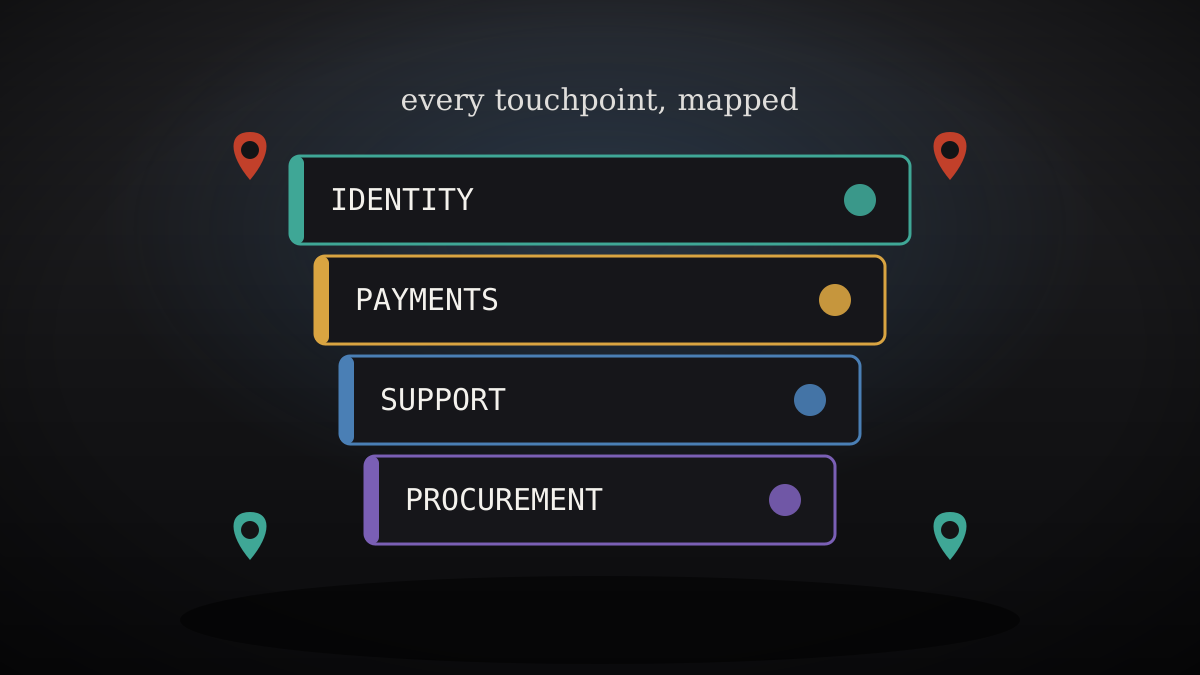
Instálala en 3 pasos
Sin registro. Sin herramientas CLI. Elige tu IA, copia una línea y pégala.
¿Prefieres hacerlo tú mismo? Compra la habilidad ($4.99), descarga el ZIP desde la confirmación de compra, descomprímelo en el directorio que se muestra arriba y reinicia tu sesión de IA — el mismo resultado. ¿Ya la compraste? Tu asistente de IA puede descargarla por ti.
Qué incluye
Un SKILL.md (la guía paso a paso) + una plantilla inicial. Una vista previa:
Agent-Economy Stack Mapper
When to use
- Customers' agents are already interacting with your business (or will be next quarter) and you have no map of where.
- You're deciding where to invest in agent-readiness: identity, payments, APIs, support.
- Leadership asks "what's our agent strategy" and you want an answer grounded in your actual touchpoints.
- You're a vendor selling into the agent economy and need to speak your buyer's language.
Workflow
- List the touchpoints (input: your business → output: touchpoint inventory)
Walk the customer journey and mark everywhere an agent could act: discovery (agents comparing your product), purchase (agents buying), support (agents filing tickets), procurement (agents negotiating renewals), identity (agents proving humanity), and post-purchase (agents managing subscriptions, returns). Include the touchpoints you don't control — review sites, marketplaces, social — where agents already summarize you. - Classify each touchpoint (input: inventory → output: classified map)
Tag each: who sends the agent (your customer? a third party? you?), what it can do there today (read-only? transact? modify?), and what's at stake (money, data, reputation, legal). The high-stakes transacting touchpoints are your investment priority; the read-only ones are your monitoring priority. - Score agent-readiness (input: classified map → output: readiness scores)
Per touchpoint, score 1–5 on: machine-readable (can an agent parse your offering without a human?), identity-aware (can you tell a verified-human-backed agent from a bot?), transactable (can an agent complete the action with proper authorization?), and observable (do you log agent interactions separately from human ones?). Anything scoring under 3 on identity-aware is where fraud will arrive first. - Match trust infrastructure (input: scores → output: infrastructure plan)
For each priority touchpoint, name the infrastructure: delegated identity proofs (so agents prove a human principal), scoped payment credentials (so agents spend within bounds), structured APIs or agent protocols (so agents don't screen-scrape), and audit trails (so every agent action is attributable). Mark build vs buy vs wait per item — not everything needs building this quarter. - Write the agent policy (input: plan → output: one-page policy)
Your public stance, in plain language: which agents you welcome, what they may do, how they identify themselves, what happens to unverified bots (rate-limited? blocked? served read-only?), and where to get credentials. Publish it — the agent economy rewards the businesses agents can understand. - Set the review cadence (input: everything → output: quarterly review)
Agent capabilities move quarterly; your map must too. Each quarter: re-score readiness, check the fraud signals (bot traffic share, disputed agent orders, support tickets filed by agents), and move one touchpoint up the maturity ladder. The map is a living doc, not a deck.
Vista previa de la plantilla
Agent-Economy Stack Worksheet
Map where agents touch your business — then decide what each touchpoint needs.
1. Touchpoint inventory
2. Classify
Investment priority = high-stakes + transacting. Monitoring priority = read-only.
3. Readiness scores (1–5)
Under 3 on identity-aware = where fraud arrives first.
4. Infrastructure plan
5. One-page agent policy (publish it)
- Which agents you welcome:
- What they may do:
- How they identify themselves:
- Unverified bots get (rate-limited / blocked / read-only):
- Where to get credentials:
6. Quarterly review
- Re-score readiness: date
- Fraud signals (bot traffic share, disputed agent orders, agent-filed tickets):
El paquete de la habilidad (SKILL.md + plantilla) está escrito en inglés.
También te puede interesar
 Otros
Continuity Asset Set
Un kit que hace que cada entregable parezca parte del mismo conjunto.
 Otros
Device-Canvas Product Launch
Un gran lienzo de dispositivo carga con toda tu historia de lanzamiento.
 Otros
Frame-Token Editorial Launch
Un solo conjunto de tokens, todos los materiales, cero desviaciones.