Ratio Between Two Sides
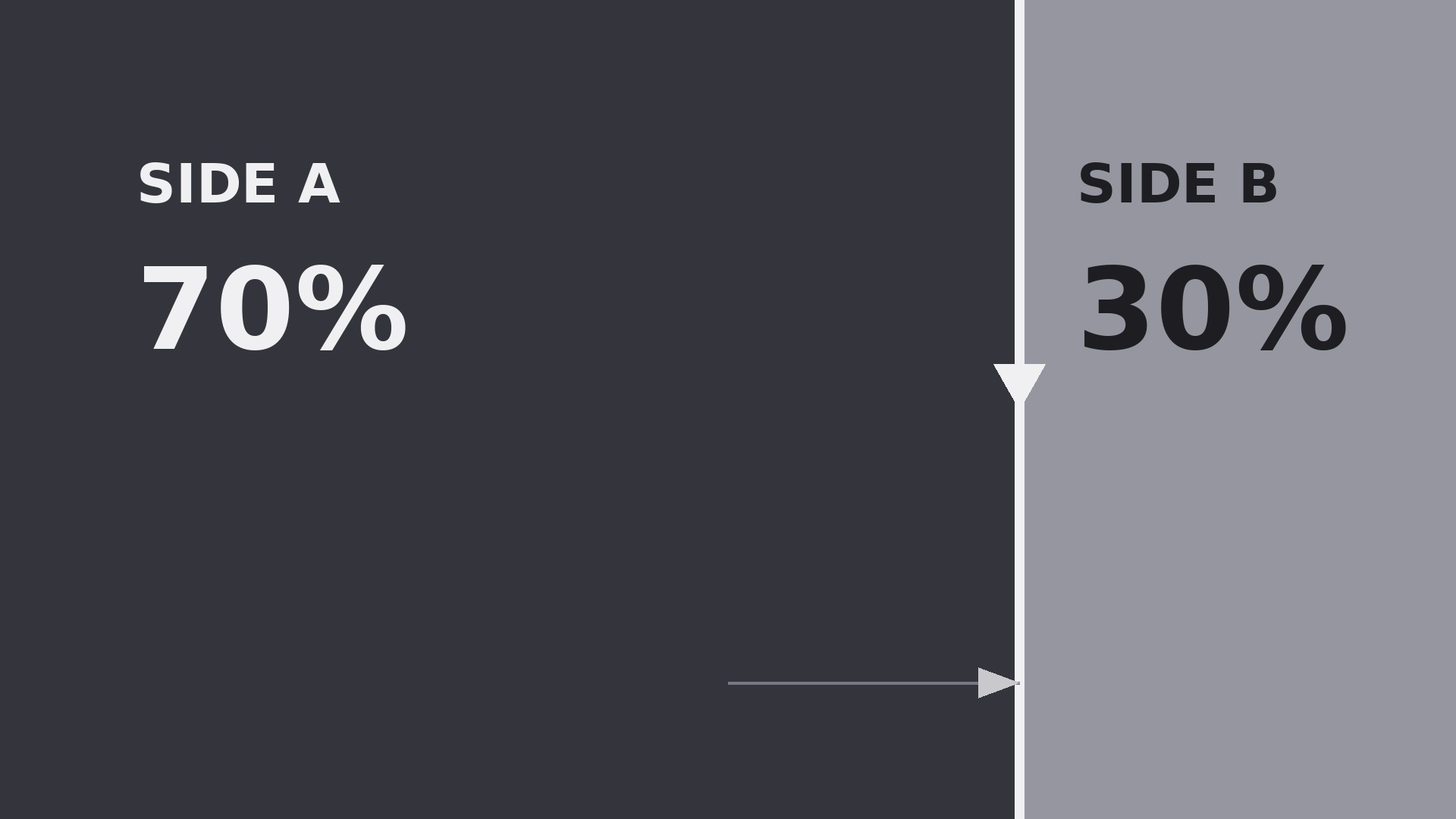
Zwei Seiten, eine gleitende Trennlinie — spüren Sie das Ungleichgewicht, bevor Sie es lesen.
Ein Verhältnis, inszeniert als Gegenüberstellung zweier Seiten: zwei Hälften, eine Trennlinie, die von ausgeglichen zur wahren Aufteilung gleitet, sodass die Balance oder das Ungleichgewicht gefühlt wird, bevor es gelesen wird.
In 3 Schritten installieren
Keine Anmeldung. Keine CLI-Tools. Wählen Sie Ihre AI, kopieren Sie eine Zeile und fügen Sie sie ein.
Lieber selbst machen? Kaufen Sie den Skill ($4.99), laden Sie die ZIP-Datei aus Ihrer Kaufbestätigung herunter, entpacken Sie sie in das oben angezeigte Verzeichnis und starten Sie Ihre AI-Sitzung neu — gleiches Ergebnis. Haben Sie ihn schon gekauft? Ihr AI-Assistent kann ihn für Sie herunterladen.
Was ist enthalten
Eine SKILL.md (die Anleitung) + eine Startvorlage. Eine Vorschau:
Ratio Between Two Sides
When to use
- The comparison has exactly two sides (this vs that, yes vs no, new vs old, us vs them) and the ratio between them is the story
- A single bar or a sentence ("70/30") states the ratio but doesn't make the audience feel the imbalance
- You are framing a decision, a debate, a split vote, or a before/after where two states oppose each other
- The clip is a 12–25 second opener for a discussion, a pitch slide, or a lesson beat — the visual is the argument
- The two sides have distinct identities (colors, labels, icons) that deserve equal visual dignity, even when the numbers are lopsided
Workflow
- Name the two sides (input: comparison → output: two labeled sides + ratio)
Give each side a 1–3 word name and, if it helps, one icon or color. Write the ratio in its simplest honest form: "70 : 30" (keep the raw numbers too — 70:30 is not the same story as 7:3 rounded from 68:32 if the gap matters). Decide the reading: is this a contest (one side winning), a balance (two parts of one whole), or a tension (two forces pulling)? The reading decides the staging in step 3 — pick it deliberately. - Stage the split (input: sides + ratio → output: split-screen layout)
Divide the frame into two halves at the ratio: for 70:30, side A owns 70% of the width, side B 30%. The divider sits at the ratio point, not the center — the asymmetry IS the message. Each side gets its label, its value, and its color; the larger side gets more room but not more visual noise. Center the divider line clearly (2–4 px, high contrast) so the split reads even at thumbnail size. Vertical split (left/right) is the default; use a horizontal split (top/bottom) only for vertical formats where it reads better. - Animate the face-off (input: layout → output: divider + side keyframes)
Start at 50:50 — a neutral, even split — and animate the divider to the true ratio over 1.0–1.4 s with ease-in-out. The movement from even to lopsided is what makes the audience feel the imbalance; starting at the final ratio skips the drama. As the divider moves, each side's value counts up/down to its final number in sync (0.0 → final, same duration). Optional: the winning/larger side's color subtly deepens as it gains ground; keep it subtle or it reads as cheering. - Add the verdict line (input: animated split → output: takeaway caption)
After the divider settles, hold 0.5 s, then bring in one takeaway line (8–14 words) centered on or beneath the divider: what the ratio means, not the ratio restated ("New users now outnumber returning ones 2 to 1" — not "The ratio is 70:30"). Fade/slide in over 0.4 s, ease-out. If the ratio is a contest, the takeaway names the leader; if a balance, it names what the balance enables; if a tension, it names the question. - Hold and end (input: finished face-off → output: 12–25 s clip)
Hold the finished split + takeaway for 2–3 s. End with a 0.4 s fade, or — for a debate/discussion opener — a slow 1.5 s push-in on the divider itself (scale 1.0 → 1.15) that leaves the question hanging. Never add a third element after the verdict; the two sides plus one line is the whole composition. Export 1920×1080 or 1080×1080, 30 fps.
Vorschau der Startvorlage
Ratio Between Two Sides — Template
Fill in the blanks, then build the clip from the SKILL.md workflow.
The two sides
Ratio (simplest honest form): {e.g. 70 : 30} Reading: [ ] Contest (one side winning) / [ ] Balance (two parts of one whole) / [ ] Tension (two forces pulling)
Layout
Split: [ ] Vertical (left/right) / [ ] Horizontal (top/bottom) Divider at: {ratio point — NOT center, unless ratio is 50:50} Divider style: {2–4 px, high-contrast line} Footnote (if needed): {e.g. "12% undecided — not shown as a side"}
Animation
Divider: 50:50 → true ratio over 1.0–1.4 s, ease-in-out Values: count up/down in sync with divider (same duration)
Das Skill-Paket selbst (SKILL.md + Vorlage) ist auf Englisch verfasst.