PHP2Shell Vulnerability Check
Finden Sie noch heute Abend heraus, ob das PHP Ihrer Website zu den verwundbaren gehört
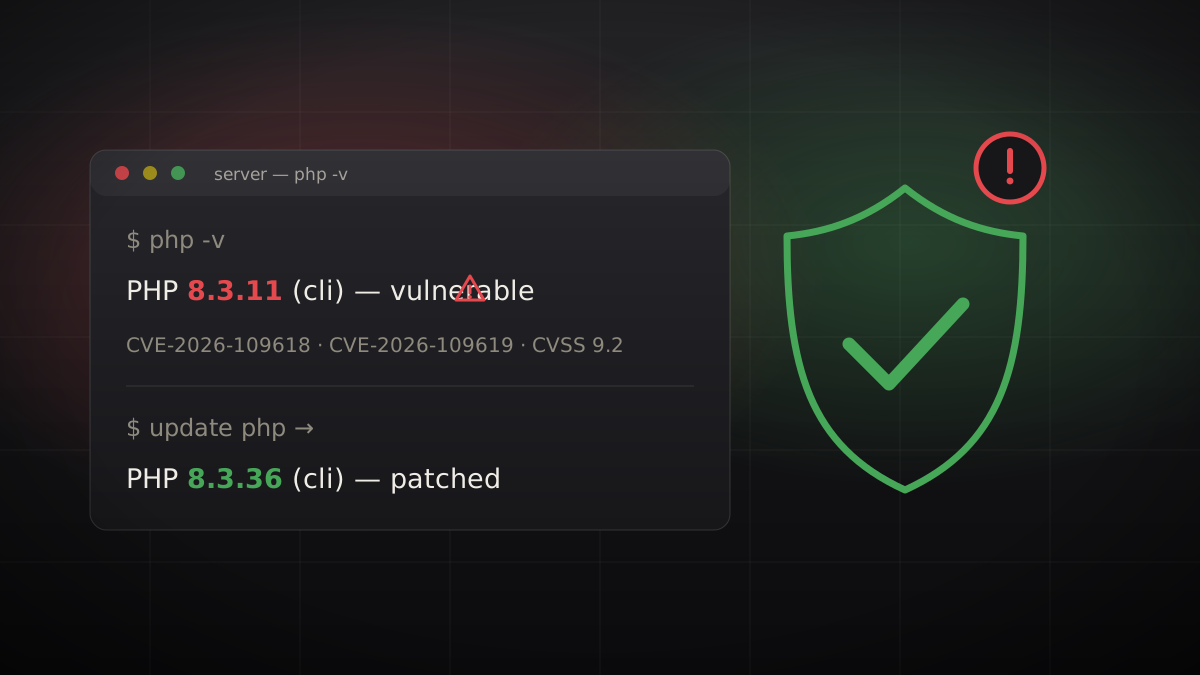
Prüfen Sie eine Website, die Ihnen gehört, auf die PHP2Shell-Schwachstellen (CVE-2026-109618 / CVE-2026-109619, CVSS 9.2): Fingerprinten Sie die PHP-Version aus der Ferne, klären Sie Fälle mit versteckter Version und Distro-Backports, gehen Sie den Patch oder die Entscheidung zur vorübergehenden Abschaltung durch, verifizieren Sie den Fix auf zwei Wegen und erhalten Sie einen einseitigen Bericht für den Inhaber.
In 3 Schritten installieren
Keine Anmeldung. Keine CLI-Tools. Wählen Sie Ihre AI, kopieren Sie eine Zeile und fügen Sie sie ein.
Lieber selbst machen? Kaufen Sie den Skill ($4.99), laden Sie die ZIP-Datei aus Ihrer Kaufbestätigung herunter, entpacken Sie sie in das oben angezeigte Verzeichnis und starten Sie Ihre AI-Sitzung neu — gleiches Ergebnis. Haben Sie ihn schon gekauft? Ihr AI-Assistent kann ihn für Sie herunterladen.
Was ist enthalten
Eine SKILL.md (die Anleitung) + eine Startvorlage. Eine Vorschau:
PHP2Shell Vulnerability Check
The facts this skill runs on (verified 2026-10-21)
- PHP2Shell = CVE-2026-109618 + CVE-2026-109619, both CVSS v4.0 9.2, unauthenticated remote code execution in the PHP interpreter itself. The malicious request is processed before any application code runs — logins and app-level auth do not block it, and even a one-line test page exposes the flaw.
- Fixed upstream releases (21 Oct 2026): PHP 8.2.35, 8.3.36, 8.4.27, 8.5.12. Anything older on those branches is vulnerable.
- PHP 8.1 and older (back to 5.x): affected and end-of-life. PHP provides only minimal source backports for 7.4/8.0/8.1 that you must compile yourself, and there is no official binary patch; the fix is moving to a fixed, supported release. (Some Linux distros backport — step 4 handles that.)
- Only patching fixes it. The circulating tip to set
session.upload_progress.enabled=0blocks the attack path most abused in the wild (per Hadrian/Upwind) but is NOT a complete fix — Datadog's reproduction showed other paths remain; only the PHP update fully fixes these flaws. WAF rules are a stopgap, not a fix. - WordPress/CMS updates do not update PHP. The PHP version is set by the server/hosting plan.
- Japan's prime minister and several national cybersecurity agencies advised on 2026-10-21: patch immediately, or temporarily take the site offline until you can.
- Sources: php.net security release; Datadog Security Labs, "PHP2Shell — detection, analysis, and remediation"; Ubuntu php2shell advisory; Tenable FAQ.
When to use
- You own or operate any website and heard about the PHP vulnerabilities in the news — you want a straight answer: *am I exposed?*
- You run WordPress, Drupal, Joomla, Magento, or anything PHP-based and don't know which PHP version the server uses.
- Your host sent a vague "we are aware" email and you want to verify the fix yourself.
- You patched (or your host says they patched) and want independent confirmation.
Safety rules (non-negotiable)
- Only check sites the user owns or is explicitly authorized to test. If ownership/authorization is unclear, stop and ask.
- Read-only checks only. Headers, public pages, version comparison. Never send an exploit request or attack payload to any server — the verdict comes from fingerprinting, never from exploitation.
- Never report "safe" from absence of evidence. A hidden version means "unconfirmed", and the report must say so.
Workflow
- Scope and permission (input: user's site list → output: confirmed check list)
Confirm each site is the user's to test. Note for each: where it is hosted (shared host, VPS, Docker, managed WordPress) and whether the user has server/shell access — this decides which steps can run. - Remote fingerprint (input: site URL → output: version evidence or "hidden")
Method A — the free online checker (same logic as this skill, hosted):GET https://aiservicesmarket.lol/api/php2shell-check?url=returns a JSON verdict with its evidence.
Method B — independent raw check (do at least one raw check yourself; don't just relay Method A):
curl -sI https://site.example | grep -iE 'x-powered-by|^server:|set-cookie'— look forPHP/x.y.zinX-Powered-Byor theServerheader, andPHPSESSIDcookies (PHP present, version unknown).- Fetch the homepage and look for CMS markers (
wp-content→ WordPress, etc.): a PHP-based CMS with no version still means PHP is in play.
Record exactly which signal produced the version — the report cites it.
- Exposed phpinfo probe (input: site origin → output: exact version and/or an exposure finding)
curl -s https://site.example/phpinfo.phpand/info.php. If a phpinfo page answers, extract the version from its header ("PHP Version x.y.z"). The exposure itself is a critical finding regardless of version: phpinfo prints the full server configuration to the public. Tell the user to remove or protect it today, and record it in the report. - Verdict against the fixed table (input: version + suffix → output: one of five verdicts)
- Version ≥ fixed release for its branch (8.2.35 / 8.3.36 / 8.4.27 / 8.5.12) → Patched.
- Version below the fixed release, clean upstream string → Vulnerable.
- Version is 8.1 or older → Vulnerable + end-of-life (no official binary patch exists; remediation is an upgrade — unless step 4a clears it).
- 4a. Distro backport check. If the version string carries a package suffix (
-1ubuntu…,-deb…,+deb…), the distro may have backported the fix into an old-looking number. Compare the *full package version* against the distro's fixed packages (examples from Ubuntu's advisory: Ubuntu 24.04 php8.3 fixed in8.3.6-0ubuntu0.24.04.13; Ubuntu 22.04 php8.1 fixed in8.1.2-1ubuntu2.28). Get the package version from the server (dpkg -l | grep php,rpm -q php) or the host. New enough → Patched (distro backport); older or unprovable → treat as Vulnerable and say why. - No version found but PHP signals present → Unconfirmed — version hidden. Never soften this into "probably fine".
- Resolve the hidden-version case (input: hosting setup → output: the version, from the server side)
- Shell access:
php -v(and for FPM: the version the web server actually runs — check the pool/FPM binary too, CLI and FPM versions can differ). - Hosting panel: most panels (cPanel → MultiPHP Manager, Plesk → PHP Settings) show and select the version per site.
- No access: send the host this exact message — *"Which PHP version does my site [domain] run, and is it at or past the fixed PHP2Shell releases (8.2.35 / 8.3.36 / 8.4.27 / 8.5.12)? If not, when will you apply the update? Please confirm in writing."* Then run step 4 on their answer.
- Remediation walkthrough (input: verdict + hosting setup → output: patched server or a deliberate temporary-offline decision)
- Fixed-branch update paths: distro packages (
apt update && apt upgrade php*, then restart PHP-FPM/Apache), hosting panel PHP-version selector (pick a *fixed* release, not just a newer branch), Docker (bump the image tag to a fixed release and redeploy), source builds (rebuild with the fixed tarball). - EOL branch: schedule the move to 8.2+ fixed; check the site's CMS/plugin compatibility first, but do not let "later" win — if the move can't happen now, use the stopgap below.
- Stopgap if patching will take time: temporarily take the site offline or restrict access (the explicit advice of Japan's PM and national agencies on disclosure day), and/or put a WAF/CDN rule set in front — labelled clearly as a stopgap, never as the fix.
- Remove the exposed phpinfo page found in step 3.
- Verify the fix (input: patched server → output: confirmed version, two ways)
Re-run step 2's fingerprint and confirm on the server (php -v/ panel). Both must show a fixed version. Then look for signs of earlier exploitation (per Datadog's hunting notes): unusually large form submissions in access logs, memory-exhaustion errors during request initialization, and unexpected shell processes spawned by PHP workers. Any hit → tell the user this is now an incident-response matter, not a patching matter. - Write the owner report (input: all findings → output: the one-page report in template.md)
One page per site: verdict in the first line, evidence, the fix applied (or the decision taken), verification result, and the date. Plain language — the reader is a site owner, not a security engineer.
Vorschau der Startvorlage
PHP2Shell Owner Report
One page per site. Fill every field — "unknown" is an answer, a blank is not.
Site
- Website:
- Hosting / server:
- Checked on (date, time, timezone):
- Checked by:
Verdict (tick one)
- [ ] Patched — running a fixed PHP release
- [ ] Patched via distro backport — old-looking version, fixed package (evidence below)
- [ ] Vulnerable — below the fixed release for its branch
- [ ] Vulnerable + end-of-life — PHP 8.1 or older; no official binary patch for this branch (PHP source backports exist for 7.4/8.0/8.1; distro backports may apply)
- [ ] Unconfirmed — site runs PHP but hides its version; server-side check still needed
Das Skill-Paket selbst (SKILL.md + Vorlage) ist auf Englisch verfasst.