Hand-Rendered Explainer
Zeichnungen, die sich auf dem Bildschirm aufbauen, während der Sprecher erklärt.
Schreibt das Drehbuch, erstellt das Storyboard und animiert ein Erklärvideo im handgezeichneten Stil, in dem sich die Zeichnungen synchron zur Erzählung auf dem Bildschirm aufbauen — sodass eine komplizierte Idee am Ende selbstverständlich wirkt.
In 3 Schritten installieren
Keine Anmeldung. Keine CLI-Tools. Wählen Sie Ihre AI, kopieren Sie eine Zeile und fügen Sie sie ein.
Lieber selbst machen? Kaufen Sie den Skill ($4.99), laden Sie die ZIP-Datei aus Ihrer Kaufbestätigung herunter, entpacken Sie sie in das oben angezeigte Verzeichnis und starten Sie Ihre AI-Sitzung neu — gleiches Ergebnis. Haben Sie ihn schon gekauft? Ihr AI-Assistent kann ihn für Sie herunterladen.
Was ist enthalten
Eine SKILL.md (die Anleitung) + eine Startvorlage. Eine Vorschau:
Hand-Rendered Explainer
When to use
- You need to explain a product, process, or concept that people glaze over when they read about it
- A sales or onboarding video has to work for viewers who know nothing about the topic
- Your pitch deck is not landing and you want a 60–90 second version that does the explaining
- A tutorial needs to show a sequence of steps in a way viewers can follow without rewinding
- You want a video style that feels human and approachable rather than corporate and templated
Workflow
- Find the one idea (input: topic + audience → output: single message + viewer takeaway)
Decide what the viewer should be able to say after watching: one sentence, in plain language. Everything in the video serves that sentence. If you have two messages, you have two videos. Also name the audience precisely — "new hires on day one" produces a different script from "busy executives" — and note the one thing they currently misunderstand, because the video's job is to replace that misunderstanding. - Write the spoken script (input: single message → output: narration script, 130–160 words per minute of video)
Write for the ear, not the eye: short sentences, everyday words, one idea per sentence, and the structure problem → why it matters → how it works → what to do next. Read it aloud as you write — any sentence you stumble over gets rewritten. Mark the words that need visual support ("when I say 'three steps', three drawings appear") so the narration and the drawing stay locked together. - Storyboard the drawings (input: script → output: panel-by-panel storyboard)
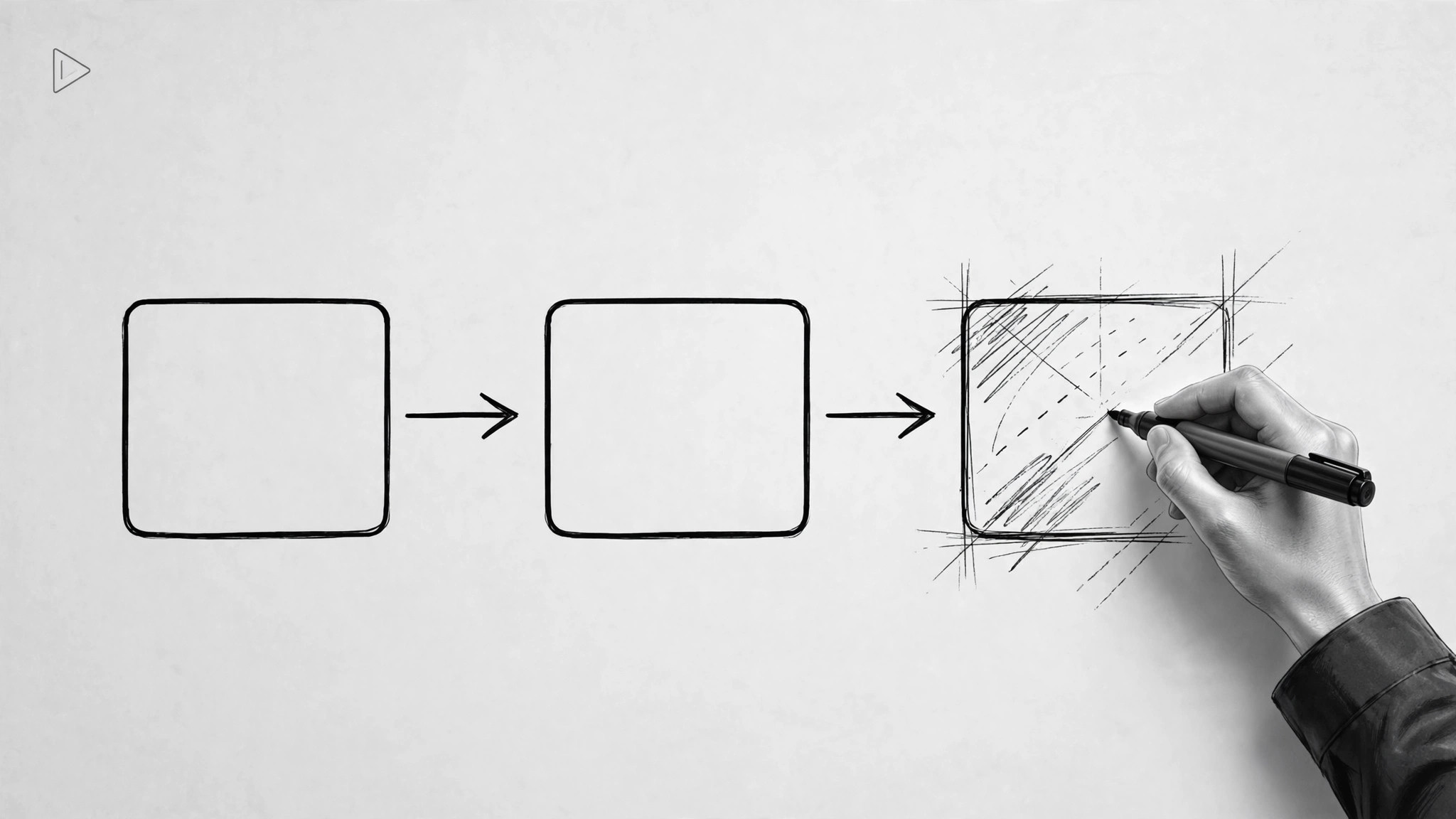
Break the script into beats of 3–8 seconds and sketch one panel per beat: what gets drawn, in what order, and what stays on screen. The hand-rendered style means drawings build up stroke by stroke in sync with the narration — a diagram that appears fully formed breaks the illusion, so every panel must show the drawing order. Keep each panel to one focal drawing plus at most one short on-screen label; a busy frame defeats the style. - Record narration and animate (input: script + storyboard → output: timed video draft)
Record the narration first in a quiet room, in a conversational tone — the drawing timing follows the voice, never the other way round. Then animate: each drawing appears stroke by stroke, timed to the words it illustrates, with a hand or pen cursor if the tool supports it. Pace the reveals so the viewer is always looking at what the voice is talking about; nothing should appear more than a beat before it is mentioned. - Cut, check, and finish (input: timed draft → output: final video)
Watch the draft twice: once with sound off (the drawings alone should carry the rough shape of the idea), once with sound on (the voice and drawing should never compete for attention). Cut any beat that does not serve the single message, tighten pauses, and add captions — many viewers watch muted. Export at the platform's native size, and write a title and one-line description that state the takeaway, not the topic.
Vorschau der Startvorlage
Hand-Rendered Explainer — Production Template
One video = one message. Fill in the brief before writing a single line of script.
Brief
Topic: {topic}
Audience (be precise): {e.g. new hires on day one}
One takeaway sentence (what the viewer should be able to say afterwards): {sentence}
Misunderstanding this video replaces: {what they currently think}
Target length: {60–90 sec typical / up to 3 min for complex topics}
Narration script (130–160 words/min, write for the ear, read aloud as you write)
Structure: Problem → Why it matters → How it works → What to do next
Read-aloud check: [ ] No sentence stumbled over [ ] Everyday words throughout
Das Skill-Paket selbst (SKILL.md + Vorlage) ist auf Englisch verfasst.