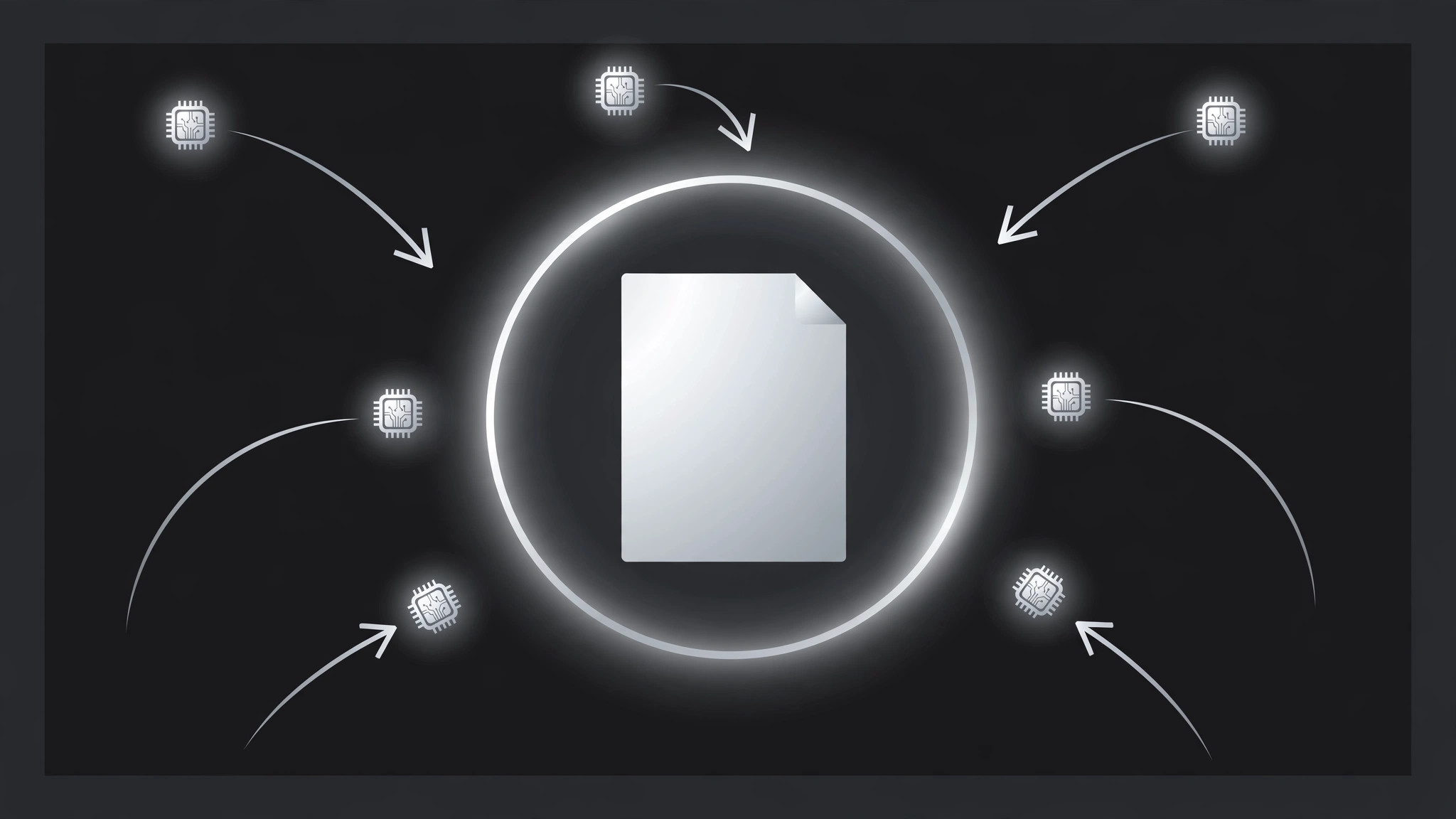
Convergence to Evidence
Verstreute Hinweise fliegen herein. Ein Urteil landet.
Verstreute Behauptungen, Hinweise oder Datenpunkte fliegen auf gekrümmten Bahnen von den Rändern herein und laufen auf ein einziges Beweisstück zu, das als Urteil landet — die visuelle Form eines Arguments, das zusammenfindet.
In 3 Schritten installieren
Keine Anmeldung. Keine CLI-Tools. Wählen Sie Ihre AI, kopieren Sie eine Zeile und fügen Sie sie ein.
Lieber selbst machen? Kaufen Sie den Skill ($4.99), laden Sie die ZIP-Datei aus Ihrer Kaufbestätigung herunter, entpacken Sie sie in das oben angezeigte Verzeichnis und starten Sie Ihre AI-Sitzung neu — gleiches Ergebnis. Haben Sie ihn schon gekauft? Ihr AI-Assistent kann ihn für Sie herunterladen.
Was ist enthalten
Eine SKILL.md (die Anleitung) + eine Startvorlage. Eine Vorschau:
Convergence to Evidence
When to use
- An explainer or investigation has several threads and needs a "they all point here" moment
- A verdict or conclusion must feel earned, because the audience watched the pieces come together
- A documentary or essay needs to turn a pile of clues into one decisive exhibit
- A pitch or report must show that multiple independent signals agree on one finding
- A true-crime, history, or science story reaches its turning point: the moment scattered facts become proof
- You have 3–6 supporting points and one central piece of evidence they all support
Workflow
- Name the evidence and the tributaries (input: your argument → output: convergence plan)
Write the central evidence first, in one sentence: the quote, the document, the measurement, the exhibit. Then list 3–6 tributaries — the claims, clues, or data points that point at it. Each tributary gets ≤8 words ("Three witnesses, same time", "Sensor logged 41.2°C"). If a tributary does not actually support the evidence, cut it now — convergence only works when every incoming piece genuinely points the same way. The evidence sentence must be checkable on screen (a visible quote, figure, or document), not a vague claim. - Place the tributaries around the frame (input: convergence plan → output: layout)
The evidence lands centre-screen as a card. The tributaries start at the frame edges — top-left, top-right, left, right, bottom-left, bottom-right — small chips or short text lines, dimmed to 70% opacity. Give each tributary a distinct start position and a distinct flight path angle; two tributaries flying the same line look like a duplicate. Keep the centre empty at the start: the convergence needs somewhere to go, and an empty centre creates the pull. - Choreograph the flight (input: layout → output: timing map)
Total duration 4–6 seconds. Tributaries fly in staggered: one every 250–350ms, each travelling 1.2–1.8 seconds along a slightly curved path toward the centre. The curve matters — a straight-line rush feels mechanical, a gentle arc (control point offset 40–80px perpendicular to the direct line) feels pulled, like gravity. Easing: ease-in cubic for the first third (accelerating inward), then ease-out for the final approach (decelerating into the landing). The evidence card itself stays hidden until the first tributary is halfway in. - Set keyframes for flight and landing (input: timing map → output: keyframe spec)
Tributary keyframes: 0% — at edge position, scale 0.9, opacity 0.7, blur 2px; 50% — mid-path, scale 0.95, opacity 0.9, blur 0; 85% — just short of centre, scale 1.0, opacity 1; 100% — absorbed: scale 0.6, opacity 0, as if swallowed by the centre point. On each absorption, the centre flashes a 150ms accent pulse (a ring expanding 20px and fading) and a faint tick sound if audio is on. Then the evidence card scales in: 0% scale 0.8 opacity 0 → 60% scale 1.04 opacity 1 → 100% scale 1.0, over 450ms with ease-out back. - Reveal the evidence as the verdict (input: keyframe spec → output: finished motion)
The evidence card holds centre-screen for at least 1.5 seconds — this is the payoff, and rushing it wastes the whole build. Inside the card: the evidence itself in large type (the quote, the figure, the document snippet), plus a one-line verdict beneath it ("The timeline holds."). Add a thin ring or bracket graphic around the card that draws itself on during the hold, clockwise, over 600ms — the visual seal on the conclusion. Then either hold for reading or dissolve the tributary chips entirely so only the evidence remains. - Check the logic reads at full speed (input: finished motion → output: verified animation)
Watch at real speed with the sound off: can you read each tributary as it flies, see it land in the centre, and read the evidence card without rewinding? If the tributaries are unreadable in flight, slow the flight or shorten the text. Check the final frame: does it show the evidence and the verdict, and nothing else competing for attention? If a stray chip is still visible, it must fade out during the hold.
Vorschau der Startvorlage
Convergence to Evidence — Starter Template
Fill in every {placeholder}. Every tributary must genuinely support the evidence — cut any that does not.
Convergence plan
- Central evidence (one sentence, checkable on screen): {quote / figure / document}
- Verdict line (beneath the evidence): {one line, e.g. The timeline holds.}
- Tributaries (3–6, ≤8 words each):
- {tributary} — start position: {edge + corner}
- {tributary} — start position: {edge + corner}
- {tributary} — start position: {edge + corner}
- {tributary} — start position: {edge + corner}
- {tributary} — start position: {edge + corner} (add/remove rows to match count)
Layout
Das Skill-Paket selbst (SKILL.md + Vorlage) ist auf Englisch verfasst.