Composition Study Generator
Ein Blatt, das Ihnen beibringt, warum ein Bild funktioniert.
Erstellt strukturierte Kompositions-Studienblätter, die ein Kunstwerk oder Foto in Thumbnails, Tonwertkarten und kommentierte Diagramme zerlegen — für gezieltes Üben.
In 3 Schritten installieren
Keine Anmeldung. Keine CLI-Tools. Wählen Sie Ihre AI, kopieren Sie eine Zeile und fügen Sie sie ein.
Lieber selbst machen? Kaufen Sie den Skill ($4.99), laden Sie die ZIP-Datei aus Ihrer Kaufbestätigung herunter, entpacken Sie sie in das oben angezeigte Verzeichnis und starten Sie Ihre AI-Sitzung neu — gleiches Ergebnis. Haben Sie ihn schon gekauft? Ihr AI-Assistent kann ihn für Sie herunterladen.
Was ist enthalten
Eine SKILL.md (die Anleitung) + eine Startvorlage. Eine Vorschau:
Composition Study Generator
When to use
- You're learning to paint or draw and want to study master works or photos systematically, not just copy them
- You teach art and need a ready-to-print study sheet for a class exercise
- You keep making the same composition mistakes (dead-centre subjects, tangent edges, flat values) and want targeted drills
- You're preparing a portfolio and want to show you can analyse composition, not just render detail
- You found a photo or painting with a composition you admire and want to understand why it works
- You want a repeatable practice routine — one sheet, one study, 30–45 minutes
Workflow
- Choose the reference (input: candidate images → output: one selected reference)
Pick one image with a clear compositional idea: a strong focal point, an interesting value structure, or a deliberate arrangement of shapes. Avoid images that are all detail and no structure (a busy crowd scene with no hierarchy) and images you chose for subject matter alone ("I like cats"). The best study references are ones where you can describe the composition in one sentence before you start — "a dark diagonal divides the frame, the light figure sits at the crossing point." - Make the thumbnail set (input: selected reference → output: 4–6 thumbnails)
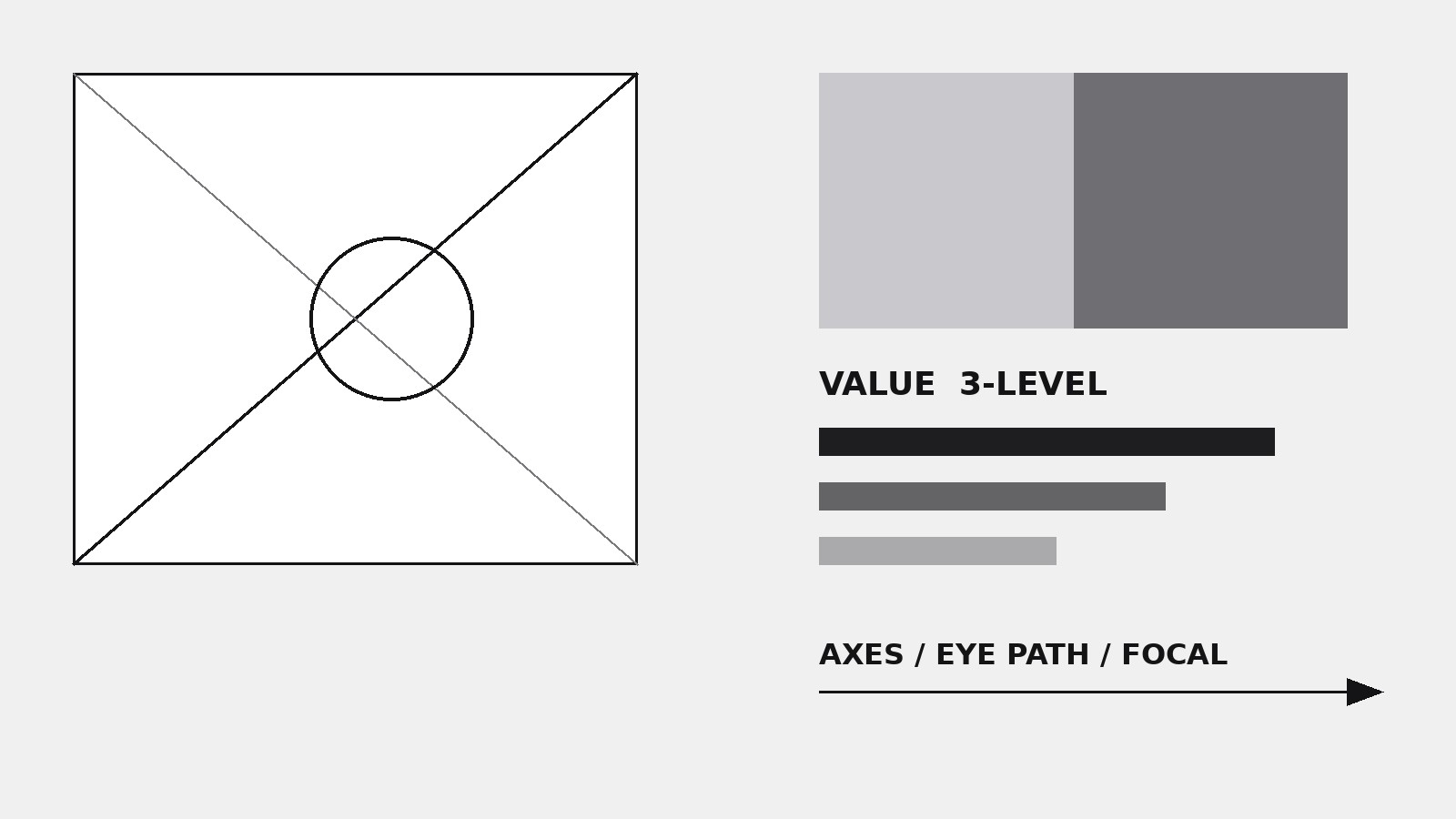
Draw or generate 4–6 small thumbnails (roughly 2:3 or 3:2, no bigger than a playing card) from the reference: one faithful small copy, one with the subject removed (shapes only), one with values pushed to 3 levels (dark / mid / light), and one rotated or cropped differently to test what breaks. Thumbnails force you to see structure before detail — if you can't reduce the image to five shapes, you don't yet understand it. - Map the values (input: reference → output: value map)
Reduce the image to 3–5 value masses: squint, and block in the big dark shapes, the big light shapes, and the mid-tones. Label the darkest dark and the lightest light, and mark where they touch — high-contrast adjacencies are where the eye goes. Note the overall value key (mostly dark? mostly light? balanced?) in one line. Most failed compositions fail here: the values are evenly spread and nothing leads the eye. - Diagram the structure (input: reference + value map → output: annotated diagram)
Overlay the structural skeleton on a clean copy of the thumbnail: the main axes and diagonals, the focal point and the path the eye takes to reach it, any framing devices (arches, shadows, foreground shapes), and any tangents or edge problems (objects just touching the frame edge, subjects half-cut). Use arrows for eye movement and circles for focal areas. One diagram, clearly labelled — this is the sheet's analytical core. - Write the takeaways (input: diagrams → output: 3–5 written lessons)
State what the composition does, in plain language: "The diagonal road carries the eye from bottom-left to the figure, then the dark tree stops it from leaving the frame." Each takeaway must name a device and its effect — not "nice balance" but "the large dark mass on the left balances the small bright figure on the right." End with one rule to try in your own work ("in my next piece, put the focal point where two diagonals cross, not at the centre"). - Set the practice task (input: takeaways → output: timed exercise)
Convert the study into a 30–45 minute exercise: make one original composition (from a different subject) using the same structural device, at thumbnail scale, in 3 variations. The point is transfer — copying the reference proves you can copy; applying its device to a new subject proves you learned it. Put the time limit on the sheet: timed practice beats open-ended noodling.
Vorschau der Startvorlage
Composition Study Generator — Study Sheet Template
One sheet per reference. Keep it to one page where possible.
Reference
- Image: {reference_image}
- Artist / photographer: {creator}, {year_if_known}
- Source: {source}
- Composition in one sentence: {one_sentence_description}
Thumbnail set (4–6 small thumbnails, playing-card size)
- Faithful small copy: {notes_or_file}
- Shapes only (subject removed): {notes_or_file}
- 3-value version (dark / mid / light): {notes_or_file}
- Cropped or rotated variation: {what_you_changed_and_what_broke_or_survived}
- (Optional) Second variation: {notes}
- (Optional) Third variation: {notes}
Value map
Das Skill-Paket selbst (SKILL.md + Vorlage) ist auf Englisch verfasst.