Cobalt Serif Marketing Deck
Ein Kampagnen- oder Launch-Plan in einem Deck: Zielgruppe, Positionierung, Kanäle, Zeitplan, Budget und Belege.
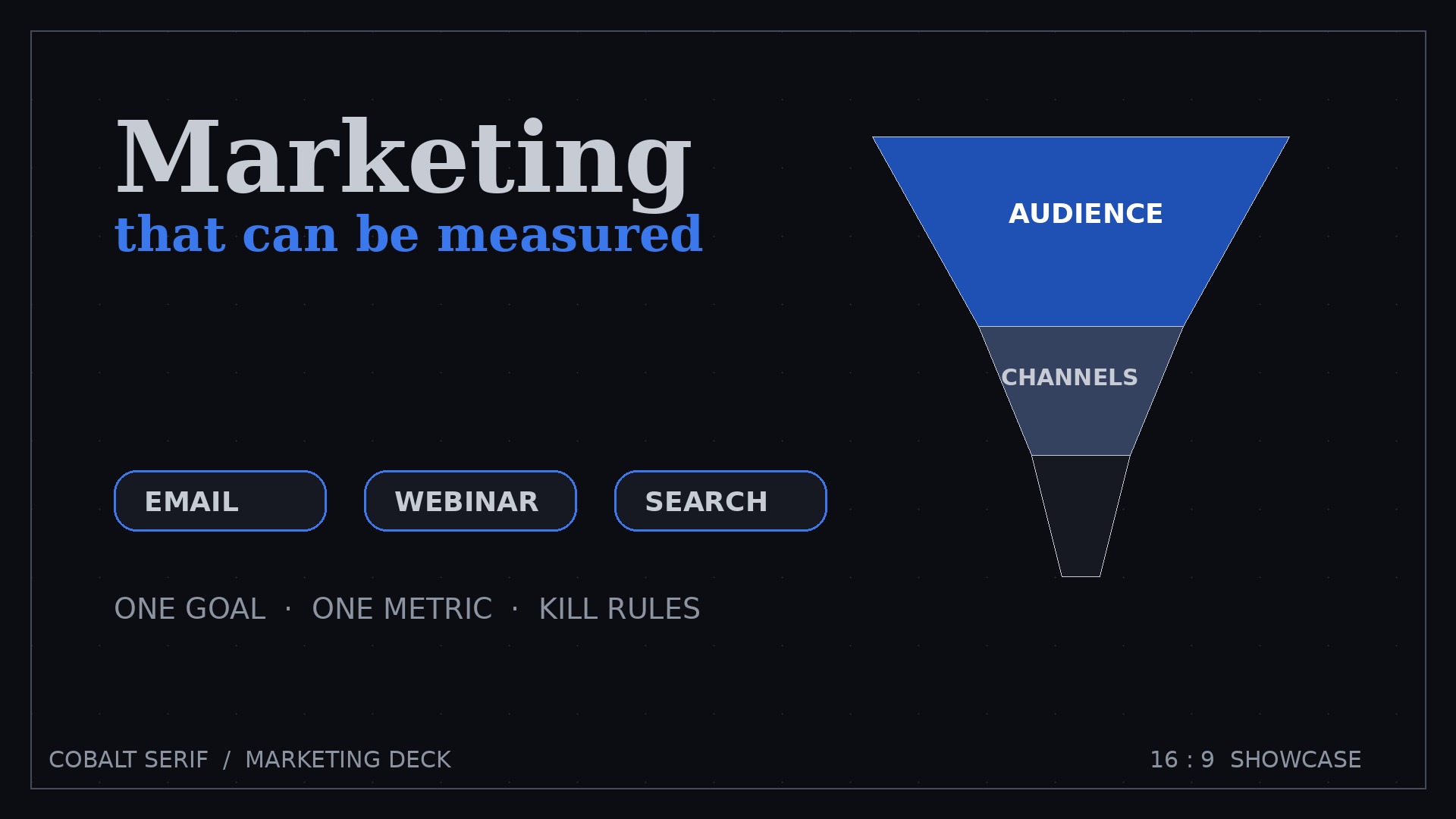
Erstellt ein Marketing-Deck mit 10–14 Folien im Cobalt-Serif-Stil: Serifenschrift-Überschriften, tiefe Kobalt-Akzente, silbergrauer Fließtext. Ein Ziel mit einer messbaren Kennzahl, ein Positionierungssatz, dem jede Folie dient, 2–3 Kanäle mit Verantwortlichen und Terminen, ein Budget, das benennt, was nicht finanziert wird, und ein Messplan mit Abbruchregeln.
In 3 Schritten installieren
Keine Anmeldung. Keine CLI-Tools. Wählen Sie Ihre AI, kopieren Sie eine Zeile und fügen Sie sie ein.
Lieber selbst machen? Kaufen Sie den Skill ($4.99), laden Sie die ZIP-Datei aus Ihrer Kaufbestätigung herunter, entpacken Sie sie in das oben angezeigte Verzeichnis und starten Sie Ihre AI-Sitzung neu — gleiches Ergebnis. Haben Sie ihn schon gekauft? Ihr AI-Assistent kann ihn für Sie herunterladen.
Was ist enthalten
Eine SKILL.md (die Anleitung) + eine Startvorlage. Eine Vorschau:
Cobalt Serif Marketing Deck
When to use
- You're presenting a campaign plan to a client, boss, or team and need them to approve budget and scope
- You're planning a product launch and marketing needs one document everyone works from
- It's quarterly planning and you need to show what marketing will do, for whom, and how you'll know it worked
- You're an agency pitching a marketing proposal — strategy and deliverables in one deck
- Your last marketing deck was 40 slides of channel ideas with no goal, no budget, and no owner
Workflow
- Audience and goal (input: who you're reaching, what they should do → output: one goal + one primary metric)
Name the audience precisely — not "everyone", but "ops managers at 20–200 person logistics firms". Then pick one goal and one metric that proves it: "book 60 demo calls" beats "raise awareness". If the goal can't be measured, it can't be managed, and the deck will drift into activities with no finish line. - Positioning (input: product, audience, alternatives → output: positioning statement — problem, audience, promise, proof)
Write the positioning in four lines: the problem the audience already feels, who exactly it's for, the promise (one outcome, plainly stated), and the proof (a fact that makes the promise believable). Everything in the deck — every channel, every message — must trace back to this statement. If a slide doesn't serve the positioning, it gets cut. - Plan the work (input: positioning + constraints → output: channels, offers, calendar, budget)
Choose 2–3 channels you can actually run well with the team and budget you have — depth beats breadth. For each channel: the offer (what the audience gets), the asset needed (landing page, email sequence, ad set, event), the owner, and the date. Then lay it on a calendar and a budget table. A plan without dates and money is a wish list. - Design in Cobalt Serif (input: plan → output: styled deck — serif headlines, cobalt accents, one idea per slide)
Cobalt Serif rules: serif headlines that state the takeaway, deep cobalt accent bars and callouts for the numbers that matter, silver-grey body type, one chart or table per slide at most. The budget slide and the calendar slide get full-slide treatment — they are the slides the room will actually argue about, so they deserve the space. - Set measurement (input: plan → output: measurement plan — metrics, targets, review cadence)
For each initiative: one metric, a target with a date, and who reports it. Add a review cadence — weekly check, monthly decision — and a kill rule: the condition under which an initiative gets paused ("if cost per demo exceeds $X for 2 weeks, pause and reallocate"). A deck with no kill rule is a deck that keeps spending on what doesn't work.
Vorschau der Startvorlage
Cobalt Serif Marketing Deck — Template
Fill in goal, audience, and positioning first. Channels come last — they serve the positioning, not the other way round.
Goal + audience
Goal (one sentence): { } Primary metric + target + date: {metric} — {target} by {date} Audience (precisely): {not "everyone" — who exactly}
Positioning statement
- Problem the audience already feels: { }
- Who it's for: { }
- Promise (one outcome, plain words): { }
- Proof (a fact that makes the promise believable): { }
Slide-by-slide draft
1. Goal
{goal + primary metric + date}
2. Audience
{who, what they care about, where they already look}
3. Positioning
Das Skill-Paket selbst (SKILL.md + Vorlage) ist auf Englisch verfasst.


